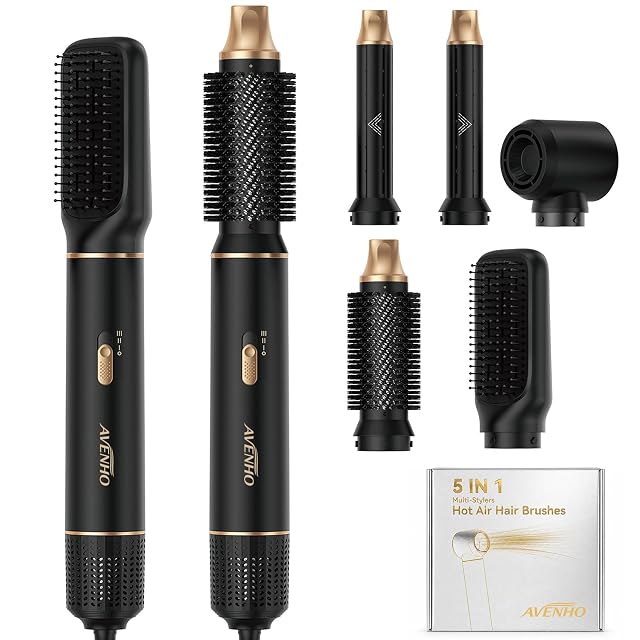
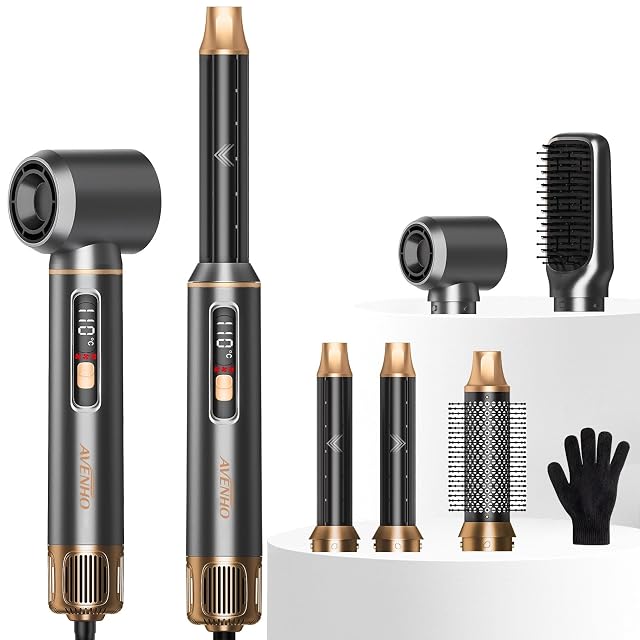
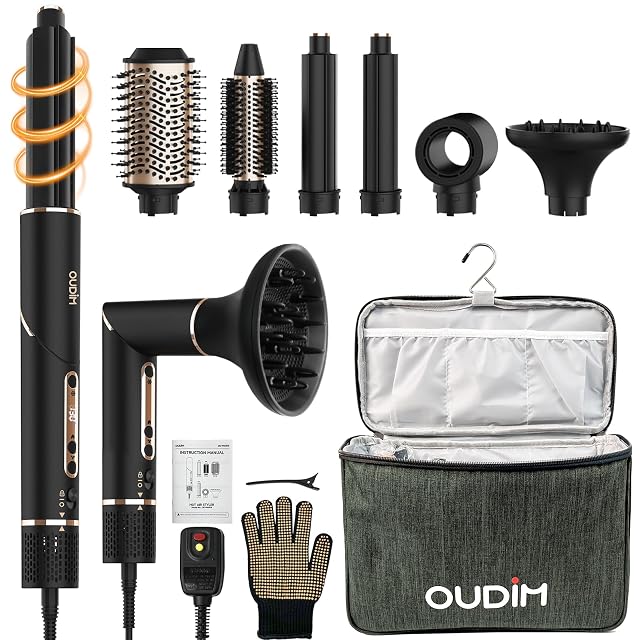
What the maker puts in writing
- “7-in-1 Multi Styler – All-in-One Power: …combines a hair dryer, curling wand, and styling brush in one versatile tool. Dry, straighten, curl, and volumize with ease… IMPORTANT: This model is designed for US outlets only. Do not use it with 220–240V power sources or incompatible voltage converters.”
- ”10s Hot + 5s Cool Auto Cycle: Create long-lasting styles with a single press. The smart “Heat + Cool” cycle automatically alternates between 10 seconds of hot air and 5 seconds of cool air, locking in your look with zero guesswork. For a longer-lasting style, finish with a setting spray.”
- “110,000 RPM High-Speed Motor: Powered by a 110,000 RPM brushless motor with 28 m (92 ft)/s airflow for ultra-fast drying. Helps minimize heat damage…”
- “Intelligent Temperature Control – No Heat Damage: …Choose from 4 heat settings (Cool Air, 140°F, 176°F, 212°F) and 3 speed levels… An advanced microprocessor monitors temperature 1,000 times per second, keeping it below 176°F (80°C) to prevent overheating.”
- “1.25” Auto-Wrap Curlers (Coanda Technology): Includes 2 × 1.25” (32 mm (1.26 in)) auto-wrap curlers powered by advanced Coanda technology. Hair is gently attracted and wrapped around the barrel… With proper technique, it delivers salon-quality results at home.”
- “200 Million Negative Ions – Smooth & Shiny Hair: …releases up to 200 million negative ions to reduce frizz, boost shine, and eliminate static. Combined with a ceramic coating for even heat distribution…”
- “2-Year Worry-Free Warranty: Enjoy 2 full years of reliable coverage… Our support team typically responds within 24 hours”
- Reference TD2301 · Catalog: 375 × 120 × 270 mm (14.8 × 4.72 × 10.6 in)
Two hundred and twelve degrees, and a ceiling of a hundred and seventy-six
Bullet four says both, in one sentence each.
“Choose from 4 heat settings (Cool Air, 140°F, 176°F, 212°F) and 3 speed levels to suit any hair type or style. An advanced microprocessor monitors temperature 1,000 times per second, keeping it below 176°F (80°C) to prevent overheating.”
So the dial offers 212 °F and the same bullet says the device is kept below 176 °F.
Two readings are possible and the page does not say which.
Either the 212 °F setting is not reachable, in which case the top of the dial is decoration.
Or the two figures describe different things — 212 °F as the air leaving the outlet, and 176 °F as the surface the hair touches, or the heater block, or a limit that applies only in a fault condition.
The second reading is the more plausible and the page gives no basis for it.
Why it matters rather than being a quibble. 176 °F is 80 °C and 212 °F is 100 °C — the boiling point of water — and a 20-degree-Celsius difference is the difference between a mild setting and the second hottest thing on this shelf.
The shelf, on temperature:
50 / 80 / 110 °C — 122 / 176 / 230 °F — the AVENHO WT-665 at $49.99, the only page here in both scales and the highest ceiling anywhere on this shelf
135 / 170 / 205 °F — the StyleVibe at $93.96, the narrowest spread here
Cool Air · 140 °F · 176 °F · 212 °F — this, with the contradiction
High, Medium and Low with no figures — the AVENHO WT-677 at $49.99, described by hair type instead
Four settings with no figures — the oudim at $46.50
What is genuinely good here and should not be lost in the contradiction: four settings, one of which is cool, and a thousand readings a second.
A fast-sampling controller is what keeps a heating element from overshooting between readings — a slow controller lets the element run on after the air has reached temperature, and the overshoot is what scorches. No other page on this shelf publishes a sampling rate at all.
The practical advice: treat 176 °F as the setting you use and 212 °F as the one you do not need.
Hair keratin begins to change somewhere above about 150 °C (302 °F), so neither figure is dangerous — and the whole argument for an air styler is that the airflow does the work rather than the heat, which this page supports with its own 28 m (92 ft)/s.
The only automatic cool cycle on this shelf
“The smart “Heat + Cool” cycle automatically alternates between 10 seconds of hot air and 5 seconds of cool air, locking in your look with zero guesswork. For a longer-lasting style, finish with a setting spray.”
Why cooling is the third of three steps and the one people skip.
Heat makes hair pliable. Cooling it in the shape you want is what sets it. A curl taken off a barrel warm has no set in it at all and drops within the hour — which is the commonest reason home styling fails, and the thing nobody is told.
So this is not a convenience feature. It is the feature.
The four implementations on this shelf are not equivalent.
An automatic cycle — this, alone
A one-touch toggle that stays on without holding the button — the StyleVibe at $93.96, which adds the instruction “wait 10s to lock styles”: the same ten seconds, timed by you
A cool setting on the dial — the oudim at $46.50, and the AVENHO WT-665 at $49.99, whose lowest setting is explicitly a “Cool Shot (50℃/122℉) for setting styles and adding shine”
Nothing at all — the AVENHO WT-677 at $49.99, whose three settings are all heat
What the 10:5 ratio is doing. Two thirds heat, one third cool, repeating — which means the barrel is never on hot air for more than ten seconds at a stretch. That is a heat-exposure claim as much as a styling one, and it sits with the page’s other claim to “minimize heat damage”.
And it means you cannot forget: the tool cools whether you were going to or not.
“For a longer-lasting style, finish with a setting spray” is the honest footnote. A cool-set curl holds for hours; product holds it for a day — and the page is not pretending otherwise, which is more than most of this shelf does.
Coanda, named, and the barrel size in both units
“Includes 2 × 1.25” (32 mm) auto-wrap curlers powered by advanced Coanda technology. Hair is gently attracted and wrapped around the barrel, creating natural, voluminous curls. With proper technique, it delivers salon-quality results at home.”
What the effect is. A jet of air that leaves a slot alongside a curved surface tends to follow that surface rather than travel straight — and as it does, it drags the surrounding air with it.
Put air slots along a barrel and the air hugs the barrel; the air it drags in brings a section of hair with it, and the hair wraps.
So the “auto” in auto-wrap is not a motor turning the barrel. It is air.
Which is why these barrels have no moving parts, and why they work at modest temperatures: the wrapping is done by airflow, and the heat only has to make the hair pliable.
Why naming it matters. Three of the five appliances here have auto-wrap barrels and only this page says how they work.
The StyleVibe at $93.96 describes the result — “left/right barrels create natural, face-framing waves without manual wrapping”
The oudim at $46.50 describes the part — “two 1.25-inch directional curling barrels”
The two AVENHO at $49.99 use four names for the attachment — “curling wrap, wrap styler, air curler and hot air curler” — and publish no diameter at all
All three pages that give a diameter agree: 1.25 inches, 32 mm.
And nobody on this shelf offers a second size. Which is the real gap in every one of these sets: a 1.25-inch barrel makes one size of curl; a looser wave wants 1.5 inches and a tight ringlet 0.75.
The pair is the other half, and this page has it without naming the purpose. The StyleVibe states it: “left/right”. One barrel for each side of the head, so the curl frames the face rather than fighting it — curl both sides the same way and one side turns in and the other turns out.
“With proper technique” is the qualifier to take seriously. A Coanda barrel needs a section of the right width and the right distance from the slots — too much hair and the wrap does not start, too little and it snaps round.
It is the one attachment on this shelf with a learning curve, and this is the one page that says so.
A hundred and ten thousand revolutions, twenty-eight meters a second
“Powered by a 110,000 RPM brushless motor with 28 m/s airflow for ultra-fast drying. Helps minimize heat damage while leaving your hair smooth, frizz-free, and brilliantly shiny.”
At least three of the nine items here publish a motor figure, and all three publish the same one.
this at $109.99 — 110,000 RPM brushless, plus 28 m/s
StyleVibe at $93.96 — 110,000 RPM brushless, plus 28 m/s
oudim at $46.50 — 110,000 RPM brushless, no airflow figure
The two AVENHO at $49.99 — no motor specification at all
So $46.50 buys the same published motor as this does at $109.99, and two of the three publish the measurement that matters.
Why the m/s is the better number. 110,000 RPM is a shaft speed, not a quantity of air. A conventional hair dryer motor runs 20,000 to 30,000 RPM with a large impeller; a brushless high-speed motor runs several times faster with a much smaller one — which is how these tools are made thin enough to hold like a brush.
The RPM is a proxy. The 28 m (92 ft)/s is the measurement. And on that measurement this tool and the $93.96 one are identical.
“Helps minimize heat damage” is the right conclusion from it, and the StyleVibe page states the mechanism more fully: “accelerating rough-drying and reducing total heat exposure.”
Fast air means less time, and less time at any temperature is less damage than more time at the same temperature. Which is the honest argument for the whole category — and it is also why the contradiction in bullet four matters less than it might: a tool that dries fast does not need to run hot.
“releases up to 200 million negative ions to reduce frizz, boost shine, and eliminate static. Combined with a ceramic coating for even heat distribution…”
Two pages on this shelf give an ion number. 500M on the StyleVibe at $93.96, and 200 million here.
So the dearer of the two claims fewer.
And neither states the unit nor the distance at which it was measured. An ion figure is normally ions per cubic centimeter at a stated distance from the outlet, and without those two conditions the two numbers are not comparable with each other — which is the point worth making about both of them.
The mechanism, though, is real. Hair strands rubbing against each other and against a brush pick up a static charge, and like charges repel — which is why dry, brushed hair stands apart from itself.
That separation is what frizz is. And it is also why hair looks dull: strands lying flat and parallel reflect light together, and strands standing apart scatter it.
A negative ion generator sprays charge into the airstream, the charge neutralizes what has built up, and the strands lie down. “Reduce frizz, boost shine, eliminate static” are one claim stated three ways, and the mechanism supports all three.
Two more pages claim ions without a count: the oudim at $46.50 and the AVENHO WT-677 at $49.99. One claims none: the AVENHO WT-665 at $49.99.
So treat the presence of the claim as meaningful and the number as decoration, in both directions.
The ceramic coating is a different mechanism and worth separating. A ceramic surface spreads heat rather than concentrating it on a hot spot, which is a genuine thing on a barrel you wrap hair around and hold there. The StyleVibe at $93.96 claims the same, as a “ceramic airflow path”. Neither AVENHO page claims it, and the oudim does not either.
Two years, which nothing else on this shelf offers
“2-Year Worry-Free Warranty: Enjoy 2 full years of reliable coverage with support via the Amazon order page and 7MAGIC customer service… Our support team typically responds within 24 hours, providing a smooth, hassle-free support experience.”
At least four of the nine items on this shelf publish no warranty of any kind.
Not the oudim at $46.50. Not either AVENHO at $49.99. Not the StyleVibe at $93.96.
This is the only term here, and it is two years.
Why it matters more on this category than on most. The failure modes are a motor bearing, a heating element and a controller — and all three are wear items in a handheld appliance that is dropped, wound round a cord and run in a damp room.
A 110,000 RPM bearing is spinning several times faster than a conventional dryer’s, and the thing that kills it is lint through the intake. Which is the one protection this page does not publish and the oudim at $46.50 does: a “protective air inlet”.
The response-time claim is the other half and it is unusual. “Typically responds within 24 hours” is a commitment to answer rather than to replace — and on a two-year term, naming a response time is the kind of statement a company has to live with.
What the page does not publish alongside it is the safety part the StyleVibe at $93.96 does.
An ALCI safety plug — an appliance leakage current interrupter, the block on a hairdryer cord that cuts power if current leaks. It watches the current going out against the current coming back, and cuts the circuit if they differ by a few milliamps, which is the specific protection for an appliance used near water.
One of the five powered items on this shelf publishes one, and it is not this one.
What this page publishes instead is the microprocessor, and the two protect different things. A temperature monitor protects the heater and the hair. An ALCI protects the person holding it.
US outlets only, and the trap this page is the only one to name
“IMPORTANT: This model is designed for US outlets only. Do not use it with 220–240V power sources or incompatible voltage converters.”
At least three of the nine items here publish a voltage, and this is the only one to name the failure.
this — US outlets only, no 220–240 V, and no incompatible converters
AVENHO WT-665, $49.99 — “110–120V Only” in its product name
AVENHO WT-677, $49.99 — “110 Voltage”, twice
The oudim at $46.50 and the StyleVibe at $93.96 — nothing
Why it matters more on this tool than on most. A heating element on double its design voltage draws double the current and dissipates four times the power. That is not a slow degradation; it is an immediate failure, and on a heated appliance it is a fire. A brushless motor and its controller are no more tolerant.
And the distinction only this page draws is the one people get wrong.
A travel adapter changes the shape of a plug, not the voltage. A plug adapter will happily connect a 110 V appliance to a 230 V socket.
What you need is a converter — and the bullet is careful even about those, with “incompatible voltage converters”, because a cheap converter rated for a phone charger cannot carry a hair appliance’s current.
Which is the right warning on the right page, and it applies to two of its neighbors that do not give it. Three pages on this shelf sell themselves for travel — both AVENHO and the StyleVibe with its travel bag — and two of those three are 110 V only.
What is not published
No weight. This and the AVENHO WT-677 at $49.99 are the only two items on this shelf with no catalog weight. The rest: 1500 g on the oudim at $46.50, the heaviest here and the only one with a 90-degree folding handle · 1012 g on the StyleVibe at $93.96 · 800 g on the AVENHO WT-665 at $49.99, which makes no claim about weight and is the lightest appliance here.
Which matters on this tool more than on most, because you hold it above your head with your arm bent for several minutes at a time. 1500 grams at arm’s length is the thing people complain about — and on the most expensive item on this shelf, the figure is missing.
No attachment list. “7-in-1” is the highest count here and the page names four or five things: “a hair dryer, curling wand, and styling brush”, plus the two auto-wrap curlers.
Only the oudim at $46.50 itemizes on this shelf: “two 1.25-inch directional curling barrels, a 1-inch round brush, an oval volumizing brush, a drying nozzle, and a diffuser attachment” — five heads plus the handle, which is the honest arithmetic behind its “6-in-1”.
So a 7-in-1 and a 6-in-1 on this shelf may ship the same five heads, and the higher number is the one with less behind it.
No diffuser. One item here has one: the oudim at $46.50. Which is the attachment a curly head needs — fast directional air separates the strands that make up a curl clump, and a separated clump is frizz — and at 28 m/s this is one of the two fastest airflows on this shelf.
No ALCI plug, as above.
No protective air inlet, as above — on the tool with the highest-speed bearing and a two-year term to honour.
No wattage. Not at least one of the nine items on this shelf publishes one, which on a heated appliance is the figure you would most expect.
No noise figure. Three pages publish 110,000 RPM and none publishes a decibel. A high-speed motor in a tube held beside your ear is a loud thing, and it is the specification this whole shelf omits.
No cord length. One page mentions the cord at all: the StyleVibe at $93.96, as a “360° swivel cord” — the more useful property on a tool you rotate round your head, since a cord that swivels does not wind itself up, and still not a length.
No cleaning instruction. Two pages give one and between them they make the whole rule. The AVENHO WT-665 at $49.99: “main unit… dry cloth only; attachments… damp cloth… completely dry before reuse or storage.” The oudim at $46.50 adds the condition: its diffuser cleans “after the appliance has cooled.” Let it cool, wash the heads, dry them fully, then put it back.
No second barrel size, as above.
No country of manufacture, which no item on this shelf publishes.
Availability
Read on the day this page was built: $110 at the American Amazon shop.
Read from Keepa on the day this page was last revised; stock and price both move without notice.
Prices quoted in this text were read on 2026-10-05. The live price is at the top of the page.