Skip to content

The best rotary shavers for 2026

A rotary shaver works in circles, which is why it suits a neck that grows in several directions and a face that is not shaved every day. Three round heads on independent pivots follow the jaw; the number of directions each head tilts in is a published figure and it is the one that separates the ranges. Beyond that, three things decide the years you get from it: whether it is rated for wet use, whether a cleaning station is supported, and what a replacement head costs — because it is a consumable, and the cheapest shaver is rarely the cheapest over three years.

The models we recommend

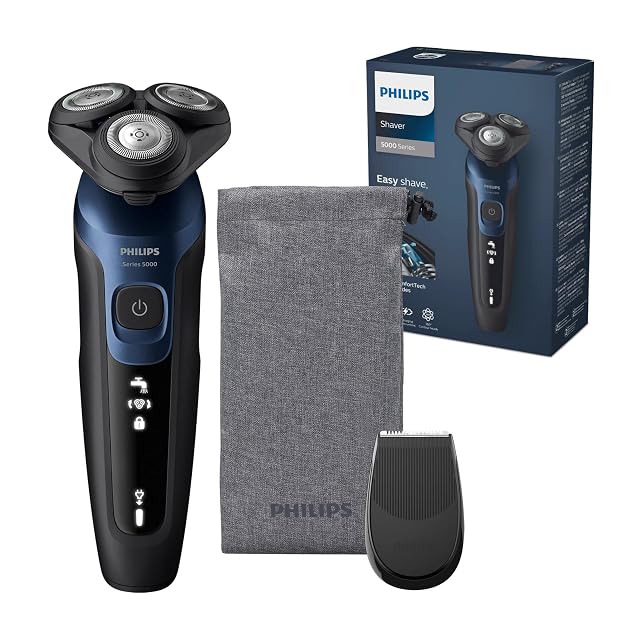
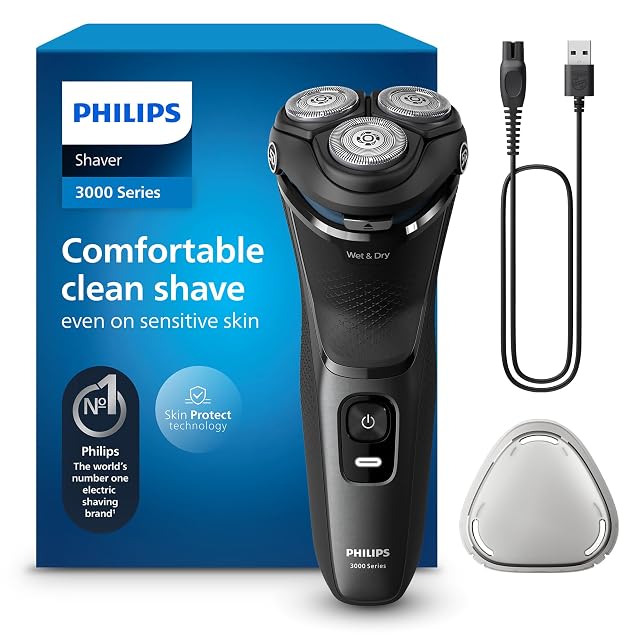
  1. Philips S3145/00

    27 self-sharpening blades · 55,000 cuts/min · 5D flex heads · wet & dry

    The entry Philips rotary: 27 self-sharpening blades cutting 55,000 times a minute, heads that move in five dimensions, SkinProtect, and stainless blades Philips states keep sharpening themselves for two years.

    Best for: A first electric shaver, for a face shaved in the shower a few times a week.
    7.0/10

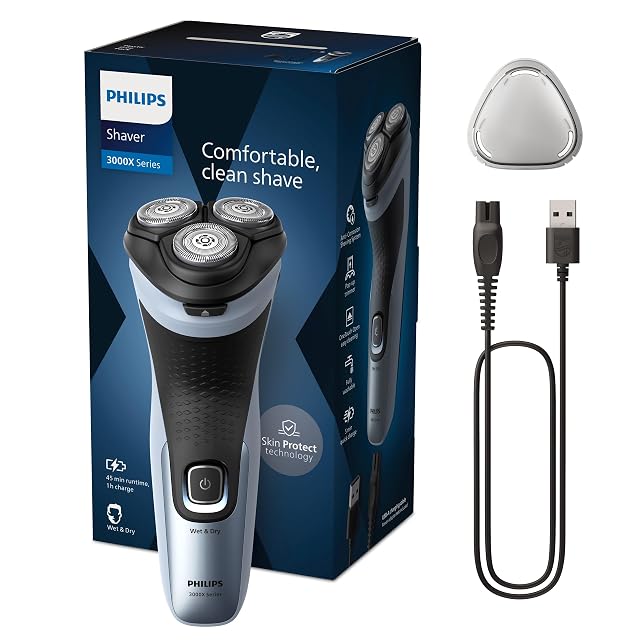
  2. Philips X3053/00

    27 blades · 55,000 cuts/min · 4-way flex heads · wet & dry

    The 3000X: the same PowerCut system and two-year self-sharpening blades as the Series 3000, on spring-mounted heads Philips describes as flexing in four directions rather than five.

    Best for: The same shave as the Series 3000, from a reference that can actually be ordered on amazon.com.

    6.6/10

    ≈ $77

  3. Philips S5465/18

    360° heads · click-on precision trimmer · 100% waterproof · 50 min

    Fully flexible heads that turn through 360 degrees, a click-on precision trimmer for mustache and sideburns, a head that opens for rinsing, and an hour's charge for fifty minutes of use.

    Best for: Shaving every day or two, with the head rinsed rather than brushed.

    8.2/10

    ≈ $120

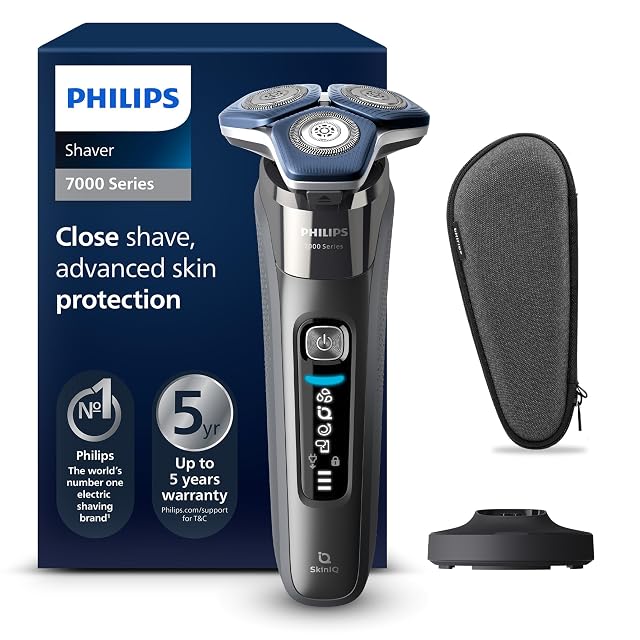
  4. Philips S7887/35

    SkinIQ · 45 blades · 90,000 cuts/min · charging stand · 5-year warranty

    Philips's top rotary in this group: 45 SteelPrecision blades cutting 90,000 times a minute, a micro-bead coating stated to add 30% glide, SkinIQ, a charging stand and travel case, and a five-year warranty.

    Best for: Shaving daily, on a three-day beard, with the shaver living on a stand rather than in a drawer.

    8.8/10

Choosing within rotary shavers, by need

Fewest passes on a dense beard

Cutting speed takes only two values on this shelf: three of the four state 55,000 cuts a minute and one states 90,000. So speed here is a single step at the top of the range rather than a ladder, and it is the step that matters when you are going over several days of growth.

Philips S7887/35

Spending the least

The entry models use the same 27-blade head and the same 55,000 cuts a minute as the mid one. What they do not publish is a runtime, a quick-charge figure, or a water rating beyond wet and dry use in the shower. The saving is real, and so is the missing information.

Philips X3053/00

The 27-blade head without paying for the top

Three of these four share the same 27-blade head. What the mid model adds over the entry pair is what the entry pair leave unstated: a published runtime, a five-minute charge for one shave, a head that opens and rinses under the tap, and a stated 100% waterproof rating.

Philips S5465/18

Rotary shavers and who each one is for

An irregular beard, or a neck that grows in several directions
Three round heads on independent pivots follow a jaw and a neck in a way a flat foil cannot. That is the reason to be on this page rather than on the foil one, and it is the one claim about rotary shavers that does not depend on the model.
Long or coarse hair
The circular action catches hairs lying in several directions, which a foil passing in lines misses more often. The blade count is published here — 27 on three models, 45 on the top one — but no maker publishes a closeness figure, so the count is a count and not a result.
Shaving every day, dry
Rotary suits a daily dry shave, and all four here are rated for dry use. On several days of growth, expect to spend longer whichever model you have; that is where the faster motor at the top of the range earns its difference.
Shaving in the shower
This is the claim to read closely, because the four models publish it in two different ways. The two entry shavers state wet and dry use, usable in the shower. The mid and top ones state 100% waterproof. Those are not the same statement, and only the manufacturer sheet settles what each permits.

The trade-offs of rotary shavers

Rotary against foil
Rotary follows contours and is used in circles; foil shaves closer on a flat surface and is used in lines. It is a matter of face as much as preference, and it is the decision to make before any of the figures on this page matter.
Dry against wet
Wet shaving with foam is gentler on many skins and slower; dry is faster and can be done anywhere. What decides whether wet is possible is the water rating, and on this shelf that rating is published in two different forms rather than one.
Speed against runtime
A faster motor draws more from the battery. The trade-off is real and it is also hard to check here: a runtime is published on only two of these four models, so there is no figure to set against the 90,000 cuts a minute at the top of the range.
What is published, and what is not
Head movement is stated four different ways across these four shavers — five-dimensional, flexing in four directions, rotating through 360 degrees, and fully flexible at 360 degrees. Those cannot be ranked against each other, which is why no comparison of them appears on this page. A warranty is published on one model of the four, and a current price on two.

What keeps coming up about rotary shavers

Rotary or foil?

Rotary follows the contours of face and neck better; foil shaves closer on flat surfaces. Beard type and face shape decide, and no figure on this page changes that choice.

How do I shave with a rotary?

In small circles, without pressing. Pressing irritates the skin without shaving closer, and it is the single most common reason a rotary shave feels worse than it should.

Can I shave in the shower?

Only where the manufacturer states it, and on this shelf that statement comes in two forms: two models state wet and dry use in the shower, and two state 100% waterproof. Read the sheet for the model rather than assuming the range behaves alike.

Do more blades shave closer?

Nobody publishes a figure that would answer it. Three of these four use a 27-blade head and the top one uses 45, which is a count of cutting edges rather than a measured result. Treat it as a specification, not as a promise.

What does five-dimensional or 360 degrees mean on a head?

Each maker describes head movement in its own words, and across these four shavers there are four such descriptions. They are not a common scale, so a shaver described in degrees is not demonstrably more flexible than one described in dimensions.

Does self-sharpening for two years mean the heads last two years?

All four models here publish a self-sharpening claim stated at two years. It describes the sharpening, not a service life, and the replacement interval is published separately by the manufacturer. A shave that pulls, or that needs several passes where one used to do, is the practical signal.

How often should the heads be changed?

Manufacturers publish a replacement schedule, and it is worth pricing the heads at the same time as the shaver: on an entry-level model a replacement head can cost a large share of the machine, which changes which shaver is actually cheaper over three years.

Why is my skin irritated?

Three causes, in the order worth checking: too much pressure, heads that have gone past their replacement interval, and going over the same area several times. Reducing the pressure is the first thing to try, because it costs nothing and it is the commonest of the three.

Do I need a product before dry shaving?

A pre-shave helps some skins glide and does nothing for others, so it is worth one trial rather than a rule. On very dry skin many people end up wet shaving instead, which the water rating on your model either permits or does not.

How do I clean a rotary shaver?

Rinsing in lukewarm water where the model allows it, otherwise a brush, and drying completely before reassembly so the contacts do not corrode. One of the shavers here publishes a head that opens at the press of a button and rinses under water; the others state what they allow on their own sheets.

Are the heads interchangeable between models?

Rarely, and not reliably even within one maker's range. The reference is printed on the head itself or given in the manual, and that reference rather than the shaver's model number is what a replacement is ordered against.

What does a five-minute quick charge give?

On the two models here that publish one, enough for a single shave. Both also publish a full-charge figure of an hour. The two entry models publish neither, so there is nothing to compare them on.

In short, on rotary shavers

Rotary follows contours and foil shaves closer on the flat, so face shape decides as much as preference. Within this shelf the published figures separate into two groups rather than four: three models share a 27-blade head at 55,000 cuts a minute, and one steps up to 45 blades at 90,000. Everything else worth knowing is about what is stated and what is not — a runtime on two models of four, a water rating in two different forms, a warranty on one. Shave in small circles without pressing, price the replacement heads before you buy, and change them as soon as one pass stops being enough.

Rotary shavers at a glance

  • Published prices here run from $77 to $120, across 2 of the 4 models; the rest publish none.
  • Cutting speed: 55,000 to 90,000 cuts per minute, on 3 of the 4 models.
  • Highest figure for cutting system: Philips S7887/35 (45 self-sharpening SteelPrecision blades).

Rotary shavers, side by side

Specifications that fewer than four of these models in five publish are left out of this table. Keeping them would fill it with blanks and make a shared gap look like a difference.

ModelPriceCutting systemHead movement
Philips X3053/00$77PowerCut, 27 self-sharpening bladesSpring-mounted heads, flexing in four directions
Philips S5465/18$12027 self-sharpening blades, 55,000 cuts per minute, per PhilipsFully flexible, rotating through 360 degrees
Philips S3145/00—PowerCut, 27 self-sharpening blades5-dimensional flex heads
Philips S7887/35—45 self-sharpening SteelPrecision bladesFully flexible, 360 degrees

Where rotary shavers are covered

Where the numbers come from

Specifications: manufacturer sheets for grooming tools and the matching Amazon product pages. Prices and availability: Keepa. Every figure in this table names its source.

Most recent revision in this category: October 12, 2026.

How we assess rotary shavers

Prices quoted in these summaries are dated readings. The live price is shown next to each product.