What the maker puts in writing
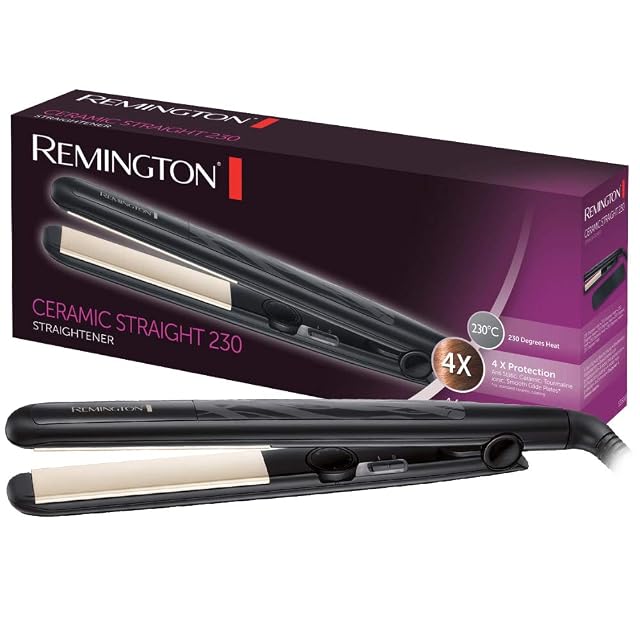
- “ADVANCED CERAMIC PLATES: Infused with Argan oil, protein-packed Keratin, and a micro-conditioner, this straightener delivers even heat for optimal hair health. Good for all hair types- fine, normal, thick, and coarse hair. Use on dry hair only.”
- “2X SHINE-ENHANCING TECHNOLOGY: As you style with this hair iron straightener, the micro-conditioner combines with advanced ceramic to gift you smooth, radiant shine.”
- “1” WIDE FLAT IRON: Straighten or add curves in one smooth motion—best for small sections to achieve flawless, root-to-tip results.”
- “SHINE LIKE NEVER BEFORE: Achieve up to 50% shinier hair with the Remington Shine Therapy ceramic hair straightener.”
- “TRAVEL-FRIENDLY RADIANCE: Compact and lightweight, built for US/CA 110V outlets.”
- “PRECISION HEAT CONTROL: 9 temperature settings with only a 15 second heat-up! Customize for your hair type or activate Turbo Mode to reach 450°F. Automatic shut-off after 1 hour. Cord length 9’ long. See manual for heat settings chart.”
“Use on dry hair only”, which is the sentence that matters
Water inside the hair is the actual damage mechanism, and this is one of only two products on this site to say so.
What heat does to hair.
Hair holds water inside the shaft.
When plates at 200 to 230 °C (392 to 446 °F) close on it, that internal water can pass 100 °C (212 °F) and flash to steam inside the fiber — and the steam has nowhere to go but outward, through the cortex.
It blows microscopic cavities in the fiber. That is the damage pattern known as bubble hair, and it is the worst thing a hot tool does.
Which makes drying the hair first the single most protective step available — more protective than any coating, any ceramic and any ion.
Across all of GroomVerdict, exactly two products print the rule.
this — “Use on dry hair only”
Bumble and bumble heat protectant, $17.00, on the heat-protection shelf — “This mist protects dried hair against heat tools (up to 450 degrees)”
The nearest third is the OGX protectant at $10.47 on that same shelf, which gives the fuller version as a two-stage routine: “apply on damp hair… before blow-drying; then apply on dry hair before curling or straightening.”
That distinction is exactly right: a dryer is how the water gets out, while an iron clamps heat onto hair that still holds it.
And the counter-example is on the same shelf. The Hairitage protectant at $8.94 says its spray “can be used on wet or dry hair before blow drying or using any hot styling tools”, which explicitly permits an iron on wet hair.
So the instruction is rare, and it is rare in the two categories where it decides the outcome.
Seven straighteners on this shelf do not print it: the REVLON at $13.96, the Arkam at $20.99, the XIKEZAN at $21.52, the FEBOTE at $25.99, the Arkam at $28.99, the Wild Willies at $29.90 and the CHI at $44.12.
Which matters most on the hottest of them: the FEBOTE reaches 446 °F and the Arkam at $28.99 reaches 450 °F, and neither says to dry first.
And the framing here is right too. “Good for all hair types - fine, normal, thick, and coarse hair” followed immediately by the dry-hair rule reads as: the tool suits everyone, and the condition is the same for everyone.
Fifty per cent shinier, with no method
“2X SHINE-ENHANCING TECHNOLOGY”, and “Achieve up to 50% shinier hair”
Three questions the page does not answer.
Fifty per cent shinier than what — untreated hair, hair straightened with a plain ceramic iron, the brand’s own previous model?
Measured how — shine is measured instrumentally as specular reflectance, and no instrument or standard is named.
And what “2X” refers to — a second, different multiplier, in a different bullet, with nothing attached to it.
A percentage without a comparison is not a measurement.
Which is a shame, because the underlying mechanism has something real in it.
Shine on hair is almost entirely a function of how flat the cuticle lies.
The cuticle is made of overlapping scales. Flat, they form a near-continuous surface that reflects light in one direction, which the eye reads as shine. Lifted, they scatter it, and the hair looks dull.
And straightening a section with heat and tension is precisely the operation that lays those scales down.
So a straightener genuinely does make hair shinier, and an even ceramic plate contributes by heating without hot spots.
The honest version of this claim needs no percentage: a well-used iron on dry hair shines the hair.
Now the infusion claim, which is the part to read most carefully.
“Advanced ceramic plates infused with Argan oil, protein-packed Keratin, and a micro-conditioner”
What is published is a coating containing those substances.
What is not published is any mechanism by which they reach hair — no quantity, no depletion rate, no statement of how many uses the infusion lasts, and no explanation of how an oil or a protein behaves at 450 °F.
That last point is worth stating plainly: argan oil has a smoke point well below 450 °F, and keratin denatures with heat. A substance baked into a ceramic surface at iron temperatures is not in the same state as the same substance in a bottle.
How the shelf handles plates.
CHI, $44.12 — “ceramic floating plates”: the only mechanical feature on this shelf, and the one worth paying for — plates on springs that stay parallel under pressure, so you cannot clamp harder at the hinge end and crease the section
Wild Willies, $29.90 — “Tourmaline ceramic”. Tourmaline releases negative ions when heated, so the plate and that page’s ion claim are the same feature described twice.
XIKEZAN, $21.52 and FEBOTE, $25.99 — “PTC ceramic”, which is a self-limiting heating element rather than a coating: its resistance rises as it warms, so it cannot run away
REVLON, $13.96 — a “ceramic coating… even heat distribution”
this — ceramic, infused
Four of eight items name a coating, and this is the only one claiming it deposits something into the hair.
One inch and nine settings, which is the best control among the irons
“1” WIDE FLAT IRON: Straighten or add curves in one smooth motion—best for small sections to achieve flawless, root-to-tip results”
A straightener clamps a section between two heated plates and draws them along it. Width is how much hair one pass can take, and it is a trade.
1 in — this, and the CHI at $44.12
2 in — the REVLON at $13.96
Not applicable — the five heated beard combs on this shelf, which have teeth rather than plates
A one-inch plate is slower on long hair, and it does two things a wide plate cannot.
It can reach a root, because it is small enough to angle into the hairline without the plate pressing against the scalp — which is what “root-to-tip” means.
And it can curve. A curl is made by wrapping the section around the barrel of the iron as you draw it through, and a one-inch plate has a small enough radius to turn inside a section.
A two-inch plate has a flat face too broad for either — which is why the REVLON page’s own claim that its “plates get close to the roots” is the one thing a two-inch iron is worst at.
“Best for small sections” is the honest half of the trade, stated plainly: it will take longer.
Now the heat control.
9 settings, Turbo to 450 °F — this
392 °F, fixed — the CHI at $44.12: “an on/off switch (no adjustable heat setting)”. The most expensive item on this shelf has exactly one temperature.
400 °F, “multiple” settings — the REVLON at $13.96, which publishes a ceiling and no count
So among head-hair irons this is the only one you can actually set.
And 15 seconds is the fastest heat-up on this shelf. Both Arkam combs publish 30 seconds, the FEBOTE at $25.99 publishes “338 °F in 30 seconds”, and the CHI says “heats quickly” with no figure.
Where 450 °F sits: on GroomVerdict’s heat-protection shelf, eight of the nine protectant sprays claim protection “up to 450 °F”. So Turbo Mode is exactly at the figure that whole category is built around, and nothing on this shelf exceeds it — the Arkam at $28.99 is the only other item to reach it.
Two things to weigh against all that.
“See manual for heat settings chart” means the mapping of settings to hair types is not on the page — where the cheapest beard comb here, the Arkam at $20.99, prints its own: “300°F for thin hair, 355°F for medium and wavy hair, and 400°F for thick and curly hair.”
Nine settings without a chart is nine numbers and no guidance, and on a tool that reaches 450 °F the guidance is the safety-relevant half.
An hour, which is twice the shelf standard
“Automatic shut-off after 1 hour.”
A hot object left switched on is the classic domestic hazard of this whole category, and this is the longest interval on this shelf.
30 minutes — the Arkam at $20.99, the XIKEZAN at $21.52, the FEBOTE at $25.99, the Arkam at $28.99: four of the five beard combs
“Turns off when not in use” — the Wild Willies at $29.90, with no interval
1 hour — this
Nothing at all — the REVLON at $13.96 and the CHI at $44.12
So the shelf’s standard is thirty minutes, and this doubles it.
Why that is a real difference rather than a quibble.
The scenario a cut-off exists for is leaving the house with the iron on. Thirty minutes means the tool is cold before you have reached the end of the street; an hour means it is still at 450 °F when you are at work.
And the thing it is sitting on is whatever surface you left it on.
What the page does publish in the same bullet is one of only two cord lengths on this shelf.
11 ft — the CHI at $44.12, which is a salon figure
9 ft — this
Swivel, no length — the REVLON at $13.96, the Arkam at $20.99, the XIKEZAN at $21.52, the Arkam at $28.99, the Wild Willies at $29.90
Nine feet is generous, and on a tool used in front of a mirror reach is the difference between standing where you can see and standing where the plug is.
What this page does not claim is a swivel — and at least six of the twelve items here do. A fixed cord accumulates twist every time you rotate the tool, and the twist concentrates where the cord enters the handle, which is where cords fail. On an iron you turn constantly to bend the ends of a section, that is the more useful feature of the two.
A hundred and ten volts only
“Compact and lightweight, built for US/CA 110V outlets.”
This is the only item on this shelf explicitly locked to one voltage, and the bullet it appears in is headed “TRAVEL-FRIENDLY RADIANCE”.
Which is an odd pairing: a 110 V tool is travel-friendly within North America and nowhere else.
The shelf.
110–240 V — the Arkam at $20.99, the XIKEZAN at $21.52, the FEBOTE at $25.99, the Arkam at $28.99 and the CHI at $44.12, which makes the point explicitly: “Dual-voltage capability makes this classic styling iron ideal for home or on the go”
US and Canada 110 V only — this
Not stated — the REVLON at $13.96 and the Wild Willies at $29.90
So five of eight items work anywhere and the most expensive flat iron is among them, while this one does not.
Why a transformer is not a workaround: the thing drawing the current is a heating element, and an element is a high-wattage load. A converter capable of running one is heavy enough that nobody packs it, which is why dual voltage is a genuine specification on heated tools rather than a nicety.
“Compact and lightweight” in the same bullet is unquantified, and one item on this shelf publishes both figures: the XIKEZAN at $21.52 — “ultra-compact size (10.47” x 2”)” and “lightweight (only 8.8 oz)”, the only such numbers anywhere here.
What is not published
No method for the shine figure, as above — and no footnote, which is the usual place such a claim is qualified.
No floating plates. One item on this shelf has them: the CHI at $44.12, “ceramic floating plates”. It is the only mechanical feature here, and the one that most changes the result. Plates mounted on springs stay parallel under pressure; fixed plates do not — so you clamp harder near the hinge, the section gets more heat at one end of the plate than the other, and the result is a visible crease rather than a smooth line. On a one-inch iron sold for “small sections” and “root-to-tip” work, where the plate is in contact with hair along its whole length, that is the gap worth noting.
No heat settings chart, as above — referred to the manual.
No ionic claim. At least five of the twelve items here make one, and all five are the beard combs: both Arkam combs (“advanced ionic technology… get rid of frizz and lock in moisture”), the XIKEZAN at $21.52, the FEBOTE at $25.99, and the Wild Willies at $29.90 (“Negative ion function”). The distinction worth knowing is that ions neutralize static charge — which is flyaway — and do nothing about humidity frizz, where water enters the hair and swells the shaft. What helps there is a flat cuticle, which is what heat and tension produce — and which is also, as above, where shine comes from. So on this page the shine claim and the absence of an ioniser are consistent: it is relying on the mechanism that actually works.
No element type. Three pages publish one, and it is a safety property: “PTC ceramic” on the XIKEZAN at $21.52 and the FEBOTE at $25.99, and the clearest statement on the Wild Willies at $29.90 — “PTC technology with self-regulating heat elements”. A PTC element’s resistance rises as it warms, so it self-limits and cannot overshoot without a controller intervening. On a tool whose Turbo Mode reaches 450 °F, what kind of element produces that is worth knowing.
No certifications. Two pages publish them, both beard combs: the XIKEZAN at $21.52 lists “CE, FCC, ROHS, UL and CA65” and the FEBOTE at $25.99 lists “FCC, CE, ROHS” plus “UL approved”. UL is the one that matters on a mains heating appliance, because it is an independent test of fire and shock risk rather than a conformity marking. Six of eight items on this shelf publish none.
No swivel cord, as above.
No weight and no dimensions, on a bullet that claims to be compact and lightweight.
No country of manufacture, which no item on this shelf publishes.
Availability
Read on the day this page was built: $34 at the American Amazon shop.
Read from Keepa on the day this page was last revised; stock and price both move without notice.
Prices quoted in this text were read on 2026-10-05. The live price is at the top of the page.