What the maker puts in writing
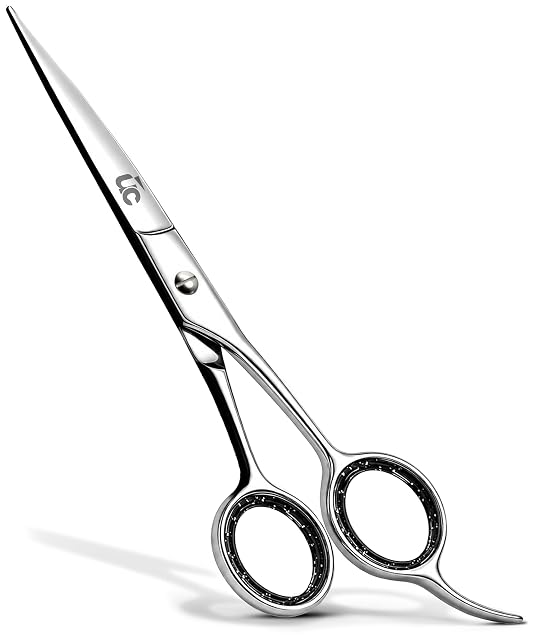
- “Professional barber hair cutting scissors, 6.5 inches”
- “Hand-crafted razor edged blades deliver a smooth and precise cut”
- “Ergonomically designed finger rest”
- “Non-slip handles with removable rubber band”
- “The ideal weight of scissors allows perfect balance and stability”
- From the name: “Professional Barber”, “Razor Edge”, “Stainless Steel”
- Reference UC0028 · Catalog: 141 g (5 oz), 165 × 55 × 7 mm (6.50 × 2.17 × 0.28 in)
It was on the wrong shelf
This pair reached this shelf from “blade-care”, where it had been filed among the sprays, the oils and the blade wash.
A pair of scissors on a shelf of liquids.
The word that put it there was “blade” — “hand-crafted razor edged blades” — and a blade is what a clipper shelf is about. Which is a match on a shared word rather than on a shared purpose, and the reason it is worth saying out loud is that the mistake is invisible from inside: on the blade-care shelf this page looked like a blade product, and nothing about it looked wrong.
It belongs here, with the seven other things on this shelf that cut hair with two edges closing on each other.
The heaviest pair here, and it sells that
“The ideal weight of scissors allows perfect balance and stability.”
At 141 g (5 oz) it is the heaviest item on this shelf — and two doors down, the same property is sold in reverse.
Equinox, $8.90, 90 g — “Weighing in at just 3.5 ounces, these shears are a breeze for anyone to handle.”
Both are right, about different users.
Why weight helps: inertia.
A heavier pair sits still in the hand. It resists being deflected when the blades meet a thick section, it does not wander at the start of a closing, and it transmits what the edges are doing back through your fingers — which is the whole of control on a cut you are watching rather than feeling.
It is also why professional shears are not as light as they could be: a featherweight pair is harder to place precisely, not easier.
Why weight hurts: endurance.
A stylist makes thousands of closings a day with the arm raised, and fifty grams at the end of an outstretched arm is felt by the afternoon.
For a home user cutting a fringe once a month, that cost is zero.
So the honest reading is the reverse of how the two pages aim themselves: the weight argument suits someone cutting carefully for ten minutes, and the lightness argument suits someone cutting all day.
The shelf, by weight:
141 g — this
90 g — the Equinox at $8.90
74 g — the Cut Factory B013 at $9.99
30 g — the Cut Factory 803 facial scissor at $9.99, the lightest
Not published — the LePinko pair at $6.99, the AULikY kit at $13.99, the CIICII kit at $19.98
What would settle it is not the gram figure but where the weight sits, and no page on this shelf publishes that. A pair balanced at the pivot handles lighter than its weight; one balanced at the tips handles heavier.
A razor edge, and the page that argues against it
“Hand-crafted razor edged blades deliver a smooth and precise cut”
This is one of two pages on this shelf to name a razor edge, and one page here argues against the whole class, in capitals.
The Cut Factory B013 at $9.99, bullet two, in full: “Why Serrated Beats Razor Edge: Unlike fragile razor edges that dull quickly and require advanced professional techniques, our micro-serrated hair scissors maintain a long-lasting edge, making them foolproof and safe for beginners cutting at home.”
What a razor edge is. A fine, smooth bevel ground like a knife. It slices a hair cleanly, and — crucially — it lets the hair slide along the blade.
That sliding is not a fault; it is the mechanism of slide cutting and point cutting, where a stylist runs the blade down a section to soften a line.
It is also why a razor edge wants a trained hand: the hair will move if you let it, and an uneven line is the result.
What a micro-serrated edge is. Fine teeth on one blade that grip the hair so it cannot slide. Which makes a blunt cut nearly foolproof and slide cutting impossible.
So the two are a trade between control and technique, not better and worse.
The shelf divides three ways.
Razor edge — this, and the Equinox at $8.90 (“Razor Edge Series”, “hand-sharpened razor-cutting edges”)
Micro-serrated — the Cut Factory B013 at $9.99, alone
Unstated — the CIICII kit at $19.98 (“hand-polished, the blade line is even and smooth”), the Cut Factory 803 at $9.99 (“flawless sharpness”), the LePinko pair at $6.99 (“straight edge blades”), and the AULikY kit at $13.99, which publishes no bullets at all
“Hand-crafted” is the word to read carefully here.
On the Equinox the equivalent claim is specific — “hand-sharpened razor-cutting edges” — and sharpening is a step you can name. “Hand-crafted blades” names no step at all.
And the rival claim that a razor edge “dulls quickly” is the part to weigh rather than accept: a fine edge has less metal behind it, so it does lose keenness sooner than a coarse one. What decides it in practice is the steel and the tension — and this page publishes neither.
The removable rubber band, which nothing else here offers
“Non-slip handles with removable rubber band” and an “Ergonomically designed finger rest”
A soft insert that sits inside the finger ring, reducing its diameter and padding the metal.
Why a ring needs one — two reasons, both real.
Fit. Finger rings are made in a few sizes and hands are not. A ring a little too large means the scissor pivots on the finger instead of with it, which is felt as imprecision and is actually looseness. An insert takes up that slack — and because it is removable, the same pair fits a larger hand without it.
Comfort. A bare steel ring bears on the side of a finger, and the load during a closing is concentrated on a thin edge of metal. Over an hour that is the specific ache people blame on the whole tool.
Why removable matters more than it sounds. Bands perish, tear and go sticky, and a fixed rubber grip that has failed cannot be replaced, so the pair is downgraded permanently. A removable one can be taken out, and a hairdressing supplier sells replacements for pennies.
This is the same gap the most expensive item here attacks from the opposite direction.
CIICII, $19.98 — the only finger-hole dimensions on this site: “Upgrade Larger Finger Holes - From Traditional 0.69-0.85 Inch to Upgraded 0.77-0.95 Inch based on customer recommendations.”
A bigger ring for bigger hands, where this page offers a smaller one for smaller hands. Between them they describe the problem completely, and neither mentions the other half.
What the rest of the shelf publishes on handles.
CIICII, $19.98 — an “Offset Handle Design - Very ergonomic & reduces fatigue”, larger finger holes, and a “High Rebound Muffler Design - Reduce the metallic noise and friction”
Equinox, $8.90 — “a curved finger rest and comfortable finger holes”
Cut Factory B013, $9.99 — a matte finish “designed to reduce hand fatigue”
Cut Factory 803, $9.99 — an “ergonomic grip”
LePinko, $6.99 — “large finger loops”
The offset handle is the one genuine distinction in that list, and this page does not have it. The thumb ring sits forward of the finger ring so the wrist stays low and flat — the standard professional geometry, and the reason a stylist’s hand does not ache.
The finger rest here is the right feature for the second reason. It is the small hook behind the lower ring that the little finger sits on, and it is the thing that stops the hand gripping: without it the whole hand squeezes, and with it the hand hangs and only the thumb moves.
Four pages on this shelf mention one, and only the pet scissors at $18.99 explains how to use it: “Hold shears with thumb in bottom finger loop and ring finger in top finger loop, resting your little finger on the finger rest.”
Six and a half inches, which is also a statement about the handle
6.5 inches is an overall figure, and about four inches of it is handle and pivot.
One page on this shelf separates the two.
Equinox, $8.90 — “6.5 inches in overall length with 2.55-inch blades”
CIICII, $19.98 — 6.7 in overall
this and the Cut Factory B013 at $9.99 — 6.5 in overall
LePinko pair, $6.99 — 3.54 in, which is a detail scissor rather than a cutting shear
Not published — the Cut Factory 803 at $9.99 and the AULikY kit at $13.99
What the blade length decides: how much hair one closing can take.
A 2.55-inch blade cuts a section about two and a half inches wide in a single clean closing — the professional standard for general cutting, because it is wide enough to take a real section and short enough to control.
A shorter blade cuts the same section in two or three bites, and every join between bites is a potential step in the line.
So two 6.5-inch shears can have noticeably different blades, and only one page on this shelf lets you check.
What 6.5 inches does tell you is the class: this is a cutting shear rather than a detail scissor, which puts it with four others here and against the two detail scissors, the LePinko pair and the Cut Factory 803.
What is not published
No tension screw, which is the one that matters. Two pages here publish one: the Equinox at $8.90 in its own title — “Fine Adjustment Tension Screw” — and the CIICII at $19.98, which ships the key, “1 × Scissors Adjuster.” The two blades bear on each other at one moving point and the screw sets how hard: too loose and they separate under load, the hair slides into the gap and FOLDS instead of being cut — the commonest fault in a worn pair, which feels exactly like bluntness and is not; too tight and the action is heavy and the edges wear against each other rather than against hair. And the tension drifts with use, because every closing works the pivot a little. A pair with no adjustable screw is a pair that will eventually fold hair and cannot be brought back — which matters more here than on most of this shelf, because a razor edge is the edge that lets hair slide in the first place.
No blade length, as above.
No steel grade. “Stainless steel” with nothing after it, where three pages do better: the CIICII at $19.98 names “6CR stainless steel” — a real designation, a mid-range martensitic stainless of the 6Cr13 family; the Equinox at $8.90 names “Japanese stainless steel” with “precisely tempered blades”, and tempering is the heat treatment that sets hardness; and the Cut Factory B013 at $9.99 names “High-Carbon Steel” under a “rust-resistant matte black finish”, which is the old trade resolved by a coating. No hardness figure appears anywhere on this shelf, and hardness is the number that would settle every one of these edge arguments.
No care instruction. One rival gives the first half. The Equinox at $8.90 on a new pair: they arrive “vacuum-sealed in protective plastic and coated with lubricating oil”, so “wash them with gentle soap and lukewarm water, then dry with a soft cloth” — because that film is a preservative rather than a lubricant, and left on it makes hair stick to the blade, so a new pair cuts worse than an old one. And no page on this shelf gives the second half: wipe the edge dry after each use, with alcohol rather than water. Neither half is here.
No pouch or case. Three items on this shelf ship one, two of them at about this price: the Cut Factory B013 at $9.99 with a “protective leather pouch” and a gift box, the Cut Factory 803 at $9.99 with a “sleek PU leather pouch”, and the CIICII kit at $19.98 with a “gift leather bag”. A bare scissor loose in a drawer is a scissor whose edge meets other steel, which is how a razor edge is lost without ever cutting hair.
No thinning or texturizing option, where two items here include thinning shears and one publishes real figures: the CIICII at $19.98, “28 Teeth Thinning Scissors… (Thinning rate of 25-28%)” — the only tooth count anywhere on this site.
No left-handed option, which no page on this shelf mentions and which matters more on scissors than on anything else on this site: a right-handed pair used in a left hand pushes the blades apart rather than together, which is the folding fault described above, permanently.
No warranty. One item on this shelf publishes one and it is the richest term on this site: the CIICII at $19.98 — “90-DAYS Unconditional Return + 12-Month Quality Promise”, with support stated to respond “in 12 hours”. Seven publish nothing.
No country of manufacture, which no item on this shelf publishes.
Availability
Read on the day this page was built: $9 at the American Amazon shop.
Read from Keepa on the day this page was last revised; stock and price both move without notice.
Prices quoted in this text were read on 2026-10-05. The live price is at the top of the page.