What the maker puts in writing
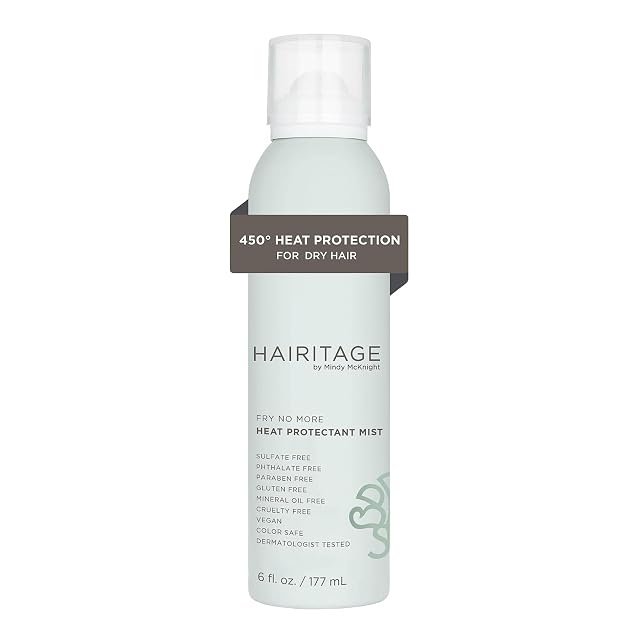
- “PROTECT YOUR HAIR FROM HEAT DAMAGE - Hairitage Fry No More Heat Protectant Spray is formulated to protect your hair from heat styling tools up to 450°F. Contains argan oil and rice protein to provide hydration.”
- “LEAVE-IN FORMULA FOR CONVENIENT STYLING - Say goodbye to multiple products for heat protection, hydration, and conditioning.”
- “ENRICHED WITH ARGAN OIL & RICE PROTEIN - argan oil, known for its moisturizing properties, and rice protein which helps strengthen and repair damaged hair.”
- “IDEAL FOR ALL HAIR TYPES - Whether you have curly or straight hair, thick or thin strands… It can be used on wet or dry hair before blow drying or using any hot styling tools.”
- “CRUELTY-FREE AND ENVIRONMENTALLY FRIENDLY”
- From the description: “lightweight formula won’t weigh down your hair or leave any sticky residue behind”, “Simply spritz onto damp or dry hair before using hot tools”
“Wet or dry” is the wrong instruction
“It can be used on wet or dry hair before blow drying or using any hot styling tools.”
Water is the damage mechanism, which makes this the one instruction on this shelf that matters most.
What heat actually does to hair.
Hair holds water inside the shaft.
When a flat iron or a curling wand touches it, that internal water can pass 100 °C (212 °F) and flash to steam inside the hair — and the steam has nowhere to go but outward, through the cortex.
It blows microscopic cavities in the fiber. That is the damage pattern known as bubble hair, and it is the worst thing a hot tool does.
So the most protective instruction any of these products could give is: dry the hair first.
How the shelf divides.
Bumble and bumble, $17.00 — correct and explicit: “This mist protects dried hair against heat tools”
OGX, $10.47 — the only two-stage instruction here, and the right one: “apply on damp hair from mid-length to ends (avoiding roots) before blow-drying; then apply on dry hair before curling or straightening”
Moroccanoil, $15.00 — “may be used on damp or dry hair”, and uniquely a dry-spray application “on second-day hair for hot-tool touch-ups”
this — “wet or dry”
And the other five — no application instruction at all
The OGX distinction is the one to borrow: a blow dryer held at a distance is a different thermal event from 200 °C (392 °F) plates clamped onto a strand.
Why the error here is understandable and still an error.
A leave-in on wet hair is normal — that is how most leave-in conditioners are used, and this page sells itself as a combined protectant, hydrator and conditioner, so wet application is natural for two of its three jobs.
The problem is the third.
Spraying this on wet hair and then reaching for a flat iron is the worst available sequence — and the bullet puts “before blow drying or using any hot styling tools” in the same breath as “wet or dry”, which explicitly permits it.
The practical reading: use it on dry hair before any iron or wand. As a leave-in on wet hair before blow-drying it is defensible, and then reapply when the hair is dry if you are going to iron it — which is what the OGX page tells you to do and this one does not.
Argan oil and rice protein, and only one of them is doing the job named
“argan oil, known for its moisturizing properties, and rice protein which helps strengthen and repair damaged hair”
Read what each ingredient is credited with on this page: the oil for moisturizing, the protein for strengthening and repairing.
Neither is credited with blocking heat — which is accurate, and worth noticing. The page does not claim what it cannot.
What actually slows heat transfer: a film.
A heat protectant works by leaving a thin continuous layer over the cuticle that conducts heat more slowly than the hair does and — more importantly — slows the escape of water, so the internal water heats less abruptly and the steam damage is reduced.
The film-formers that do this in most commercial heat protectants are silicones.
And not one page on this shelf names a silicone, or any film-forming agent at all.
That is the shelf’s largest collective silence: nine products sold on a protective mechanism, and none says what forms the protective layer.
Why oil is the wrong candidate for that job.
Oil conducts heat. It does not insulate.
A film of oil on a strand transfers heat into the hair rather than holding it off — and oils have smoke points, so at 230 °C (446 °F) an oil on a plate is being cooked rather than protecting anything.
Three of the nine pages here lead with argan oil: this one, the Moroccanoil at $15.00 (“Infused with Argan oil”, plus panthenol) and the TYMO at $16.99 (“Argan oil-infused essence”).
Which is selling the wrong mechanism, however good the oil is for conditioning.
Why protein is the better story, though still not insulation.
Protein patches a damaged cuticle. A smoother, better-filled cuticle holds water in and resists mechanical abrasion, which genuinely reduces the damage a hot tool does.
It is repair and reinforcement rather than a thermal barrier.
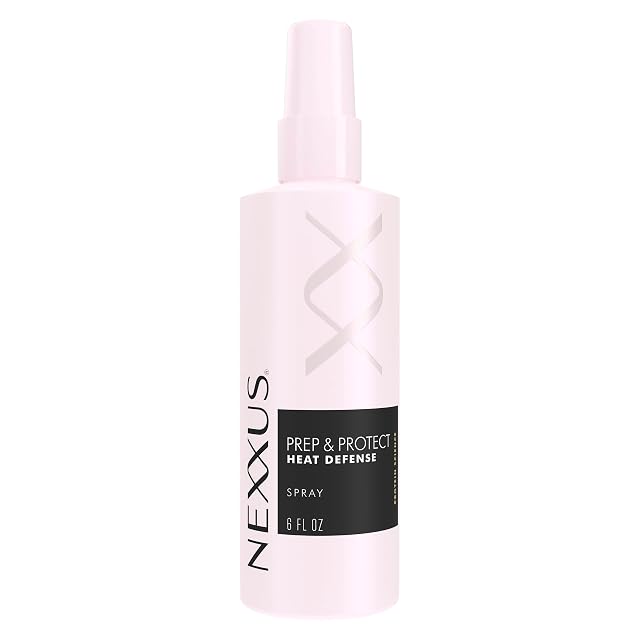
The shelf’s proteins: rice protein here, “smart binding hair proteins” on the OGX at $10.47, a “Honey Protective Complex” on the Bumble at $17.00, hydrolyzed keratin on the TYMO at $16.99, and “protein science” and “STYLEPROTECT Technology” on the Nexxus at $13.99.
So the honest summary of this bottle: a conditioning leave-in with a protein that helps the fiber and an oil that helps the feel, under a heat-protection headline whose mechanism is not described.
At $8.94 that is a reasonable thing to buy. It is not the same as knowing how much protection you are getting.
Four hundred and fifty degrees, which eight pages share
“protect your hair from heat styling tools up to 450°F”
The shelf.
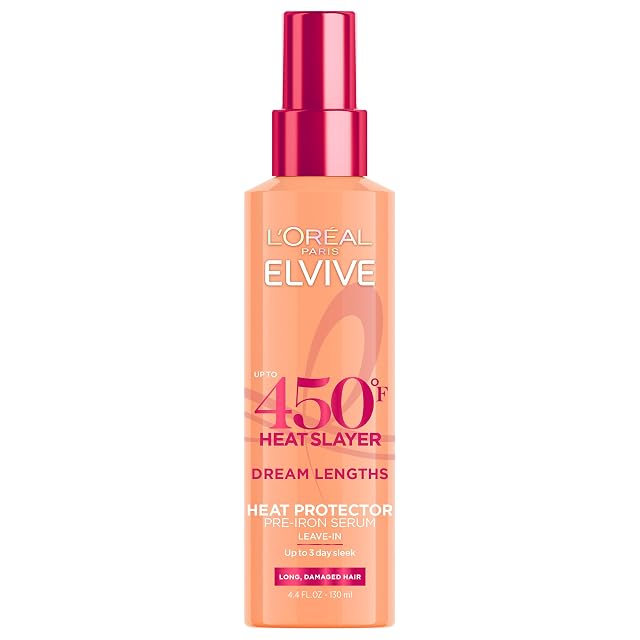
450 °F — this at $8.94, the L’Oreal Paris at $8.99, the OGX at $10.47, the CHI at $13.99, the Nexxus at $13.99, the Moroccanoil at $15.00 (as 450 °F / 230 °C), the TYMO at $16.99, the Bumble and bumble at $17.00
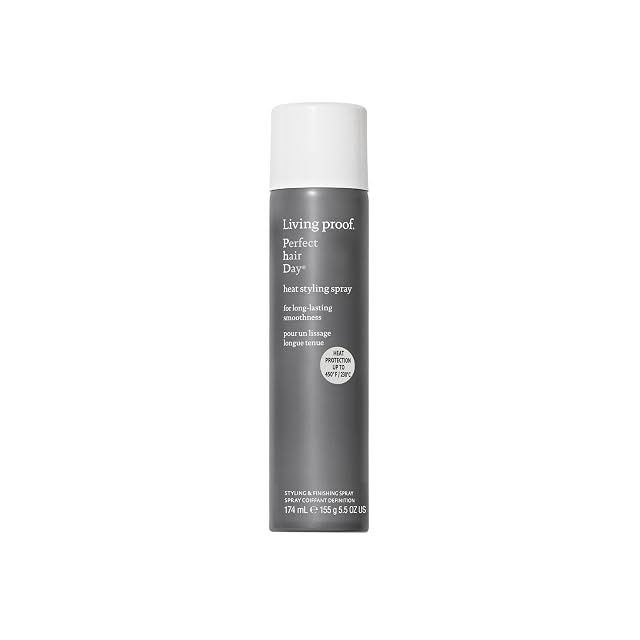
No temperature at all — the Living Proof at $34.00, the most expensive item here
What it means that eight brands across a price range of twice over publish an identical ceiling.
450 °F is not a specification. It is a convention.
And the convention has an obvious origin: 450 °F is the maximum setting of nearly every consumer flat iron sold.
So “protects up to 450°F” is a statement about the tool rather than the product. It says: whatever your iron can do, this is sold for it — a compatibility claim dressed as a performance figure.
A number that nine products at a four-fold price range all share is a number that cannot help you choose between them.
What is missing from every page here is the degree of protection.
Nothing on this shelf publishes how much cooler the hair runs, what proportion of damage is prevented at a stated temperature, how long the film lasts, or how many passes of an iron it survives.
“Up to 450 °F” is a ceiling with no measurement underneath it.
The weightlessness promise, which nine of nine make
“lightweight formula won’t weigh down your hair or leave any sticky residue behind”
Every item on this shelf makes a version of this claim, which tells you what the category’s real failure is.
CHI, $13.99 — “non-greasy spray instantly absorbs without buildup”
Nexxus, $13.99 — “no sticky buildup or flakes”, and “helps prevent static”
TYMO, $16.99 — “Different from other greasy and crunchy hair oil”
Moroccanoil, $15.00 — “Weightless formula”, “no hold”
OGX, $10.47 — “weightless”, “without weighing down hair”
L’Oreal Paris, $8.99 — “ultra lightweight”
Bumble, $17.00 and Living Proof, $34.00 — lightweight and fine-mist claims
this — won’t weigh down, no sticky residue
When nine of nine promise the same thing, the promise stops distinguishing them and starts describing the risk.
Buildup is the real failure of a heat protectant, and it has a cause worth knowing: too much product, or product applied too close.
Which is why the one page that publishes an application distance is doing something the rest are not.
OGX, $10.47 — “Holding 6.5 fl oz continuous mist spray bottle 6-8 inches away from hair”
Too close and you deposit a wet patch rather than a film — and a wet patch is both the sticky residue every page disclaims and a worse thermal situation, because it is water sitting on a strand you are about to heat.
A film only forms if the mist is even, and evenness is a function of distance.
This page says “simply spritz” and gives no distance, which is the gap behind its own no-residue promise.
What is not published
No volume. One page on this shelf publishes one: the OGX at $10.47, “6.5 fl oz”. The Bumble and bumble at $17.00 says “Mini Travel Size”, which tells you it is small. Without volumes, $8.94 and $34.00 cannot be compared at all — and on a spray, price per ounce is the whole of the value question. This being the cheapest bottle on the shelf means nothing until the size is known.
No application distance, as above.
No film-forming agent, as above — the shelf-wide silence.
No degree of protection, as above.
No hold statement. One page on this shelf settles it, and settles it twice: the Moroccanoil at $15.00 — “Weightless, no-hold spray blends seamlessly into any existing styling regimen”, and “contains no hold”. The Living Proof at $34.00 claims the opposite: “Enduring Style: Maintains style for extended periods.” This is a genuine fork rather than a detail: a protectant WITH hold is also a styling product, and it interferes with whatever you apply after it; a no-hold one is a base layer that disappears under your routine. Seven pages, including this one, do not say which they are.
No UV filters. One item on this shelf claims them: the Bumble and bumble at $17.00 — “Added UV Filters help protect hair against the drying effects of the sun.” It is the only additional protective claim anywhere here.
No color-safety statement. Two pages make one: the Bumble at $17.00 (“Color Safe”) and the Nexxus at $13.99 (“protects vibrancy after styling”). It matters on a product used before an iron, because heat is what lifts color.
No study, trial or evidence of any kind. Two pages cite something: the OGX at $10.47 with three footnoted figures whose footnote text does not appear, and the Nexxus at $13.99 with “89% agree hair felt moisturized In a salon study with 45 consumers on 11.3.2021” — a sample size, a date, and a measure that announces itself as perception rather than strength.
No free-from list beyond the cruelty-free claim. Three pages publish one: the L’Oreal Paris at $8.99 (“sulfate free, paraben free, dye free”), the CHI at $13.99 (“cruelty-free, paraben-free, & sulfate-free”) and the OGX at $10.47 (“formulated without dyes or parabens”).
No scent description, where two pages describe theirs at length and in strikingly similar terms: the TYMO at $16.99 (“spicy amber and musk with sweet florals”) and the Moroccanoil at $15.00 (“spicy amber aromas and sweet floral notes”).
And “environmentally friendly” is the one claim here with nothing behind it at all — no packaging statement, no refill, no certification, no ingredient sourcing. Cruelty-free is at least a definable term; environmentally friendly, unqualified, is not.
Availability
Read on the day this page was built: $9 at the American Amazon shop.
Read from Keepa on the day this page was last revised; stock and price both move without notice.
Prices quoted in this text were read on 2026-10-05. The live price is at the top of the page.