What the maker puts in writing
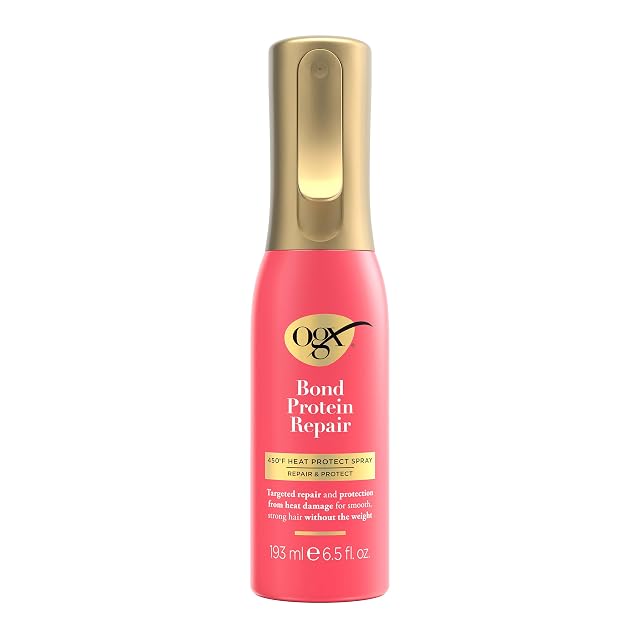
- “Heat protectant: This weightless heat protectant spray shields your hair from heat damage up to 450°F while delivering lightweight conditioning”
- “OGX Bond Repair: Repairs extreme damage, including bleach, heat, and mechanical damage; rebuilds bonds; binds to damaged hair cuticle to help keep hair strong and resilient”
- “Proven damage protection: This weightless bond repair mist offers nonstop damage protection*; makes hair six times stronger and provides 80% less breakage**; saves 5,800 hair strands from breaking each month***”
- “Sensory experience: Notes of jasmine, orange, and rose… leaves hair soft, smooth, and 6x stronger**; formulated without dyes or parabens; gentle on all hair types”
- “To Use: Holding 6.5 fl oz continuous mist spray bottle 6-8 inches away from hair, apply OGX spray on damp hair from mid-length to ends (avoiding roots) before blow-drying; then apply on dry hair before curling or straightening”
- From the description: “dual-action repair technology”, “smart binding hair proteins”
The only real instructions on this shelf
“Holding… continuous mist spray bottle 6-8 inches away from hair, apply OGX spray on damp hair from mid-length to ends (avoiding roots) before blow-drying; then apply on dry hair before curling or straightening.”
Three separate decisions, and all three are right.
One: damp before the dryer, dry before the iron.
A blow dryer delivers warm moving air at a distance. A flat iron clamps metal at up to 230 °C directly onto a strand.
Those are not the same thermal event, and the hair’s water content is why.
Hair holds water inside the shaft. At iron temperatures that internal water can pass 100 °C and flash to steam inside the fiber, and the steam blows microscopic cavities through the cortex on its way out — the damage pattern known as bubble hair.
Which makes ironing damp hair the worst thing you can do to it, and drying it first the single most protective step available.
A dryer, by contrast, is how you get the water out — so applying a protectant to damp hair before drying is both safe and the point.
Two applications, two purposes. No other page on this shelf makes the distinction.
Hairitage, $8.94 — gets it backwards: “can be used on wet or dry hair before blow drying or using any hot styling tools”, which explicitly permits an iron on wet hair
Bumble and bumble, $17.00 — the simple version, correctly: “protects dried hair against heat tools”
Moroccanoil, $15.00 — “damp or dry”, plus a dry-spray option for second-day touch-ups
And five pages — no application instruction at all
Two: mid-length to ends, avoiding roots.
The right geography, and the only page to give it.
Damage is not evenly distributed along a strand. Hair at the ends is years older than hair at the root, and has been washed, brushed, dried and ironed hundreds more times. It is also furthest from the scalp’s own oils.
So the ends need the product and the roots do not. And product at the roots is what makes hair look greasy and lie flat — the “weighs it down” complaint nine of nine pages on this shelf promise to avoid.
Notably, the page aimed specifically at long hair does not give this instruction: the L’Oreal Paris Dream Lengths at $8.99, “specially formulated for long, straightened hair”.
Three: six to eight inches.
Why the distance matters
No other page on this shelf publishes one.
The protective mechanism is a thin continuous layer over the cuticle that conducts heat more slowly than hair does and slows the escape of water from inside the shaft.
A layer only works where it exists.
Sprayed from two inches, a mist does not spread. It lands as droplets, the droplets run together, and you get saturated patches with bare hair between them — so the protection is uneven, and the places that got the most product are the heaviest and the slowest to dry.
Sprayed from six to eight inches, the mist has distance to break up and arrive as a fine, even deposit.
Two things follow.
First, it explains the residue problem that every page on this shelf promises to avoid.
Nexxus, $13.99 — “no sticky buildup or flakes”
CHI, $13.99 — “non-greasy spray instantly absorbs without buildup”
Hairitage, $8.94 — “won’t weigh down your hair or leave any sticky residue”
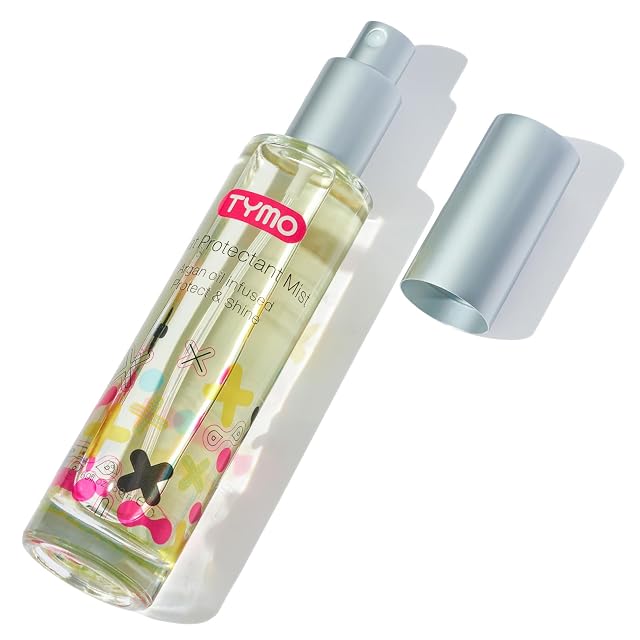
TYMO, $16.99 — “Different from other greasy and crunchy hair oil”
Moroccanoil, $15.00 — “Weightless formula”
When every product in a category makes the same promise, the promise is describing the category’s failure — and the cause is usually too much product applied too close, rather than the formula.
This is the only page that tells you how to avoid causing it.
Second, and this is the thermal point: a wet patch is worse than no product.
Water sitting on a strand you are about to iron is extra water to flash into steam. So over-spraying a heat protectant is not merely wasteful — on an iron it is actively counterproductive, and this page’s own instruction to let the hair dry between the two applications is what prevents it.
“Continuous mist” is worth separating from an ordinary pump. It delivers a steady fine spray for as long as the trigger is held, rather than a pulse per press — which is what makes an even pass over a length of hair possible at all.
The TYMO at $16.99 makes a related claim from the other end: a “patent anti-stuck spray nozzle” that “releases weightless mist”, which addresses nozzle clogging rather than distribution.
“offers nonstop damage protection; makes hair six times stronger and provides 80% less breakage**; saves 5,800 hair strands from breaking each month***”*
Three figures, three different markers — one asterisk, two, three — and the text of none of them appears anywhere on the page.
That is the problem rather than the numbers.
A footnote marker is a promise that the conditions are stated somewhere, and here there is nothing to read: no test method, no comparison product, no hair type, no number of washes, no sample size.
“Six times stronger” than what? Than untreated hair, than bleached hair, than the brand’s own previous formula? Each is a different claim, and two of them would be easy to achieve.
Now the 5,800 strands, which invites a check.
A head of hair holds roughly 100,000 strands.
Normal shedding is 50 to 100 strands a day — call it 1,500 to 3,000 a month.
So “saves 5,800 hair strands from breaking each month” describes breakage running at two to four times the rate of all normal shedding combined.
That is a very large baseline.
It may be defensible for severely bleached hair under aggressive mechanical testing — which is the population this product explicitly names: “repairs extreme damage, including bleach, heat, and mechanical damage”.
Presented without its footnote, it reads as a figure for ordinary hair. And for ordinary hair it does not describe anything a person would recognize.
The better evidence on this shelf promises less and shows more.
Nexxus, $13.99 — “89% agree hair felt moisturized In a salon study with 45 consumers on 11.3.2021”
A sample size, a date, and a measure that announces itself as perception rather than strength. Forty-five people agreeing that hair felt moisturized is a modest claim, and it is one you can evaluate.
Everything else here cites nothing at all: the Hairitage at $8.94, the L’Oreal at $8.99, the CHI at $13.99, the Moroccanoil at $15.00, the TYMO at $16.99, the Bumble at $17.00 and the Living Proof at $34.00.
Bond repair, which is a different claim from heat protection
“Repairs extreme damage, including bleach, heat, and mechanical damage; rebuilds bonds; binds to damaged hair cuticle”, “smart binding hair proteins”
This page is selling two things, and they work on different timescales.
Heat protection is prevention, in the moment the plates close.
Bond repair is restoration, over washes — patching a fiber that is already damaged.
What “bonds” means here. Hair’s strength comes from cross-links between its keratin chains, and bleaching in particular breaks them. A bond-repair product aims to re-form or substitute for those links, which is a genuine category of chemistry and the reason this bottle costs more than its two cheaper neighbors.
What “binds to damaged hair cuticle” describes is different again: a protein depositing where the cuticle is lifted or missing, which smooths the surface and holds water in.
Both are real and neither is a thermal barrier.
Which brings up the silence this whole shelf shares.
The mechanism that actually slows heat transfer is a film, and the film-formers that do it in most commercial heat protectants are silicones.
Not one of the nine pages on this shelf names a silicone, or any film-forming agent at all.
Nine products sold on a protective mechanism, and none says what forms the protective layer.
What they name instead divides three ways.
Proteins — “smart binding hair proteins” here, rice protein on the Hairitage at $8.94, hydrolyzed keratin on the TYMO at $16.99, a “Honey Protective Complex” on the Bumble at $17.00, and “protein science” and “STYLEPROTECT Technology” on the Nexxus at $13.99
Oils — argan on the Hairitage, argan and panthenol on the Moroccanoil at $15.00, argan on the TYMO
Nothing at all — the L’Oreal Paris at $8.99, the CHI at $13.99 and the Living Proof at $34.00
And oil is the wrong mechanism for the job: it conducts heat rather than insulating, and oils have smoke points, so at 230 °C (446 °F) an oil on a plate is being cooked.
Protein is the better story and it is repair rather than insulation — which is exactly what this page calls it.
Four hundred and fifty degrees, which eight pages share
“shields your hair from heat damage up to 450°F”
450 °F — this, the Hairitage at $8.94, the L’Oreal Paris at $8.99, the CHI at $13.99, the Nexxus at $13.99, the Moroccanoil at $15.00 (as 450 °F / 230 °C), the TYMO at $16.99, the Bumble and bumble at $17.00
No temperature at all — the Living Proof at $34.00, the most expensive item here
Eight brands, a price range of nearly twice over, one identical ceiling.
Which means 450 °F is not a specification. It is a convention — and the convention has an obvious origin: 450 °F is the maximum setting of nearly every consumer flat iron sold.
So “up to 450°F” is a statement about the tool rather than the product.
A number nine products across a four-fold price range all share cannot help you choose between them.
What no page here publishes is the degree of protection: how much cooler the hair runs, what proportion of damage is prevented at a stated temperature, how long the film lasts, or how many passes of an iron it survives.
This page comes closest with its footnoted strength figures, and they are claims about the fiber rather than about the heat.
The only item here you can price
“6.5 fl oz continuous mist spray bottle”
This is the only volume published anywhere on this shelf.
At $10.47 that is about $1.61 per fluid ounce.
And it is the single most useful fact on the shelf, because without volumes the rest of the prices are not comparable.
$8.94 — the Hairitage, volume not published
$8.99 — the L’Oreal Paris, not published
$10.47 — this, 6.5 fl oz
$13.99 — the CHI, not published
$13.99 — the Nexxus, not published
$15.00 — the Moroccanoil, not published
$16.99 — the TYMO, not published
$17.00 — the Bumble and bumble, which says “Mini Travel Size”, so it is small
$34.00 — the Living Proof, not published
Which makes the Bumble the sharpest value question on this shelf — $17.00 for a declared travel mini — and this one the only bottle whose cost per use can be worked out at all.
What is not published
The footnote text for three claims, as above — the central omission on an otherwise unusually informative page.
No film-forming agent, as above.
No hold statement. One page on this shelf settles it, twice: the Moroccanoil at $15.00 — “Weightless, no-hold spray”, “contains no hold, blending seamlessly into any existing styling regimen”. The Living Proof at $34.00 claims the opposite: “Enduring Style: Maintains style for extended periods.” It is a genuine fork rather than a detail — a protectant with any hold is also a styling product and interferes with what you apply after it, while a no-hold one disappears under your routine. This page says “weightless” four times and never says whether it holds.
No UV filters. One item on this shelf claims them, and it is the only additional protective claim anywhere here: the Bumble and bumble at $17.00 — “Added UV Filters help protect hair against the drying effects of the sun.”
No color-safety statement, which is the odd gap on a product whose own second bullet names bleach as the damage it repairs. Two pages do make one: the Bumble at $17.00 (“Color Safe”) and the Nexxus at $13.99 (“protects vibrancy after styling”). Heat is what lifts color, so a protectant used before an iron is exactly where the claim belongs.
No pH, and no wash-resistance figure, on a bond-repair product whose benefit accrues over repeated use.
No degree of protection, as above.
No country of manufacture.
Availability
Read on the day this page was built: $10 at the American Amazon shop.
Read from Keepa on the day this page was last revised; stock and price both move without notice.
Prices quoted in this text were read on 2026-10-05. The live price is at the top of the page.