What the maker puts in writing
- “PROFESSIONAL STYLING: 1″ ceramic floating plates deliver even heat for smooth straightening, curls, flips, waves, and polished looks for all hair types.”
- “FAST HEAT UP: Heats quickly to optimal 392°F with an on/off switch (no adjustable heat setting) for fast styling results while reducing frizz and static, giving hair a silky, shiny finish.”
- “SALON-READY DESIGN: Ergonomic tool features an 11 ft swivel cord and analog controls for easy handling and maneuverability during styling sessions.”
- “TRAVEL FRIENDLY: Dual-voltage capability makes this classic styling iron ideal for home or on the go.”
- “HOW TO USE: Turn on this hair tool via the on/off switch- tool automatically heats up to a set optimal temperature of 392°F. Divide hair into one to two inch sections. Use fluid motions to run the iron over the length of your hair one section at a time.”
- “CHI: Founded by Farouk Shami, a hairdresser allergic to ammonia who sought to create the first ever ammonia-free hair color & has remained committed to crafting the finest ethical haircare. All CHI products are cruelty-free, paraben-free, & sulfate-free.”
Floating plates, which is the one mechanical feature here
“1″ ceramic floating plates deliver even heat for smooth straightening, curls, flips, waves, and polished looks”
What happens without them.
A flat iron is a hinge.
When you squeeze the handles, the force is applied at the far end from the pivot — so the plates do not meet flat. They meet at an angle, pinching hardest near the tip and least near the hinge.
Two consequences, and both are visible in the result.
Uneven heat transfer. Heat moves from plate to hair by contact, so the part of the section under firm pressure gets more of it than the part under light pressure. One pass, two different amounts of straightening, along the same strand.
A crease. Where the pressure is highest the hair is held hardest, and a section clamped unevenly and drawn through takes a visible line at that point — the ridge people blame on technique, which is actually geometry.
What a floating plate is.
The plate is mounted on springs or a flexible backing rather than fixed to the body, so it can tilt a degree or two.
Squeeze the iron and the plates self-align: they find the plane the hair is in rather than imposing one.
Which means even contact along the whole length of the plate, even heat, and no pinch point.
It is the single most consequential mechanical feature on this shelf, and it is the reason this is the most expensive item here.
What the other seven publish instead.
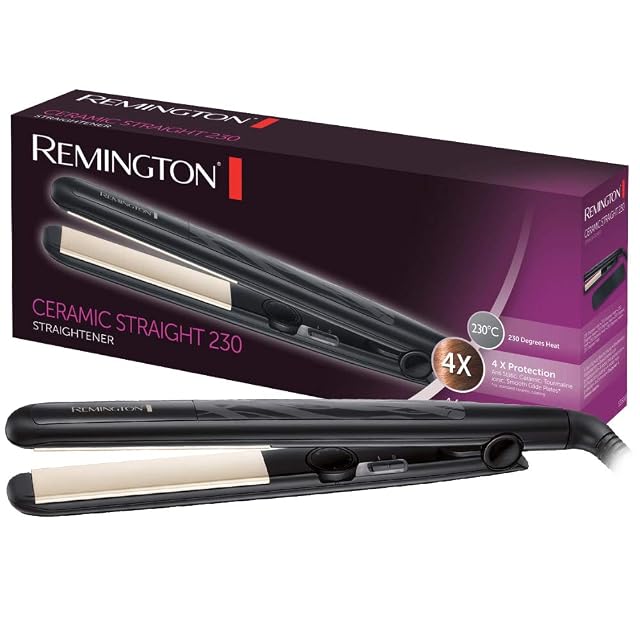
Remington, $33.99 — ceramic “infused with Argan oil, protein-packed Keratin, and a micro-conditioner”, with “up to 50% shinier hair” and no method published. A coating claim rather than a mechanical one — and on a one-inch iron sold for “small sections” and “root-to-tip” work, floating plates would have mattered.
REVLON, $13.96 — a “ceramic coating… even heat distribution”: the right phrase for what ceramic does, which is to avoid hot spots across the plate, and nothing about whether the plates meet flat
Wild Willies, $29.90 — “Tourmaline ceramic” on comb teeth rather than plates
XIKEZAN, $21.52 and FEBOTE, $25.99 — “PTC ceramic”, which is a self-limiting heating element rather than a plate geometry
Both Arkam combs, at $20.99 and $28.99 — no plate or element claim at all
So “even heat” is claimed by five of eight items on this shelf, and only one has the mechanism that delivers it along the length of a clamped section.
The analog controls in bullet three sound like a limitation and are consistent: a tool with one temperature does not need a screen, and an analog switch is one fewer thing to fail on an iron used in a wet room.
One temperature, stated plainly
“Heats quickly to optimal 392°F with an on/off switch (no adjustable heat setting)”
Note what that parenthesis does: it states the limitation as a fact rather than hiding it.
The shelf, by control.
12 levels, 250–450 °F — the Arkam at $28.99, on a digital screen: the most settings and the lowest floor here
9 settings, Turbo to 450 °F — the Remington at $33.99
5 settings, 338–446 °F — the FEBOTE at $25.99, on an LCD
3 settings, 356–428 °F — the XIKEZAN at $21.52
3 levels, 300 / 355 / 400 °F — the Arkam at $20.99, the only page here to name a hair type for each figure
3 settings to 400 °F — the Wild Willies at $29.90, on an LED display
400 °F, “multiple” settings — the REVLON at $13.96: a ceiling with no count
392 °F, fixed — this, the most expensive item on the shelf
The case for one temperature.
392 °F is 200 °C (392 °F), and it is a well-chosen figure: hot enough to break and re-form the hydrogen bonds in any hair type, and 58 degrees below the 450 °F two tools here reach.
A single correct temperature also removes the user’s chance to pick a wrong one — and the wrong one is almost always too hot, because the instinct when a pass does not work is to turn it up.
On a salon tool used by someone who knows what they are doing, a fixed optimum is a professional convention rather than a cost saving.
The case against it is the one that matters at home.
The damage a heated tool does scales with temperature, and the correct setting is the lowest one that straightens.
Fine hair straightens at 300 °F. On this iron it gets 392 °F, every time — 92 degrees more heat than it needs, for the same result.
And bleached or already-damaged hair is exactly the hair that needs the low end, and has none here.
The page claims the tool is “for all hair types”, and one temperature for all hair types is the claim that cannot be fully true.
The cheapest beard comb on this shelf makes the opposite argument plainly: the Arkam at $20.99 — “300°F for thin hair, 355°F for medium and wavy hair, and 400°F for thick and curly hair.” Three labeled settings, for $23 less.
What is missing from the same bullet is a heat-up figure.
“Heats quickly” is the whole of it.
15 seconds — the Remington at $33.99, the fastest here
30 seconds — the Arkam at $20.99 and the Arkam at $28.99
338 °F in 30 seconds — the FEBOTE at $25.99, the most honest form, because it names a target
No figure — this, the REVLON at $13.96, the XIKEZAN at $21.52, the Wild Willies at $29.90
On a tool with one temperature and no display, the heat-up time is the only thing that tells you when it is ready — which makes its absence the awkward gap here.
“an 11 ft swivel cord and analog controls for easy handling and maneuverability”
Two pages on this shelf publish a cord length.
11 ft — this
9 ft — the Remington at $33.99
Swivel, no length — the REVLON at $13.96, the Arkam at $20.99, the XIKEZAN at $21.52, the Arkam at $28.99, the Wild Willies at $29.90
Why eleven feet exists: a stylist works around a chair, moving continuously from one side of a head to the other, and the socket is on a wall.
A domestic iron at a bathroom mirror needs enough cord to stand up straight. A salon iron needs enough to circle someone.
At home the benefit is simpler and still real: the cord stops deciding where you stand.
And the swivel is the more important half on any iron, because you rotate the tool constantly — to take a section at an angle, to bend the ends, to pass it round the back of your head.
A fixed cord accumulates twist, and twist concentrates where the cord enters the handle, which is where cords fail.
Six of eight items here claim a swivel. Notably the Remington at $33.99 publishes nine feet and does not claim one.
The usage instruction, and the section width nobody else gives
“Divide hair into one to two inch sections. Use fluid motions to run the iron over the length of your hair one section at a time.”
This is the only section width published anywhere on this shelf.
And it matters for a reason the page does not give.
A section thicker than the plates can heat through comes out straight on the outside and bent inside.
So you pass it again — and the second pass is the damage.
One to two inches is the right figure for a one-inch plate, and naming it is worth more than most of this page’s adjectives.
“Fluid motions… one section at a time” is the other half: a smooth continuous pass rather than stopping, because stopping is what leaves a ridge — the same fault the floating plates exist to prevent.
What the instruction is missing is the condition one page on this site states and almost nothing else does.
Remington, $33.99 — “Use on dry hair only.”
Hair holds water inside the shaft, and at 392 °F that water can pass 100 °C (212 °F) and flash to steam inside the fiber, blowing microscopic cavities through the cortex — the damage pattern known as bubble hair.
Across all of GroomVerdict only two products print the rule: that Remington iron, and the Bumble and bumble heat protectant at $17.00 on the heat-protection shelf — “protects dried hair”.
On the one page here that publishes a usage procedure, the first step of it should have been that.
Dual voltage, which the mid-priced iron lacks
“Dual-voltage capability makes this classic styling iron ideal for home or on the go.”
The shelf.
110–240 V — this, the Arkam at $20.99, the XIKEZAN at $21.52, the FEBOTE at $25.99, the Arkam at $28.99
US and Canada 110 V only — the Remington at $33.99, stated plainly: “built for US/CA 110V outlets”
Not stated — the REVLON at $13.96 and the Wild Willies at $29.90
Which inverts the usual expectation: the most expensive flat iron travels and the mid-priced one does not.
Why a transformer is not a workaround: the thing drawing the current is a heating element, and an element is a high-wattage load. A converter capable of running one is heavy enough that nobody packs it — so dual voltage is a genuine specification on heated tools rather than a nicety.
What this page does not pair with it is a size or a weight. One item on this shelf publishes both: the XIKEZAN at $21.52 — “ultra-compact size (10.47” x 2”)” and “lightweight (only 8.8 oz)”, the only such figures anywhere here.
And the “ergonomic” claim in bullet three is unquantified in the same way: no handle dimension, no weight, no grip material.
The brand bullet, and the one thing in it that is about this product
“Founded by Farouk Shami, a hairdresser allergic to ammonia who sought to create the first ever ammonia-free hair color… All CHI products are cruelty-free, paraben-free, & sulfate-free.”
Ammonia-free hair color has nothing to do with a styling iron.
And the free-from list is a claim about the brand’s cosmetics rather than about a metal tool: an iron contains no sulfates and no parabens, because it is not a formulation.
So the useful half of that bullet is the cruelty-free claim, which is about testing policy and applies company-wide.
It is worth noting because the identical bullet appears on another shelf of this site, on a product where it does mean something: the CHI 44 Iron Guard thermal protection spray at $13.99 on GroomVerdict’s heat-protection shelf, where “paraben-free” and “sulfate-free” describe an actual formulation.
The brand-story block adds the nearest thing to a manufacturing statement on this shelf: “Farouk Systems, Inc. is a Houston based company.”
No item on this shelf publishes a country of manufacture, so a named company and city is more than the other seven give.
The only other page here to spend a bullet on the corporation is none — this is the sole instance on this shelf, where on the heat-protection shelf two of nine pages did the same.
What is not published
No auto shut-off, at all. This is the omission that matters most on a 392 °F tool with a single on/off switch and no display to remind you it is on. At least six of the twelve items on this shelf publish something: 30 minutes on the Arkam at $20.99, the XIKEZAN at $21.52, the FEBOTE at $25.99 and the Arkam at $28.99; “turns off when not in use” on the Wild Willies at $29.90; and one hour on the Remington at $33.99. This page and the REVLON at $13.96 publish nothing. A hot object left switched on is the classic domestic hazard of this category, and on an eleven-foot cord the tool is quite likely to be left lying somewhere other than beside the socket.
No heat-up time, as above.
No dry-hair instruction, as above — on the one page that publishes a procedure.
No certifications. Two pages publish them, both beard combs: the XIKEZAN at $21.52 lists “CE, FCC, ROHS, UL and CA65” — five, including California Proposition 65 — and the FEBOTE at $25.99 lists “FCC, CE, ROHS” plus “UL approved”. UL is the one that matters on a mains heating appliance, because it is an independent test of fire and shock risk rather than a conformity marking. Six of eight items here publish none, and this is the most expensive of them.
No element type. Three pages publish one, and it is a safety property: “PTC ceramic” on the XIKEZAN at $21.52 and the FEBOTE at $25.99, and the clearest statement on the Wild Willies at $29.90 — “PTC technology with self-regulating heat elements”. A PTC element’s resistance rises as it warms, so it self-limits and cannot overshoot without a controller intervening. On a tool with a fixed target temperature and no adjustment, how that target is held is exactly the question — and the answer here is “analog controls”, which is a description of the switch rather than of the regulation.
No ionic claim, though the page claims the outcome: “reducing frizz and static” from the plates alone. At least five of the twelve items here claim ions, and all five are the beard combs. The distinction worth knowing is that ions neutralize static charge — which is flyaway — and do nothing about humidity frizz, where water enters the hair and swells the shaft. What helps there is a flat cuticle, which is exactly what floating plates plus heat plus tension produce — so this page is relying on the mechanism that works, and the absence of an ioniser costs it little. One rival claims both from one source: the Wild Willies at $29.90, whose “Tourmaline ceramic” plates are themselves the ion generator, since tourmaline releases negative ions when heated.
No weight, no dimensions and no handle detail, as above.
No country of manufacture, which no item on this shelf publishes — though “Farouk Systems, Inc. is a Houston based company” is closer than anything else here offers.
Availability
Read on the day this page was built: $44 at the American Amazon shop.
Read from Keepa on the day this page was last revised; stock and price both move without notice.
Prices quoted in this text were read on 2026-10-05. The live price is at the top of the page.