Rotary shavers cut in circles, which suits a neck that grows in several directions. All three here state a two-year self-sharpening blade life; they differ in what else the maker is willing to put in writing.
Every rotary shaver has a scheduled part: the heads. Philips states two years of
self-sharpening on all three of these, and sells the replacements at $29 for the
Series 1000, 3000 and S54XX heads and $34 for the SH71 heads of the Series 7000. Against the S5465
at $120 that is just under a quarter of the machine. The S3145 and the S7887
publish no price on amazon.com, so for those two the head is the readable half of
the sum.
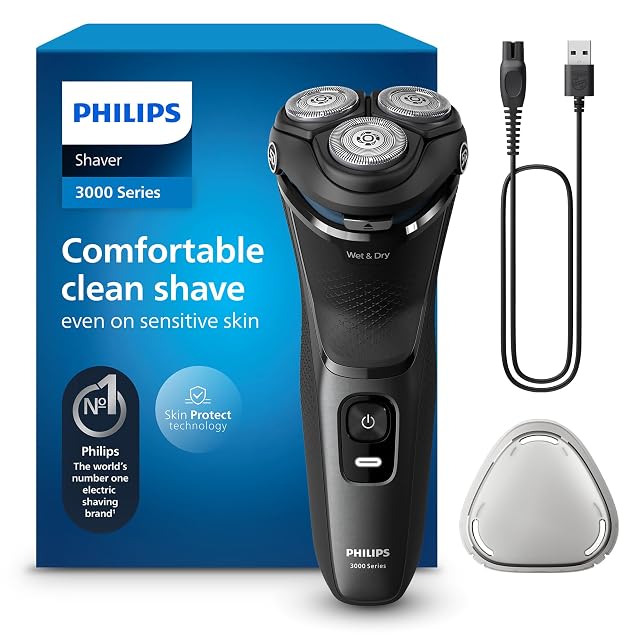
The Philips S3145 is first because it is the cheapest way into the family
and its head reference is unambiguous — the SH30 compatibility list names S3XXX
explicitly. Wet and dry, five-dimensional heads, pop-up trimmer.
When the battery figures matter
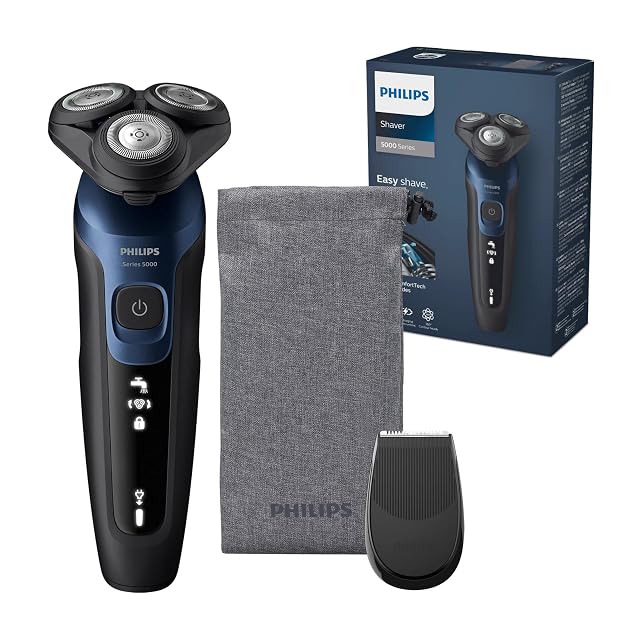
The Philips S5465 is the first in the range to publish its battery in full:
one hour to charge, fifty minutes of use, and a five-minute quick charge that
covers one shave. It also opens at the press of a button to rinse. Those two
things — a known battery and a head that rinses — are what the step up buys.
The top of the range
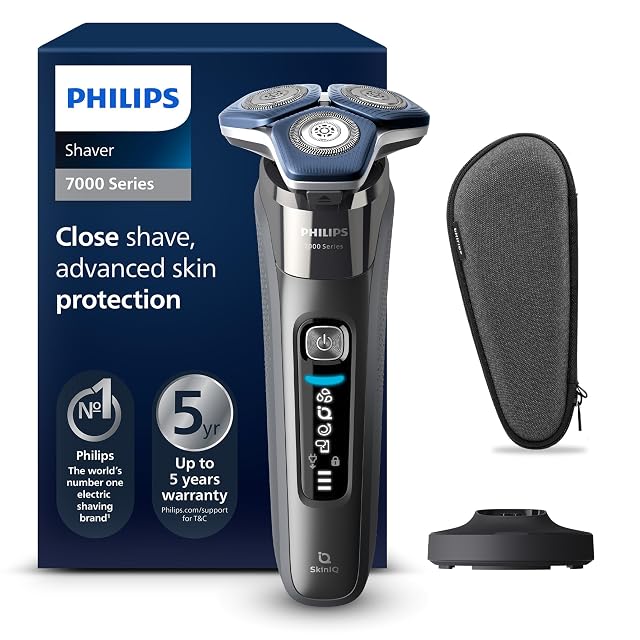
The Philips S7887 goes from 27 to 45 blades and from 55,000 to
90,000 cuts a minute, adds SkinIQ, a charging stand and a travel case, and carries a
five-year warranty. The blade life is still stated at two years, the same as on
the entry model, which is worth knowing before reading the price as a durability
figure. The S7887 / Panasonic ES-LV67 comparison
puts it against the best foil shaver on the site.
What we would not do
We would not buy an X-series shaver expecting the SH30 heads to fit it. Philips
gives the compatibility as S1XXX, S3XXX and S54XX, and the 3000X code matches
none of them.
Which clipper suits your cut?
Your hair grows in different directions
Rotary heads follow that better than a foil, which is their central advantage.
You want the closest possible shave
A foil shaver generally goes closer on flat areas, and that is the honest comparison.
You shave every two or three days
Rotary heads handle slightly longer growth better than foils do.
You shave in the shower
Check for a stated wet rating, not just a washable head.
Picking by the cut you want
Daily dry shaving
The commonest use, and where the format is comfortable and quick.
Following contours
Jaw, chin and neck. Independently floating heads are what make this the rotary's strength.
Shaving after a few days
Rotary heads cope better with longer growth than foils, which is a practical difference.
Head shaving
Many rotaries suit this well because the heads follow a curved surface.
The details that decide the result
How the heads float
Independent movement in several directions is what lets the shaver follow a jaw. It is the format's main argument and it varies between models.
Wet rating versus washable
A washable head can be rinsed under a tap; only an explicit wet rating means it can be used in the shower with foam.
Cleaning method
Rinse, brush or a cleaning station. A station is convenient and adds a recurring cost in cartridges.
Head replacement cost and availability
Rotary heads are consumables. A shaver whose heads are hard to find or expensive becomes disposable.
Battery and quick charge
A shaver that dies mid-face is a specific frustration. A useful quick-charge function matters more than total runtime.
Which figure for which hair
Your situation
Rotary
Foil
Hair growing in several directions
Better
Struggles
Very close shave on flat areas
Good
Generally closer
Two or three days of growth
Copes better
Prefers daily
Shaving the head
Well suited
Less suited
The mistakes we see
Pressing hard
Pressure does not shave closer; it irritates skin and can cause the heads to dig. Light circular movement is the technique.
Using straight strokes
A rotary works with small circles. Straight strokes leave patches, and it is the most common reason people conclude a rotary shaves badly.
Never replacing the heads
Cutters dull gradually and the shave gets less close while pulling more. This is usually blamed on the shaver rather than on the consumable.
Rinsing a head that is not washable
Water where it does not belong ends the tool. Washable and wet-rated are stated, not assumed.
By who is being groomed
The daily dry shave
A rotary with well-floating heads, cleaned regularly and with heads replaced on schedule.
The irregular shaver
Rotary handles a few days' growth better, which is a real advantage for anyone who shaves twice a week.
The one who shaves their head
The floating heads follow the curve, and that is exactly what this format does best.
Blades, oiling and working life
A rotary shaver collects hair and skin oil under its heads. Cleaning is what keeps it comfortable, and replacing the cutters on schedule is what keeps it shaving, because a dull cutter pulls before it stops cutting.
Clean under the heads regularly, following the method the model allows.
Keep each cutter with its own comb: they wear as pairs and swapping them degrades the shave.
Lubricate as instructed if the maker specifies it.
Replace the heads on the maker's schedule; they are consumables.
Safety
Blades under a comb, used on skin, sometimes near water.
Do not use a shaver with a cracked or damaged comb: it exposes the cutter to skin.
Only use in the shower if the model is explicitly rated for wet use.
Charge with the supplied adaptor and do not charge in a damp bathroom unless the model allows it.
Work around moles and skin blemishes rather than over them.
Prices quoted in this text were read on 2026-10-12. The live price is at the top of the page.
The entry Philips rotary: 27 self-sharpening blades cutting 55,000 times a minute, heads that move in five dimensions, SkinProtect, and stainless blades Philips states keep sharpening themselves for two years.
Best for: A first electric shaver, for a face shaved in the shower a few times a week.
Fully flexible heads that turn through 360 degrees, a click-on precision trimmer for mustache and sideburns, a head that opens for rinsing, and an hour's charge for fifty minutes of use.
Best for: Shaving every day or two, with the head rinsed rather than brushed.
Philips's top rotary in this group: 45 SteelPrecision blades cutting 90,000 times a minute, a micro-bead coating stated to add 30% glide, SkinIQ, a charging stand and travel case, and a five-year warranty.
Best for: Shaving daily, on a three-day beard, with the shaver living on a stand rather than in a drawer.
A rotary follows a jaw and copes with hair growing in several directions and with two-day stubble; a foil suits flat surfaces and a daily routine. They are two shapes of the same job, and both families are covered on this site.
What will it cost to keep running?
Philips states two years of self-sharpening blades on all three, and sells replacement heads at $29 for the Series 1000, 3000 and S54XX ranges and $34 for the Series 7000. Against the S5465 at $120 that is just under a quarter of the machine. Do that arithmetic before buying, not after — and check the code pattern rather than the range name, because the X3053 matches neither.
How should I move it?
In small circles, with light pressure. Straight strokes leave patches, and pressing harder irritates skin without shaving closer.
When do heads need replacing?
On the maker's schedule, or when the shave gets less close and the tool starts pulling. They are consumables and wear gradually.
Can I use it in the shower?
Only if it is explicitly rated for wet use. A washable head means it can be rinsed, which is not the same thing.
Why does it pull?
Usually worn cutters, or hair and oil packed under the heads. Cleaning first, then replacement, addresses almost every case.
Do I need a cleaning station?
It is convenient rather than necessary, and it introduces a recurring cost for cartridges. Manual cleaning is perfectly effective.
How long does a charge last?
It depends on the model and on the age of the battery, and no general figure is honest. In practice it matters more whether a short charge covers one shave.
Blades, combs and oil from the same aisle, at the price we recorded. Check they fit the clipper you pick before ordering: it depends on the blade mount and the part number, which the listing states.
Philips SH30/50 · Shaver heads — Three heads · ComfortCut · Series 1000, 3000 and S54XX · $29
Philips SH71/50 · Shaver heads — Three heads · 45 SteelPrecision blades · Series 7000 and S55XX · $34
Andis AN1COO0015-D-2 · Blade care — 5-in-1 blade spray · two cans, 15.5 oz / 458 ml each · coolant, disinfectant, lubricant, cleaner, rust preventative · $22
Andis 12241 · Blade care — Clipper oil · three 4 oz resealable bottles · colorless and odorless · for clippers, blades and shears · $14
ProCase PC-08364250 · Cases & storage — Hard EVA · movable dividers · mesh pockets · carabiner and hand strap · $18
ProCase PC-08364382 · Cases & storage — 20 × 12.5 × 5.5 cm (7.9 × 4.9 × 2.2 in) · hard EVA · mesh pocket · fits QP2824/31 and nine others
The clippers and shavers here come from the catalog of this site. Specifications are the published ones, from the maker and from the Amazon page; prices are the Keepa figure for the date below, and both change. Ranking rests on declared specifications, on stated strengths against stated limits, and on price. Nothing here has been used on hair by us, and the page does not suggest otherwise.
Last checked on
The tool we use ourselves
Chosen your tool? Now buy it at the right price.
Air stylers and cordless clippers swing widely across the year, and
the biggest "discounts" often land at prices the same model sold for six weeks earlier.
UniverTrack tracks the real price history across retailers, spots fake
reductions, and alerts you when it is genuinely the moment to buy.
Real price historyBuy-now alertsAI buying assistant