What the maker puts in writing
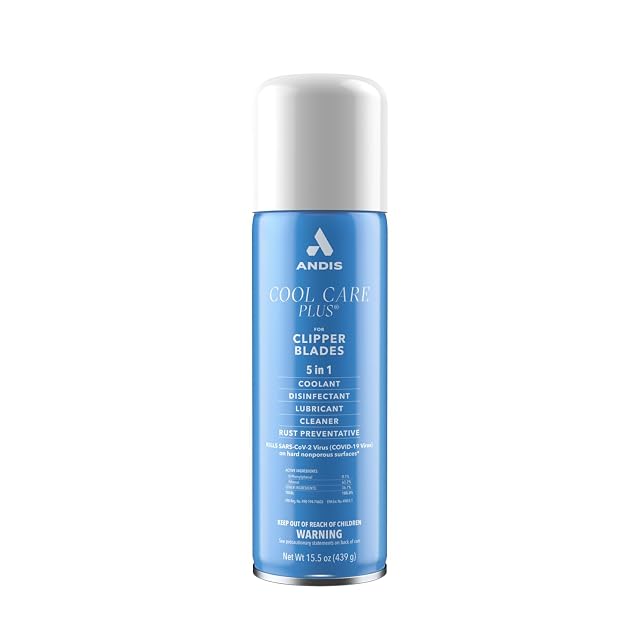
- “2 Pieces - 15.5 Ounce (458ml)”
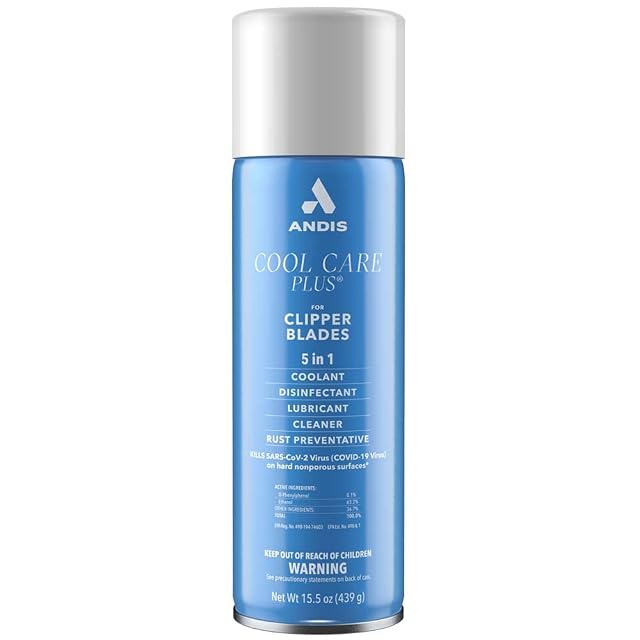
- “Five-in-One formula is a Coolant, Disinfectant, Lubricant, Cleaner and Rust Preventative”
- “Get Clean, Cool and Lubricated blades in one easy step without removing them from the clipper”
- “The disinfectant is a virucide, fungicide, batericide and tuberculocide”
- “Special SureGrip sculpted can is easy to hold”
- From the name: “Cool Care Plus For Blades”, “15.5 Ounce”, “Pack of 2”
- Reference AN1COO0015-D-2 · Catalog: 70 × 70 × 183 mm (2.76 × 2.76 × 7.20 in)
The cheapest rate on this shelf, and cheaper than the same can sold singly
The arithmetic.
This pack — “2 Pieces - 15.5 Ounce (458ml)”, so 31 oz for $21.45 — is $0.692 an ounce.
The Andis 12750 single can on this same shelf — 15.5 oz for $12.49 — is $0.806 an ounce.
Fourteen per cent less here.
And it is the cheapest rate on this shelf by any measure:
$0.69 — this
$0.81 — the Andis 12750 single can at $12.49
$0.88 — the Oster Blade Wash at $15.88, 18 oz, the largest single volume here
$1.13 — the Andis clipper oil at $13.50, three 4 oz bottles
Though an oil rate and a spray rate are not comparable. A can of spray is mostly solvent and propellant by volume; a bottle of oil is oil — so 12 oz of the latter outlasts 15.5 oz of the former, and the per-ounce figure compares like with like only within a form.
The formula here is the same as the single can’s, in the same five words.
This page: “Five-in-One formula is a Coolant, Disinfectant, Lubricant, Cleaner and Rust Preventative.”
The single can: “Blade coolant, disinfectant, lubricant, cleaner and rust pre-treatment.”
Two names for the fifth function, and neither page explains a difference — which suggests there is none.
What each listing has that the other does not.
This one publishes the disinfectant spectrum, the SureGrip can, and the metric volume, 458 ml
The single can publishes the nozzle, and it is the most practically useful sentence on the shelf: “The high-pressure, contoured nozzle even blasts stray hair out of teeth for a spotless finish, without having to detach the blade”
So read both listings as one page. The microbiology and the rate are here; the mechanical fact is there.
And the catalog weights are to be disregarded on both. This pack reads 430 g and the single can 31 g — and 458 ml of mostly-solvent liquid weighs over 400 g before you count the steel can and the propellant, so two of them cannot weigh 430 g together.
The volumes are the figures to trust: both pages publish 15.5 oz, and this one gives the milliliters.
“The disinfectant is a virucide, fungicide, batericide and tuberculocide.”
Taking them in order of how hard they are to achieve.
Bactericide — kills bacteria. The ordinary claim, and the easiest.
Fungicide — kills fungi, which matters on this tool more than it sounds: ringworm is a fungus and it moves between animals and people on grooming equipment.
Virucide — inactivates viruses, which is harder, because a virus is not alive in the way a bacterium is and the test is specific to named viruses.
Tuberculocide — kills mycobacteria, and this is the demanding one.
Mycobacterium tuberculosis has a waxy cell wall that shrugs off most disinfectants, which is why it is used as a benchmark: a product that is tuberculocidal is accepted as an intermediate-level disinfectant, which is the grade many jurisdictions require for tools that may contact broken skin.
So the four words are a real and substantial claim, and this is the only page on this shelf to make it.
The single Andis can at $12.49 claims only to be “obliterating potential germs” and lists a “disinfectant” among five functions with no spectrum at all.
The Oster Blade Wash at $15.88 makes no germ claim of any kind — which is arguably more honest than a vague one.
What is missing, and it is the whole of the usability.
The contact time.
Every one of those four claims comes from a test in which a surface is kept wet with the product for a stated number of minutes. A tuberculocidal claim in particular is typically a five- or ten-minute wet-contact claim.
And the companion listing’s own instruction is “a few quick sprays between each fresh cut”. A few quick sprays on a hot blade evaporate in seconds.
So the spectrum describes what the chemistry can do under test conditions, and the usage described on the sibling page is not those conditions.
Also absent: any active ingredient, and any EPA registration number — which is what a disinfectant claim rests on in the United States, and the document a professional would be asked for at an inspection.
None of the three chemical products on this shelf publishes either. Not this, not the single can at $12.49, not the Oster at $15.88.
The practical reading: treat this as a good cleaner with a credible disinfectant chemistry, and if a verified disinfected blade is what your work requires, ask for the registration and the dwell time before you rely on it.
Five functions, and the two that work against each other
“Five-in-One formula is a Coolant, Disinfectant, Lubricant, Cleaner and Rust Preventative”
The coolant is the one the aerosol form gives you for free, and it is real physics. A propellant expanding out of a nozzle absorbs heat — the same reason a deodorant can feels cold — so spraying a hot blade cools it immediately.
And a clipper blade does get hot. Two plates shearing at speed under spring pressure generate friction heat, which is why the coolant is first on the list — and why the Oster pour can at $15.88, being non-aerosol, cannot make the claim at all.
The cleaner is the solvent. The lubricant is an oil left behind once the solvent flashes off. The rust preventative is the same oil film, described by what it prevents — rust is water on steel, and an oiled surface has no water sitting on it.
Which is where the tension is, and no page on this shelf names it.
A cleaner and a lubricant work against each other. A solvent strong enough to carry packed hair and old oil out of the teeth carries away the fresh oil too — and the more you spray, the more you strip.
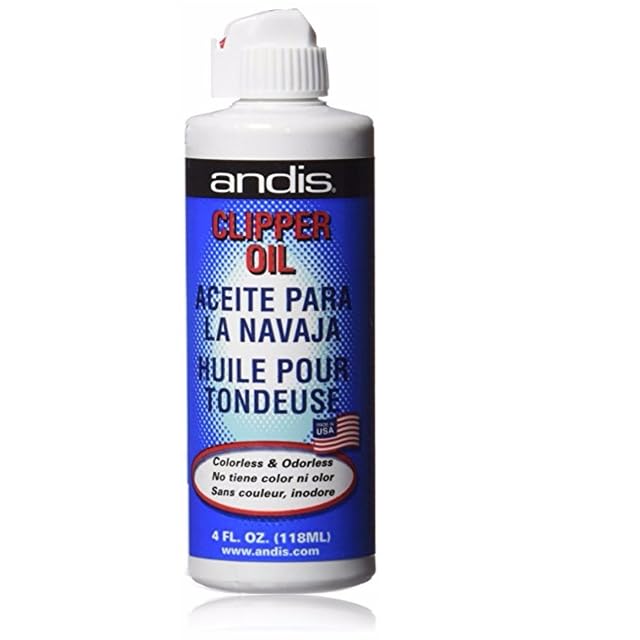
That is precisely why Andis also sells a separate oil, on this same shelf, at $13.50: “Prevents rust and corrosion on clipper and blades”, “Colorless and odorless”, “Great for shears”.
And why the professional order is wash, then oil — in that order, as two steps.
A five-in-one is a good single step and it is not two steps.
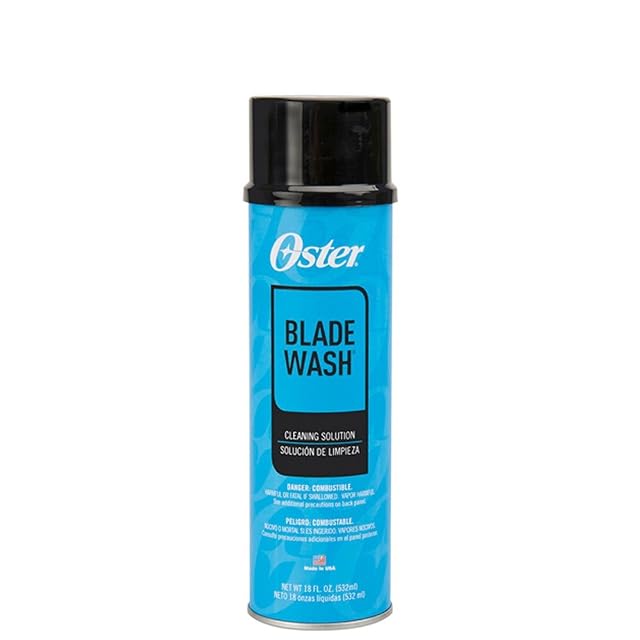
The one product here that claims both jobs in one liquid more plausibly is the Oster wash at $15.88: “Great for cleaning and lubricating clipper blades.” Which is a bath rather than a jet, and a blade lifted out of a dish comes out wetter than one that has been sprayed.
Two cans, which is a workflow rather than a discount
The rate is the headline and the count is the point.
One can at the station and one in reserve means the spray never runs out mid-cut — which is the condition under which blade care stops happening.
And the SureGrip can is the detail that goes with it. “Special SureGrip sculpted can is easy to hold.”
Which sounds like nothing and is not. An aerosol held in one hand while a running clipper is held in the other, repeatedly, through a working day, is a grip problem — and a smooth cylinder with wet or oily hands is the version of that problem nobody solves.
The single Andis can at $12.49 publishes no can shape; this one does.
What this listing does not publish is the nozzle, which is the other half of the same hand. The single can’s “high-pressure, contoured nozzle” that “blasts stray hair out of teeth” is the mechanical fact that makes the whole product work in place — and it is on the other listing.
Whether both cans have the same nozzle, neither page says. They are the same product by formula and by volume, so it would be surprising if they did not.
Without removing them from the clipper, and what that does not reach
“Get Clean, Cool and Lubricated blades in one easy step without removing them from the clipper”
Why no-disassembly is the point of an aerosol.
Taking a blade off means a screwdriver, a realignment when it goes back, and five minutes between two cuts. It is the step that makes blade care a chore, and the reason most people skip it entirely.
So a product that works in place is a product that gets used.
Three of the five liquids on this shelf are built around it. This one. The single Andis can at $12.49. And the Oster Blade Wash at $15.88 — “Wash while you clip” — which works by dipping the running blade into a dish so that its own motion pumps the liquid through the plates.
What none of them reaches.
The underside of the stationary plate, the spring that sets the shear tension, and the drive lug that takes the motion from the motor. Hair, skin and old oil collect there too, and a jet from the front does not get behind the plate.
And nothing on this shelf takes the opposite approach. No page here sells a spare blade, so the one workflow that does reach behind the plate — take the blade off, wash it, fit a second — is not an option this shelf offers.
Three blade heads in a box means one on the clipper and two washed, dried and waiting — a different workflow from spraying one blade all day.
The honest reading: this can keeps a blade running through a working day, and it does not replace taking the blade off occasionally.
And the one thing that will do more for a blade than any liquid is not on this shelf at all: cut a long or matted length down with scissors before the clipper goes near it. A blade forced through more hair than it can shear is being blunted and heated at once, and no amount of oil fixes an overloaded cut.
Which generalizes well past pets. A clipper shears; hair has to get into the teeth to be cut. A coat too long or dense to feed in packs against the face of the blade, the motor loads up, the interface heats, and the teeth fill — which is the exact condition every liquid on this shelf exists to clear.
Prevention is cheaper than five functions.
What is not published
No contact time, as above — the figure the spectrum needs.
No active ingredient, as above.
No EPA registration number, as above.
No nozzle description, as above — which its own single-can sibling publishes.
No dose. The single can at $12.49 manages “a few quick sprays between each fresh cut”, a rhythm without a quantity, and this page gives none at all. The only real quantity on this shelf is on an oil: the Wahl blade oil at $5.99 — “Apply two drops of oil on the left corner, two drops on the right corner, and a single drop in the middle of the blades every few haircuts”, which is the only quantity on this shelf.
No new-blade instruction. The Oster wash at $15.88 is the only page on this shelf to give one, twice: “Removes factory applied preservatives from new blades.” A new blade ships under a thick preservative grease that is tacky and holds hair, which is why a new blade often cuts worse than the old one it replaced — and wash before oil is the order. And it applies to any new blade, including the one already on your clipper when it was new.
No ventilation, flammability or eye statement. This is an aerosol solvent sprayed at a blade near a person’s head, repeatedly, through a day — and neither Andis page says anything about it.
No statement about ceramic or coated blades. A solvent chosen for steel-on-steel is not automatically right for a ceramic or titanium-coated cutter, and plenty of clippers now ship with one — which is exactly the case where a buyer would want to be told, and no page on this shelf tells them.
No credible weight, as above.
No warranty. Not at least one of the seven items on this shelf publishes one, which for a consumable is reasonable.
No country of manufacture, which no item on this shelf publishes.
Availability
Read on the day this page was built: $22 at the American Amazon shop.
Read from Keepa on the day this page was last revised; stock and price both move without notice.
Prices quoted in this text were read on 2026-10-05. The live price is at the top of the page.