What the maker puts in writing
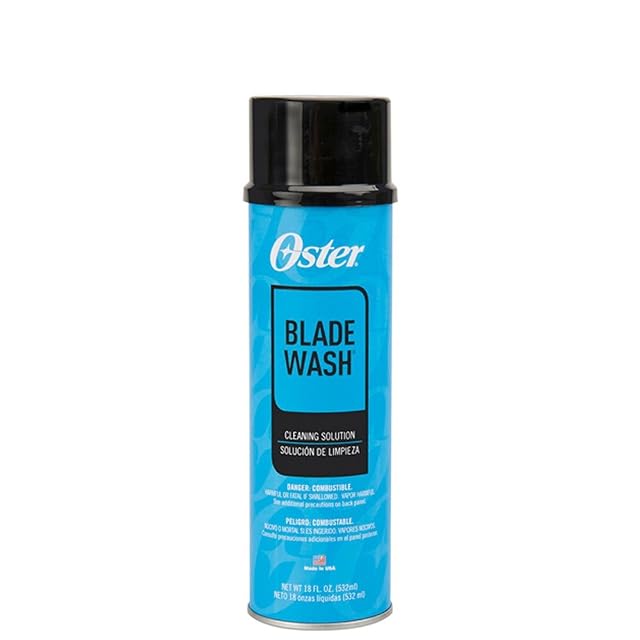
- “Great for cleaning and lubricating clipper blades as well as removing factory-applied preservatives”
- “Excellent for flushing hair accumulated between upper and lower cutting blades”
- “Removes factory applied preservatives from new blades”
- “Wash while you clip to help keep your clipper running perfectly”
- “Supplied as an 18 oz liquid pour can (non-aerosol)”
- From the name: “Blade Wash Cleaning Solution”, “18 oz”, “CL-76300103”
- Reference 76300-103-000 · Catalog: 526 g (18.6 oz), 53 × 76 × 230 mm (2.09 × 2.99 × 9.06 in)
Wash a new blade before you oil it, which only this page says
And it says it twice — in bullet one and again on its own in bullet three.
“Removes factory applied preservatives from new blades.”
What the coating is. A clipper blade is ground steel, and ground steel rusts in a warehouse, in a container and on a shelf. So it leaves the factory under a thick protective grease or wax, enough to survive months of storage and a sea crossing.
Why that is a problem rather than a head start.
The coating is a preservative, not a lubricant. It is thick where a clipper oil is thin, it is tacky where an oil is slippery — and a tacky film between two shearing plates holds hair rather than letting it pass.
Which produces the counter-intuitive thing every barber learns once: a new blade out of the wrapper cuts worse than the old one it replaced. It drags, it pulls, it heats.
And the usual conclusion is that the blade is faulty. It is not. It is dirty.
This applies to every new blade, including the one fitted to a clipper out of its box — which arrives under the same grease, and is the commonest case of all.
The correct order, which only this page half-gives and no page here gives in full: wash, then oil.
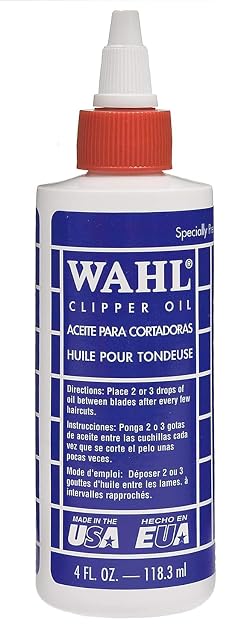
Wash the preservative off with this. Then oil, with something like the Andis clipper oil on this shelf at $13.50 — “Prevents rust and corrosion on clipper and blades”, “Colorless and odorless”.
And the reason the order cannot be reversed: oil on top of preservative is still preservative.
What neither Andis spray mentions is any of this. The 15.5 oz can at $12.49 and the pack of two at $21.45 both list a “cleaner” among five functions, and neither says a word about a new blade.
Eighteen ounces, poured rather than sprayed
“Supplied as an 18 oz liquid pour can (non-aerosol)”
What a pour can gives up, and it is two things.
The coolant. Both Andis Cool Care Plus aerosols on this shelf list a coolant first among five functions, and the aerosol form is why they can. A propellant expanding out of a nozzle absorbs heat — the same reason a deodorant can feels cold — so spraying a hot blade cools it immediately. A pour can cannot do that and does not claim to.
And the jet. The single Andis can at $12.49 publishes a “high-pressure, contoured nozzle” that “blasts stray hair out of teeth for a spotless finish, without having to detach the blade” — a mechanical advantage a poured liquid has no equivalent for.
What a pour can gives you instead, and this page states it twice.
A bath.
Bullet two: “Excellent for flushing hair accumulated between upper and lower cutting blades.”
Bullet four: “Wash while you clip to help keep your clipper running perfectly.”
The method behind those two sentences is the one every grooming shop uses. Pour an inch into a shallow dish, run the clipper, and dip the teeth of the running blade into the liquid.
The blade’s own motion pumps the liquid through the interface between the plates and carries the packed hair out with it. No jet reaches as thoroughly, because the blade is doing the work.
And a bath leaves more liquid behind than a spray does — which is why this is the only page on this shelf to claim cleaning and lubricating in one product: “Great for cleaning and lubricating clipper blades.”
A solvent that flashes off leaves a film. A liquid you dipped a blade into leaves a quantity.
The honest summary: the aerosol is for between clients, because it is quick and it cools. The bath is for the end of the day, because it flushes and it leaves something behind.
Neither replaces the other, and no page on this shelf says so.
The volumes and rates across this shelf:
18 oz — this, the largest volume here, at $0.88 an ounce
31 oz (2 × 15.5) — the Andis Cool Care Plus pack of two at $21.45, at $0.69 an ounce, the cheapest rate here
15.5 oz — the Andis Cool Care Plus single can at $12.49, at $0.81 an ounce
12 oz (3 × 4) — the Andis clipper oil at $13.50, at $1.13 an ounce
And the comparison to make carefully: a can of spray is mostly solvent and propellant by volume, and a bottle of oil is oil. Per-ounce rates compare like with like only within a form.
The catalog weight here, 526 g (18.6 oz), is the only one on this shelf that is consistent with its stated volume. 18 oz is about 532 ml, and 526 g (18.6 oz) for a can of that size is about right. Both Andis spray listings publish weights that are not: 31 g (1.1 oz) for a 15.5 oz can and 430 g (15.2 oz) for two of them, where 458 ml of liquid alone weighs over 400 g (14.1 oz).
Cleaning and lubricating in one liquid, which is a real claim here
“Great for cleaning and lubricating clipper blades”
Worth taking seriously on this product in a way it would not be on a spray, and the reason is the form.
A cleaner and a lubricant are in tension. A solvent strong enough to carry packed hair and old oil out of a blade’s teeth carries away fresh oil too — so the more you clean, the less lubricant is left.
On an aerosol that tension is sharp. The solvent flashes off fast, and what remains is a film rather than a quantity — which is precisely why Andis also sells a separate bottle of oil on this same shelf.
On a bath it is softer. A blade lifted out of a dish of liquid comes out wet, and what is left on it when the volatile part evaporates is more than a spray leaves.
Which makes the two-function claim plausible here and the professional sequence shorter: wash while you clip, and oil less often.
It does not make the oil unnecessary. A clipper blade is two plates shearing against each other thousands of times a minute under spring pressure, and that interface needs a quantity of oil, not a trace — and when it runs dry it gets hot, which is why the aerosols on this shelf claim a coolant at all.
A hot blade is usually a dry blade. Cooling it treats the symptom; oiling it treats the cause.
What this page does not give is the dose or the dwell time. “Wash while you clip” is a method and not a quantity, and nothing here says how deep to dip, for how long, or how often.
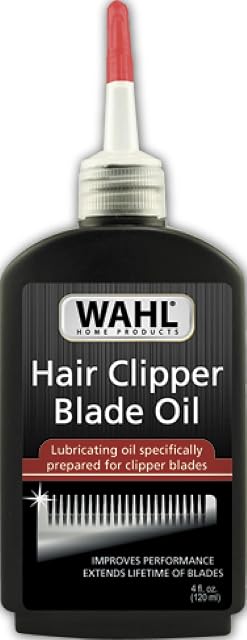
Which is the shelf’s common failing, with one exception. The Wahl blade oil at $5.99 is the exception — “Apply two drops of oil on the left corner, two drops on the right corner, and a single drop in the middle of the blades every few haircuts”, the only quantity on this shelf. Against that, the Andis can at $12.49 manages “a few quick sprays between each fresh cut”, a rhythm without a quantity; the Andis oil at $13.50 says nothing about how much. And no page here states a care rule as a rule — clean and dry after each use, which is the plainest instruction a blade ever needs.
No germ claim, which is cleaner than a vague one
The five bullets claim cleaning, lubricating, preservative removal, hair flushing, and washing while you clip. No germ claim of any kind.
Both Andis sprays on this shelf make one, to different depths.
The single 15.5 oz can at $12.49 claims it loosely — “a few quick sprays… while obliterating potential germs” — and lists a “disinfectant” among five functions with no spectrum at all.
The pack of two at $21.45 publishes the spectrum: “The disinfectant is a virucide, fungicide, batericide and tuberculocide.” Four claims, and the most specific microbiology anywhere on this shelf.
What is missing from both, and it is the figure that makes such a claim usable: the contact time.
The four words in that list come from test standards that specify minutes of wet contact — a tuberculocidal claim in particular is a demanding one, measured on a surface kept wet for a stated period. “A few quick sprays” is not that.
So a spray that claims the spectrum and omits the dwell time has given you the harder half of the claim and withheld the part that makes it work.
Neither Andis page publishes an active ingredient, and neither publishes an EPA registration number — which is the document a disinfectant claim rests on in the United States, and the thing a professional would be asked for at an inspection.
Against that, a wash that claims only to wash is doing something honest.
It cleans, and cleaning is not nothing: removing hair, skin and oil from a blade removes most of what would feed anything growing on it.
But it is not disinfection. And if a disinfected blade is what you need — between clients, in a licensed shop — this product does not claim to give it to you, and that is worth knowing before choosing it as your only blade liquid.
The practical reading of this shelf: the wash for cleaning, the aerosol for cooling and for whatever germ claim you are prepared to accept, and the oil for what both of them strip.
What is not published
No active ingredient. None of the three chemical products on this shelf names one: this, the Andis can at $12.49 and the Andis pack of two at $21.45.
No dose and no dwell time, as above — where the Wahl oil at $5.99 publishes a dose and nothing on this shelf publishes a dwell time.
No disinfectant claim, as above — which is an omission and arguably a virtue.
No coolant, as above, which follows from the form rather than being a fault.
No flammability or ventilation statement. A blade wash is a solvent, and a non-aerosol solvent in an 18 oz open can is poured into a dish and left in the air for a working day. Nothing here addresses fumes, skin contact or ignition — and neither Andis aerosol page does either.
No disposal guidance, on a liquid that ends a day full of hair clippings.
No statement about ceramic or coated blades. A solvent that suits steel-on-steel is not automatically right for a ceramic or titanium-coated cutter, and plenty of clippers now ship with one — which is exactly the case where a buyer would want to be told, and no page on this shelf tells them.
No statement about plastic parts. A clipper housing and its guide combs are plastic, and a bath that drips onto them is a question this page does not address.
No shelf life, on a product sold in an 18 oz can that most households will take years to finish.
No warranty. Not at least one of the seven items on this shelf publishes one, which for a consumable is reasonable.
No country of manufacture, which no item on this shelf publishes.
Availability
Read on the day this page was built: $16 at the American Amazon shop.
Read from Keepa on the day this page was last revised; stock and price both move without notice.
Prices quoted in this text were read on 2026-10-05. The live price is at the top of the page.