What the maker puts in writing
- “EVERYDAY PROFESSIONAL CAPE: This water and stain repellent, lightweight and breathable printed hairstyling cape is designed for professional use in a hair salon, barber shop or spa.”
- “LIGHTWEIGHT AND PROTECTIVE: The lightweight, breathable and soft polyester material can be conveniently machine washed and dried. The PFAS-free coating is plant-based and eco-friendly and repels water and other salon products as well as hair clippings to protect clothing during salon services.”
- “ADJUSTABLE CLOSURE: The durable metal snaps at the neck closure can be adjusted to many sizes from small to large making the cape suitable for most.”
- “AMPLE SIZE: The cape measures 44” wide and 58” and is suitable for most men and women.”
- “CARE INSTRUCTIONS: Machine wash cold, no bleach. Drip dry or tumble dry low. Do not iron.”
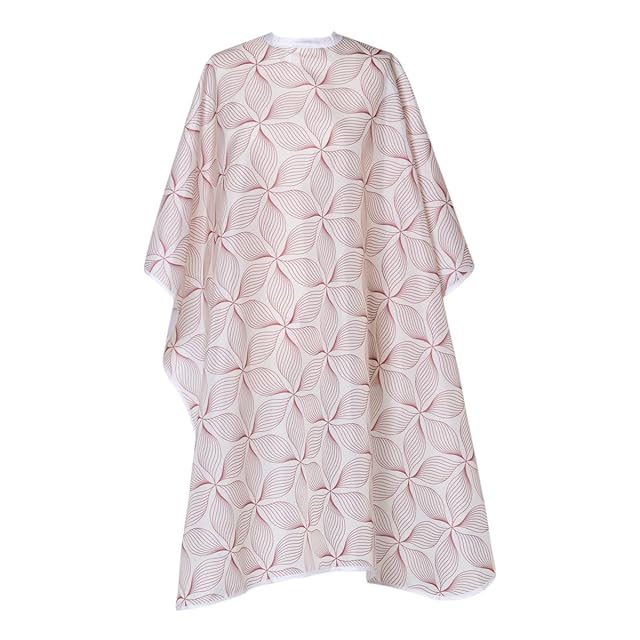
- From the name: “PFAS-free Water and Stain Repellent Coating”, “for Shampoo Bowl and Wet/Dry Cutting”, “Petals Pattern”
- Catalog: 264 × 119 × 30 mm (10.4 × 4.69 × 1.18 in) (the folded package)
A named finish, and the only one on this shelf
“The PFAS-free coating is plant-based and eco-friendly and repels water and other salon products as well as hair clippings to protect clothing during salon services.”
What PFAS are and why a cape would mention them.
Per- and polyfluoroalkyl substances are the chemistry that has made textiles water- and stain-repellent for decades — the same family as the non-stick coatings on cookware. They work extremely well and they do not break down, which is why they are being restricted.
A PFAS-free repellent is a substitute chemistry, and the common ones are silicone-based or wax-based — which this page describes as “plant-based”.
What the substitution costs, and the page’s own wording is honest about it.
A fluorinated finish repels water and oil. A silicone or wax finish repels water well and oil much less well.
Which is why this bullet says “repels water and other salon products as well as hair clippings” and never claims to be oil-repellent or stain-proof. The title says “Water and Stain Repellent”; the bullet carefully lists what it repels.
For a salon that is the right trade. The things that land on a cape are water, color, perm solution and clippings, and all of them are water-based or solid.
What the rest of the shelf claims.
nicoc, $9.85 — “high-quality waterproof fabric”, polyester taffeta, no coating named
omvoina, $4.99 — “Waterproof” in its title and in none of its five bullets, on 100% nylon
karlling, $6.59 — nothing about water at all, on a page that names “hair coloring prep”
So three capes claim or imply water resistance from the weave, and one names a finish.
The difference matters. A tight weave sheds a splash and wets through under a run of water. A coated fabric makes the water bead and run off.
Which is the whole reason this is the only cape on this shelf whose title names a shampoo bowl.
And the one thing the page does not say: a coating is a consumable. Every wash takes some of it, and nothing here says how many washes it survives, or whether it can be renewed. The test is simple and worth knowing: when water stops beading and starts soaking in, the finish has gone.
Do not iron it, which is the evidence that there is a finish
“CARE INSTRUCTIONS: Machine wash cold, no bleach. Drip dry or tumble dry low. Do not iron.”
Four rules, and every one of them points the same way.
Cold, not warm — heat softens a surface treatment and helps it wash off
No bleach — an oxidiser attacks both the finish and the printed pattern
Drip or tumble low — the dryer is the hottest thing a cape meets in normal life
And no iron — an iron is hotter still, and pressed directly onto the coated face
So the care rule is not fussiness. It is the maintenance schedule for a coating.
Compare the rest of the shelf, and the pattern is clean.
omvoina, $4.99 — “Wipe clean, machine-wash warm, or dry-clean”: the widest latitude here, including a solvent clean, which no coated fabric would tolerate. It has no coating, and that is why.
nicoc, $9.85 — “hand-washable”, paired with “wrinkle-resistant”, “not easy to deform” and “not easy to fade colors”: caution about shape and color rather than about a finish
karlling, $6.59 — no washing instruction at all; its answer is “Shakes off loose hair after use”
So the only cape here with a coating is the only cape here with a full rule and the only one that forbids an iron. That is a coherent page.
The practical consequence, which the page does not draw: this is a cape to wash and hang, not to wash and press.
“Do not iron” on a lightweight polyester means the creases from folding will stay until it is worn — and this page does not claim wrinkle resistance, where the nicoc at $9.85 does.
Which is a small cost against the benefit, and worth knowing before the cape comes out of a drawer in front of a client.
Forty-four by fifty-eight, which is the smallest cape here and the right shape for a bowl
“AMPLE SIZE: The cape measures 44” wide and 58” and is suitable for most men and women.”
Credit where it is due: it labels which figure is the width, which only one other page on this shelf does.
The four capes, by area:
nicoc, $9.85 — W59 × L67 in, about 3953 square inches, the largest here
omvoina, $4.99 — 57 × 51 in, about 2907
karlling, $6.59 — 59 × 45 in, about 2655
this, $26.49 — 44 × 58 in, about 2552, the smallest of the four
So the most expensive cape on this shelf is the smallest, by 1400 square inches against the largest.
Where the shortfall is: not the length. 58 inches is the second longest here, behind the nicoc’s 67.
It is the width. 44 inches against 57 and 59 on the other three — a difference of 13 to 15 inches, which is where a cape wraps round shoulders and meets at the back.
On a broad pair of shoulders, 44 inches is a cape that meets rather than overlaps.
Why that may be deliberate.
This is the only cape on this shelf sold for a shampoo bowl, and at a bowl the person is leaning back rather than sitting upright.
A long, narrow cape covers a reclined body down to the knees. A wide, short one bunches behind the shoulders against the bowl.
So the shape is the shape of the service — and the page names that service in its own title: “for Shampoo Bowl and Wet/Dry Cutting”.
It is also the only cape here described as “breathable”, and the word appears twice — which matters for a long wet service where a coated cape sits against a damp back. A coated fabric that does not breathe is a cape someone sweats under.
The claim to read carefully is “suitable for most men and women”. It is the same universality claim all four capes make and none of them measures.
this — “many sizes from small to large”
omvoina, $4.99 — “suitable for any size”
karlling, $6.59 — “all neck sizes from children to large-frame adults”
nicoc, $9.85 — “suitable for adults and children”
Four claims and not one circumference.
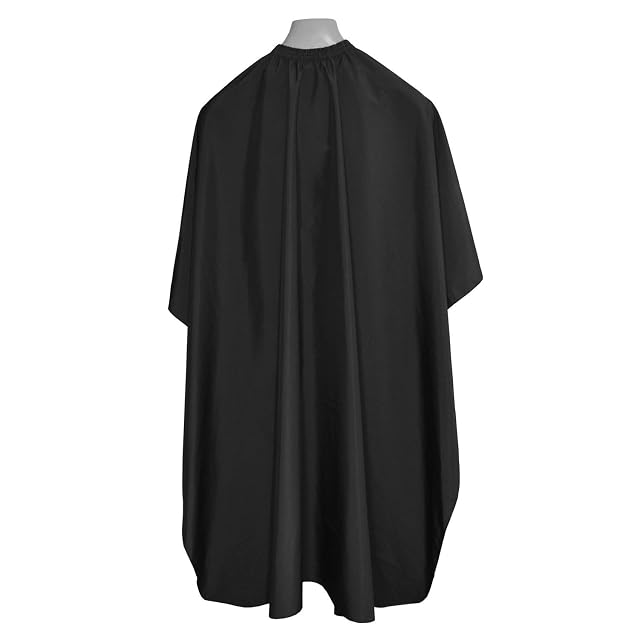
“The durable metal snaps at the neck closure can be adjusted to many sizes from small to large making the cape suitable for most.”
The neck is the whole product. A cape’s job is to stop hair getting inside a collar, and every failure a cape has is at the neck.
Four capes here, four mechanisms.
this, $26.49 — durable metal snaps, adjustable
omvoina, $4.99 — an adjustable snap closure, material unstated
karlling, $6.59 — hook-and-loop (“magic tape”), which adjusts continuously and collects hair in its hooks, a fault that page does not mention
nicoc, $9.85 — an “UPGRADED SILICONE SNAP BUTTON NECKLINE”: a silicone band that “hugs the neck effectively” plus a snap button, and “It’s not easy to get hair in clothes”
Why naming the metal matters more than it sounds.
A snap on a cape is fastened and unfastened thirty times a day in a salon. A plastic snap is the part that cracks, and once one snap of a set has gone the adjustment range goes with it.
Three of the four pages here leave the material unstated, and this is a professional cape sold for professional use — which is exactly the duty cycle that decides the question.
What metal snaps do not do, and the nicoc is the only page on this shelf with an answer: seal.
A snap pulls two pieces of a collar together at one point. Between the collar and the neck there is still a circular opening, and gravity puts cut hair straight into it.
A silicone band touches skin and follows its shape, closing the gap rather than tightening around it. This cape has the more durable fastening and the less complete seal.
For a wet service that may be the correct priority — a shampoo cape has to stop water, which runs down the outside, rather than stop clippings, which fall into the neck.
The only cape on this shelf designed for a wet service
“for Shampoo Bowl and Wet/Dry Cutting” is in the product name, and nothing else here claims it.
Why a shampoo bowl is the hardest case a cape faces.
Water running off a head does not splash. It runs — continuously, down the back of the neck and the shoulders, for several minutes, under pressure from a spray.
A tight weave sheds a splash and gives way under a run. A repellent finish makes the water bead and travel off the fabric instead of through it.
Which is why the coating and the service appear on the same page, and why the three uncoated capes here name only dry and damp work.
omvoina, $4.99 — “hairdressing, hair dye, perm and more”
nicoc, $9.85 — “haircutting, perming and coloring… isolate the damage of hair flakes and chemicals”
karlling, $6.59 — “haircutting, beard trims, styling… and hair coloring prep when the cape is used correctly”
That last qualifier is the only hedge of its kind on this shelf, and it is on the cape with no water claim at all.
“Wet/Dry Cutting” is the other half of this title and it is the broader claim. A wet cut puts a soaked head over a lap for twenty minutes — less violent than a bowl rinse and longer, which is the case a breathable coated fabric is best at.
And “spa” in bullet one widens it again: oils and treatment products rather than hair. Which is where the limit of a PFAS-free finish sits, as above — it repels water far better than it repels oil, and the bullet never claims otherwise.
What is not published
No weight. Two capes on this shelf publish one — 120 g for the karlling at $6.59 and 200 g for the omvoina at $4.99 — and this page claims “lightweight” three times without a figure.
No fabric weight. A textile has one real specification, its weight in grams per square meter, and it decides drape, opacity and durability together. None of the four capes here publishes one.
No coating life. A repellent finish is a consumable and this page gives no number of washes, no reproofing method and no test — on the one cape here whose whole argument is its finish, at the highest price on the shelf.
No neck circumference, as above.
No snap count. The adjustment range is “many sizes from small to large” and the number of positions is unstated.
No static statement. Polyester builds a charge as hair slides across it, and a charged cape attracts the clippings it is meant to shed — which is the real reason hair clings and transfers to clothing. Not one of the four capes here addresses it, and the karlling at $6.59 is the only page on this shelf to claim the benefit at all: “Shakes off loose hair after use.”
No wrinkle claim, which matters because the page forbids an iron. The nicoc at $9.85 claims “wrinkle-resistant” and allows only a hand wash.
No antimicrobial or disinfection claim. Worth noticing on a garment worn by one stranger after another in a professional setting. The only disinfection anywhere on this shelf is on a mat: the Barber Strong at $35, “wiped down with a wet cloth or disinfectant wipe”.
No pattern range beyond “Petals”.
No warranty. Not at least one of the eight items on this shelf publishes one.
No country of manufacture, which no item on this shelf publishes.
Availability
Read on the day this page was built: $26 at the American Amazon shop.
Read from Keepa on the day this page was last revised; stock and price both move without notice.
Prices quoted in this text were read on 2026-10-05. The live price is at the top of the page.