What the maker puts in writing
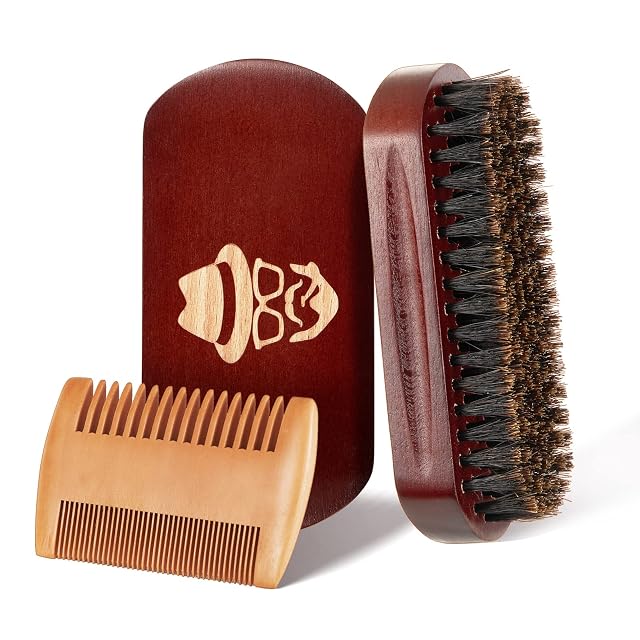
- “High-grade and firm boar bristle hair allows this brush to smooth out tangles.”
- “Massage the skin beneath your beard, enjoy a shaving or combing time.”
- “An excellent helper for daily facial hair care, quick wet and fast dry.”
- “Give you comfortable touch feeling, no bits of wood hurting your hands.”
- “Trusted brand and quality, durable, can be used for a long time.”
- From the name: “Beard Brush”, “100% Boar Bristle”, “Natural Black Walnut Wood Beard Comb”, “Hair Mustache Shaving Brush”, “Facial Hair Brush”
This shelf is small and it does not overlap, which makes the choice easy once the jobs are named.
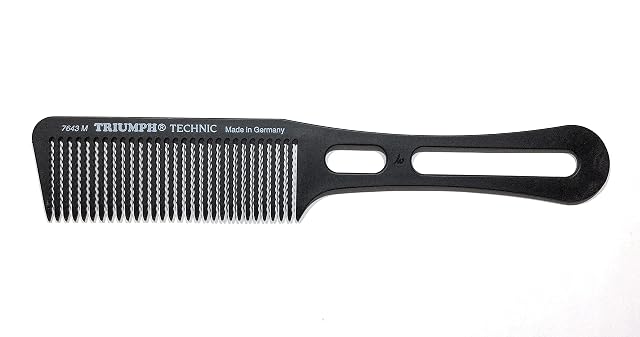
The Hercules Sägemann 7643M at $30 is a cutting comb: 8.5 inches, wavy teeth, a handle, and a centimeter scale printed on the back so a length can be read off the comb while you work against a clipper.
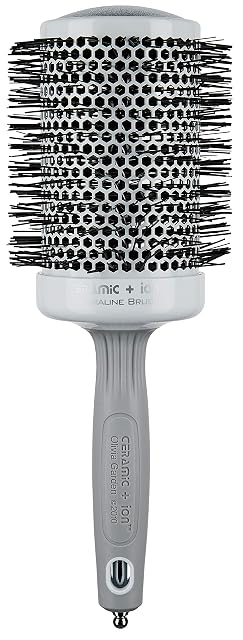
The Olivia Garden Mega Ceramic + Ion 65 is a styling brush: a 65 mm ceramic barrel, 85 mm with the bristles, vented so dryer air passes through to the hair, on antistatic ionized nylon.
This is the maintenance tool, and the only one here for facial hair. It is not used to cut and it is not used under a dryer. It is drawn through a beard, daily, to lay the hair down and move oil along it.
Which is why the bristle is different from the other brush on the shelf. Nylon charges hair and makes it stand apart, so Olivia Garden treats its bristle — “antistatic ionized nylon”. Keratin against keratin does not charge in the first place, so this brush has nothing to treat. Two routes to the same end, and the one that costs $8.99 rather than a price the other page does not publish.
The trade runs the other way on heat. Nylon on a ceramic barrel is built to be blasted with a dryer. Boar on walnut is not, and nothing here says otherwise.
“High-grade and firm boar bristle hair allows this brush to smooth out tangles.”
Stiffness is the one property that decides whether a beard brush works, and this page describes it in two adjectives.
A beard is dense and the hair is coarse — facial hair is thicker in cross-section than scalp hair. A soft brush slides over the surface and does nothing. A brush stiff enough to part the beard reaches the skin, which is where the work is.
And boar is chosen because it is naturally stiff. A boar bristle is tapered, slightly barbed along its length and ends in a split tip, which is why it grips and distributes rather than merely sweeping.
What this page does not publish:
- No bristle length, which with stiffness decides how deep it reaches
- No density or tuft count, which decides how much of the beard it engages per stroke
- No pad size, so whether this is a palm brush for a short beard or a long-handled one for a full one is unstated
- And no dimensions or weight at all
That last one is worth stating plainly, because of the company it keeps. The other two tools on this shelf are defined by their measurements: 8.5 inches and a centimeter scale on one, 65 mm (2.56 in) and 85 mm (3.35 in) on the other. This is the only item here that publishes no measurement of any kind.
“High-grade” is a grade claim without a grade. Boar bristle is graded in the trade, by stiffness and by the proportion of first-cut bristle, and no figure appears here.
Massaging the skin beneath, which is the half people skip
“Massage the skin beneath your beard, enjoy a shaving or combing time.” — “An excellent helper for daily facial hair care, quick wet and fast dry.”
What accumulates under a beard: shed skin, sebum, and the residue of whatever is put on the hair — balm, oil, soap.
A beard is a dense mat over skin that is never exposed to air or rubbed by a towel the way a scalp is, which is why beard itch and flaking are the standard complaints.
A stiff bristle reaches the skin through the hair and lifts that debris to the surface, where it can be washed or brushed away. That is the whole mechanism, and it is the reason to brush a beard that does not look untidy.
“Quick wet and fast dry” is the practical companion claim, and it matters more than it sounds. A brush used on a wet beard, in a bathroom, every morning, is a brush that never gets a chance to dry if the wood holds water.
Which is what the walnut is for.
Walnut, and the splinter the bullet is answering
“Give you comfortable touch feeling, no bits of wood hurting your hands.”
A cheap wooden brush is cut, drilled and sold without the edges being properly rounded or sealed — and the result is a splinter in the palm, or a raised grain that catches. On a brush held in a wet hand, every day, that is not a cosmetic complaint.
So the bullet is a claim about finishing rather than about the species: the edges have been rounded and the surface smoothed.
Why walnut suits the job:
- It is dense and hard, so it does not dent in a dropped-on-tile life
- It is dimensionally stable, which matters because a brush body that swells and shrinks with repeated wetting loosens the bristle tufts set into it — and loose tufts are how a natural-bristle brush dies
- It has a closed, even grain, which is what allows it to be finished smooth enough for the claim above
What is missing is the drying half. This page claims fast drying and publishes nothing about how the brush drains or hangs — no air hole, no loop, no hanging arrangement of any kind.
The habit no page here gives: shake it out bristles-down and let it dry before it goes in a drawer. Wood and keratin both mind being put away wet.
The comb in the title that the bullets never mention
The product name reads “Beard Brush, 100% Boar Bristle Natural Black Walnut Wood Beard Comb Hair Mustache Shaving Brush Facial Hair Brush”.
Five bullets follow and not one of them mentions a comb. Which leaves the contents genuinely unclear: whether this is a brush whose title lists search terms, or a brush and a comb together.
The reading that fits the bullets is the first. Every one of the five describes bristle, wood, massage or touch — and a comb has none of those.
It matters because a brush and a comb do different things to a beard, and a beard wants both. The brush lays the hair down, distributes oil and lifts debris, as above. A comb parts it, sets a line, and finds a tangle the brush passed over.
And the shelf shows what a page looks like when it settles the question. The Hercules Sägemann at $30 publishes its length, its tooth shape, its material, its country of manufacture and a centimeter scale on its back. This one publishes a title.
If the comb matters to you, buy on a page that lists it.
What is not published
No comb detail, as above.
No dimensions and no weight — the only tool on this shelf with neither, and the other two are sold on their measurements.
No bristle length, density, tuft count or grade, on a page whose first word about the bristle is “high-grade”.
No pad size or brush shape. Palm brush or handled brush is the first thing a buyer needs to know, and the title offers both readings.
No cleaning method. And a natural-bristle brush needs one more than a comb does: hair, skin and balm collect at the base of the tufts, where a rinse does not reach and where soaking is the thing that loosens the glue holding them.
No hanging or drying arrangement, as above — on the one page here that claims fast drying.
No wood finish or sealant named. “No bits of wood hurting your hands” is the outcome; what produces it is unstated, and an unsealed wood in a wet bathroom is the thing that raises grain over a year.
No warranty. Bullet five is the closest this page comes: “Trusted brand and quality, durable, can be used for a long time.”
No country of manufacture. The Hercules comb publishes one — “Made in Germany” — and this page does not.
Availability
Read on the day this page was built: $9 at the American Amazon shop. Only the United States market was checked for this reference.
Read from Keepa on the day this page was last revised; stock and price both move without notice.
Prices quoted in this text were read on 2026-10-09. The live price is at the top of the page.