What the maker puts in writing
- “28 Teeth Thinning Scissors - Sharp and no hair caught between the blades (Thinning rate of 25-28%)”
- “Upgrade Larger Finger Holes - From Traditional 0.69-0.85 Inch to Upgraded 0.77-0.95 Inch based on customer recommendations”
- “Offset Handle Design - Very ergonomic & reduces fatigue”
- “High Rebound Muffler Design - Reduce the metallic noise and friction”
- “Adjustable Screw Design - Adjust the tightness of the hair scissors according to personal feeling”
- “made of 6CR stainless steel”, “All steel manufacturing - Lasting quality”, “hand-polished, the blade line is even and smooth”
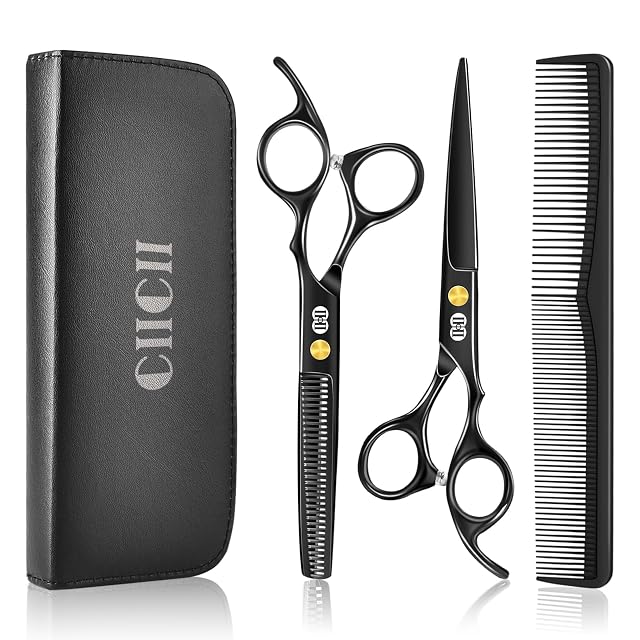
- Contents: “1 × Hair Cutting Shears, 1 × Hair Thinning Scissors, 1 × Hair Cutter Comb, 2 × Hair Clips, 1 × Gift Leather Bag, 1 × Cleaning Cloth, 1 × Scissors Adjuster”
- “90-DAYS Unconditional Return + 12-MONTH QUALITY PROMISE”, with support stated to “help you in 12 hours”
- 6.7 in · Reference C1314 · Catalog: 215 × 90 × 3 mm (8.46 × 3.54 × 0.12 in)
Twenty-eight teeth at twenty-five to twenty-eight per cent
“28 Teeth Thinning Scissors - Sharp and no hair caught between the blades (Thinning rate of 25-28%)”
These are the two numbers that define a thinning shear, and this is the only page on this site to publish either.
What a thinning shear does.
One blade carries teeth, so each closing cuts only the hair that falls between the teeth and leaves the rest standing. That is why it removes weight without leaving a line.
What the tooth count sets: how finely the removal is spread.
Few teeth, widely spaced, takes hair out in visible chunks — a de-bulking tool, used deep in the hair where the cut cannot be seen.
Many teeth, closely spaced, spreads the removal so finely that the cut disappears into the section — texturizing rather than thinning, usable much closer to the ends.
28 is in the upper range for a general-purpose shear, which makes this a blending tool rather than a bulk remover.
What the rate sets: how much one pass takes.
25 to 28 per cent is moderate. It softens a line and takes weight out gradually, so a mistake is recoverable — which is the right choice for a home kit and the honest reading of why the figure is where it is.
A 40 or 50 per cent shear takes half the section in one closing: fast, and unforgiving.
Why both figures are needed together.
A high tooth count with a high rate is a different tool from a high tooth count with a low one. The first removes a lot in a well-hidden way; the second removes a little. One number alone tells you almost nothing — which is why publishing both is the substantive thing this page does.
And the claim that comes with them is the right one to make.
“No hair caught between the blades” names the actual failure of a cheap thinning shear: hair jams in the gullets between the teeth and the shear has to be worked loose mid-cut, which is a function of how cleanly the teeth are cut and finished.
How rare this is.
The only other item on this shelf with a thinning shear is the AULikY 15-piece kit at $13.99, which claims “Thinning Scissors” in its title and publishes no bullets at all — no count, no rate, and no contents list of any kind.
And the gap runs through the rest of the site. None of the nine items on GroomVerdict’s combs-and-brushes shelf publishes a tooth pitch. None of the five on clipper-blades publishes a tooth count.
Twenty-eight is the only one.
Finger holes, measured to a hundredth of an inch
“Upgrade Larger Finger Holes - From Traditional 0.69-0.85 Inch to Upgraded 0.77-0.95 Inch based on customer recommendations”
Two ranges, to a hundredth of an inch, with the old figures given as well as the new — which is unusual enough to say out loud: most pages do not tell you what they changed from.
Why ring size matters.
A scissor is controlled by two contact points, and if either is loose the tool pivots on the finger instead of with it. That is felt as imprecision and is actually fit — the hand compensates by gripping, which is how a ten-minute cut becomes an aching hand.
A ring too small is worse. The finger cannot seat, the joint takes the load on its side, and the thumb cannot move independently — which breaks the whole scissor action, where the top blade should stay still and only the thumb should move.
What the upgrade amounts to.
About two hundredths of an inch at the small end and a tenth at the large end — half a millimeter to two and a half millimeters.
Which sounds trivial and is not, because a finger is not compressible: a ring either admits the knuckle or it does not.
And the direction tells you who complained. Larger, “based on customer recommendations”, means the original was too small for a meaningful number of buyers — and hairdressing tools are commonly sized for smaller hands, so a kit sold for home use was always going to meet hands the trade does not.
The shelf addresses the same problem from the opposite direction.
Utopia Care, $8.99 — “Non-slip handles with removable rubber band”: an insert that makes a ring smaller for a smaller hand, and removable so the same pair fits a larger one.
Between the two pages the problem is described completely, and neither mentions the other half.
What the rest of the shelf offers instead.
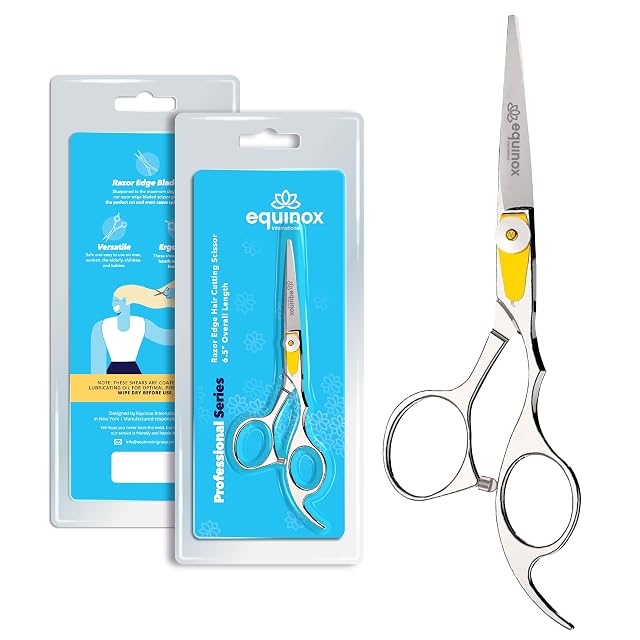
Equinox, $8.90 — “a curved finger rest and comfortable finger holes”
LePinko, $6.99 — “large finger loops”
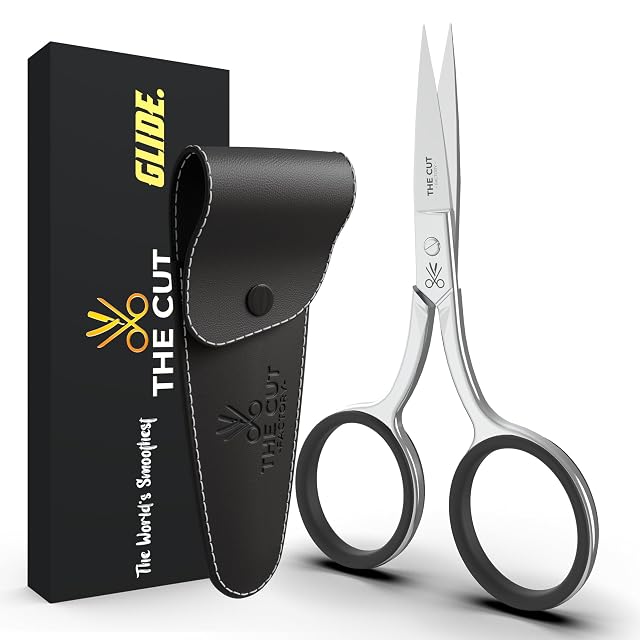
Cut Factory B013, $9.99 — a finish “designed to reduce hand fatigue”
Cut Factory 803, $9.99 — an “ergonomic grip”
Adjectives, against two measured ranges.
The offset handle, and the muffler
“Offset Handle Design - Very ergonomic & reduces fatigue”
This is the one genuine ergonomic distinction on this shelf, and only this page has it.
On a symmetrical scissor the two rings sit level, so the hand must rise to keep the blades horizontal — which lifts the elbow and cocks the wrist.
On an offset handle the thumb ring sits forward of the finger ring, so the hand can hang lower and flatter while the blades stay level. That is the standard professional geometry, and it is the reason a stylist’s shoulder and wrist survive a day.
For a home user cutting for ten minutes the benefit is smaller, and it is still the right geometry rather than a worse one.
“High Rebound Muffler Design - Reduce the metallic noise and friction”
A muffler is the small bumper at the pivot that the blades strike when they close.
It stops metal hitting metal at the end of every stroke — which is where the noise comes from, and where a blade gets knocked out of true.
So it protects the same thing the tension screw adjusts: the alignment of the two edges.
On a kit with a thinning shear that matters twice, because a toothed blade struck repeatedly out of alignment is a blade that starts catching hair — the exact failure the 28-teeth bullet promises to avoid.
“High rebound” describes the bumper material: a harder, more elastic rubber that returns rather than compressing flat, which is what stops a muffler going dead after a few months.
No other page on this shelf mentions a muffler at all.
The adjustable screw, and the key for it
“Adjustable Screw Design - Adjust the tightness of the hair scissors according to personal feeling”, and in the contents, “1 × Scissors Adjuster”
What the tension screw does.
Two scissor blades do not meet along their whole length. They bear on each other at one moving point, and the screw sets how hard.
Too loose and the blades separate under load: the hair slides into the gap and folds instead of being cut. That is the commonest fault in a worn pair, it feels exactly like bluntness, and it is not — a pair that folds hair is usually perfectly sharp.
Too tight and the action is heavy, the hand tires, and the edges wear against each other rather than against hair.
And the tension drifts, because every closing works the pivot a little.
Which makes this a durability feature rather than a convenience: a pair with no adjustable screw is a pair that will eventually fold hair and cannot be brought back.
Why the key matters and not just the screw.
A scissor tension screw is usually a flat disc or a slotted collar rather than a cross-head, and it cannot be turned properly with a fingernail or a coin without marking it.
The Equinox at $8.90 has “Fine Adjustment Tension Screw” in its own product title and ships no key.
This page ships both — and that is the one place a six-dollar difference buys something concrete rather than another adjective.
At least five of the nine items on this shelf publish no screw at all: the LePinko pair at $6.99, the Utopia Care at $8.99, both Cut Factory pages at $9.99 and the AULikY kit at $13.99.
How to set it, which no page on this shelf gives. Hold the scissors closed, lift the top blade to vertical, and let go. It should fall about two-thirds of the way shut and stop. Falling all the way is too loose; stopping near the top is too tight.
Eight pieces, every one of them named
“1 × Hair Cutting Shears, 1 × Hair Thinning Scissors, 1 × Hair Cutter Comb, 2 × Hair Clips, 1 × Gift Leather Bag, 1 × Cleaning Cloth, 1 × Scissors Adjuster”
Eight items, counted, and three of them are tools rather than padding: the shear, the thinning shear, and the adjuster key for its own screw.
Which is how a set should be published — and the comparison on this shelf is stark.
The AULikY kit at $13.99 claims “15 Pcs” in its title and names none of them. No contents, no measurements, no bullets at all.
And one page here argues against sets as a class. The Cut Factory 803 at $9.99: “Why settle for a cheap pack of 2 or 3? We deliver one scissor that outperforms them all”, “Others throw in extras to hide poor quality”, “No junk. No fillers. Just one damn good scissor.”
That argument lands on the fifteen-piece kit and misses this one, because the test it proposes is whether the extras are padding — and three tools, two clips and three accessories is not padding.
The cutter comb is the piece worth noticing.
A cutting comb is not a styling comb: it has a fine half and a coarse half, and it is what a section is held against while the blade is swept along it — which is the technique the whole 6.5-to-6.7-inch class of shear exists for.
And the cleaning cloth is the only one on this shelf, which matters because this is also the shelf with no care instruction on six of its seven pages.
$19.98 for eight pieces is about $2.50 each. Against $13.99 for fifteen unnamed pieces at 93 cents each — which is exactly the kind of comparison that favors the cheaper set until you ask what the pieces are.
6CR stainless, hand-polished
“made of 6CR stainless steel”, “All steel manufacturing - Lasting quality”, “hand-polished, the blade line is even and smooth”
6CR is a real designation, and this is the only real one on this shelf.
It is a mid-range martensitic stainless of the 6Cr13 family: enough carbon to be hardened to a working scissor edge, enough chromium to resist a bathroom. Which is the standard choice for shears at this money, and naming it is more than most pages manage.
What the rest of the shelf says.
Equinox, $8.90 — “the finest Japanese stainless steel”, “precisely tempered blades”. An origin rather than a designation, but tempering is a real process: it is the heat treatment that draws hardness back out in exchange for toughness, so the edge holds without chipping.
Cut Factory B013, $9.99 — “Premium High-Carbon Steel” under a “rust-resistant matte black finish”. The old trade resolved by a coating: carbon takes a finer, harder edge and rusts, so it is painted.
And five pages — “stainless steel” with an adjective in front
“All steel manufacturing” is the second claim, and it is about the handles rather than the blades.
A plastic-handled shear has its rings molded on, which is cheaper and is also where a cheap shear breaks — the joint between plastic and steel. An all-steel body has no such joint.
“Hand-polished, the blade line is even and smooth” is a finish claim and a process claim at once.
The blade line is where the two edges meet along their length, and “even” is the thing that matters: an uneven line is a shear that cuts at the base and not at the tip, or the reverse. Polishing by hand is how that line is corrected after grinding.
What is not here is the edge geometry. “Hand-polished” and “even and smooth” describe the finish, not the bevel — and on this shelf three pages do name a type: the Cut Factory B013 at $9.99 is “micro-serrated” and argues for it (“Why Serrated Beats Razor Edge… foolproof and safe for beginners”), while the Equinox at $8.90 and the Utopia Care at $8.99 name a razor edge.
No hardness figure appears anywhere on this shelf, and hardness is the number that would settle every one of those arguments.
The only warranty in this corner of the site
“90-DAYS Unconditional Return + 12-MONTH QUALITY PROMISE”, with support stated to “help you in 12 hours”
Three separate commitments, which is more than any other item on this shelf publishes — and the other seven publish nothing at all.
The 90-day unconditional return is the strongest of the three, because “unconditional” removes the argument. Most of the value in a return window is not the length; it is whether you have to justify yourself.
The 12-month quality promise is the longer-tail one, and worth reading for what it does not say: “quality promise” is not a defined warranty term, so what it covers is whatever the seller decides. It is still a stated commitment where nothing else here has one.
The 12-hour support claim is the softest — a response time rather than a remedy — and it is the kind of promise a listing makes and a buyer only tests once.
How this sits against the rest of the site.
Across GroomVerdict, published terms are the exception: a lifetime guarantee on one comb, 365 days on one brush, 30 days on one clipper blade, two years on one air styler — and nothing at all on capes-and-mats, blade-care, dryer-attachments or curling-tools.
So this is the richest term on this shelf and one of the better ones on this site, on the most expensive item here.
What is not published
No blade length. The page gives 6.7 inches overall, and the eight-dollar Equinox gives both: “6.5 inches in overall length with 2.55-inch blades”. That blade figure is what decides how wide a section one closing can take, and it is the distinction buyers get wrong — a 6.5-inch scissor is four inches of handle. On a kit with two different shears the omission is doubled, because the cutting shear and the thinning shear are not necessarily the same length.
No edge type, as above.
No hardness, as above.
No weight. Five items on this shelf publish one, from 30 g for the Cut Factory 803 at $9.99 to 141 g for the Utopia Care at $8.99 — and two of them draw opposite conclusions from the property: the Equinox selling its lightness (“just 3.5 ounces… a breeze”) and the Utopia Care selling its weight (“the ideal weight… perfect balance and stability”). On an eight-piece kit there would be two figures to give, and there are none.
No care instruction, which is striking on the one page that ships a cleaning cloth. One cheaper rival gives the first half. The Equinox at $8.90 on a new pair: they arrive “vacuum-sealed in protective plastic and coated with lubricating oil”, so “wash them with gentle soap and lukewarm water, then dry with a soft cloth” — that film is a preservative rather than a lubricant, and left on it makes hair stick to the blade, so a new pair cuts worse than an old one. And no page on this shelf addresses an old pair at all.
No oiling instruction, which no page on this shelf gives and which this one needs most, because it is the only page that tells you the pivot is adjustable. A screw you are invited to turn is a screw that wants oil under it. The dose is published elsewhere on this site, written for a clipper blade: the Wahl blade oil at $5.99 on the blade-care shelf — “two drops on the left corner, two drops on the right corner, and a single drop in the middle, every few haircuts.” A scissor pivot wants one drop.
No left-handed option, which no page on this shelf mentions and which matters more on scissors than on anything else on this site: a right-handed pair used in a left hand pushes the blades apart rather than together, which is the folding fault described above — and no amount of screw adjustment fixes it.
No tip geometry, which matters little on a cutting shear and is published by one page here for the tool where it counts: the LePinko pair at $6.99 (“rounded precision blade tip curves away from skin” and “extra sharp pointed tips”).
No country of manufacture, which no item on this shelf publishes.
Availability
Read on the day this page was built: $20 at the American Amazon shop.
Read from Keepa on the day this page was last revised; stock and price both move without notice.
Prices quoted in this text were read on 2026-10-05. The live price is at the top of the page.