What the maker puts in writing
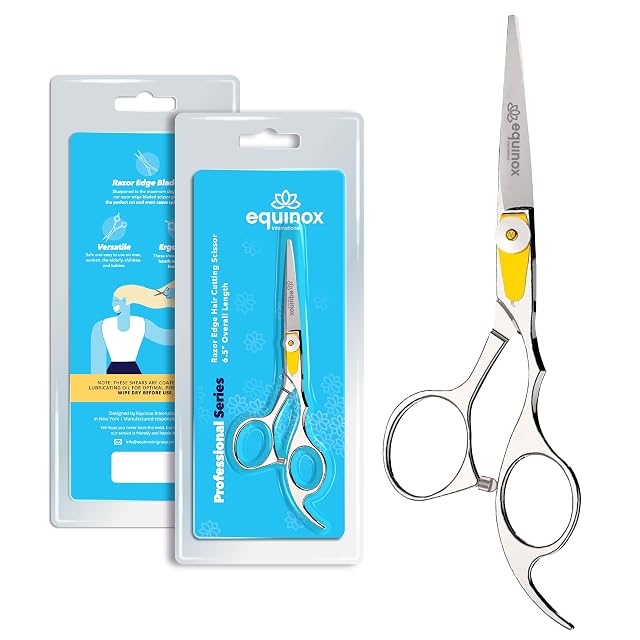
- “Design Excellence. Crafted from the finest Japanese stainless steel, Equinox Hair Scissors feature precisely tempered blades and hand-sharpened razor-cutting edges for the perfect snip.”
- “Ergonomic Comfort. Designed with a curved finger rest and comfortable finger holes, our professional hair cutting scissors are a dream for hair salon workers, barbers, and home stylists alike.”
- “Versatile Precision. Measuring 6.5 inches in overall length with 2.55-inch blades, our hair shears are designed for safety and ease of use on everyone–men, women, elderly, kids, and even babies.”
- “Effortless Convenience. Weighing in at just 3.5 ounces, these shears are a breeze for anyone to handle. With an adjustable screw, fine-tune the tension of the haircut scissors to suit your needs.”
- “Pristine Packaging. The Equinox hair cutting shears come vacuum-sealed in protective plastic and coated with lubricating oil. Wash them with gentle soap and lukewarm water, then dry with a soft cloth.”
- From the name: “Professional Razor Edge Series”, “Japanese Stainless Steel”, “6.5” Overall Length”, “Fine Adjustment Tension Screw”
- Reference PL10 · Catalog: 90 g (3.2 oz), 203 × 51 × 25 mm (7.99 × 2.01 × 0.98 in)
Blade and handle, measured separately — which nothing else here does
“Measuring 6.5 inches in overall length with 2.55-inch blades”
A 6.5-inch scissor is four inches of handle, and the blade is what cuts.
6.5 overall with 2.55 of blade means just under four inches of handle and pivot — and the two halves do different things.
What the blade length decides: how much hair one closing can take.
A 2.55-inch blade cuts a section about two and a half inches wide in a single clean closing — which is why that length is the professional standard for general cutting: wide enough to take a real section, short enough to control.
A shorter blade cuts the same section in two or three bites, and every join between bites is a potential step in the line.
What the handle length decides: reach and leverage.
A longer handle gives a lighter action for the same cut, and puts your hand further from the hair — which matters for visibility, and matters more for a stylist standing at a chair all day.
What the rest of the shelf publishes.
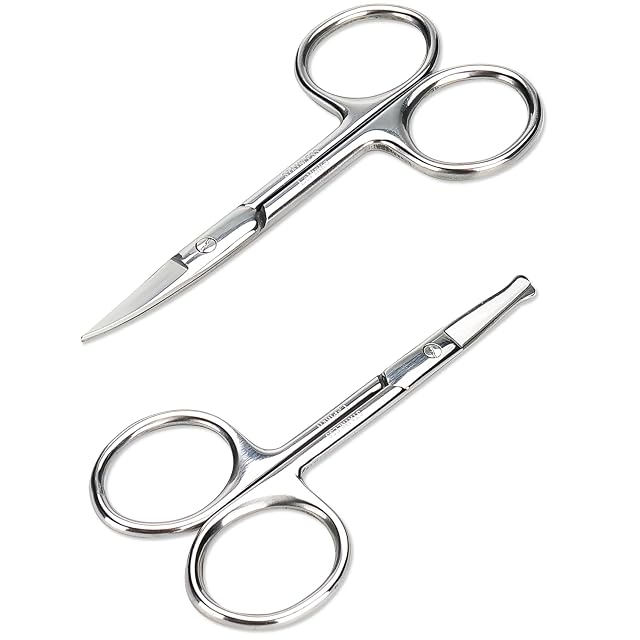
Overall length only — the CIICII kit at $19.98 (6.7 in), the Utopia Care at $8.99 (6.5 in), the Cut Factory B013 at $9.99 (6.5 in), the LePinko pair at $6.99 (3.54 in, which is a detail scissor)
Nothing at all — the Cut Factory 803 facial scissor at $9.99 and the AULikY 15-piece kit at $13.99
So four pages give one figure, one gives two, and three give none.
The practical consequence: two 6.5-inch shears can have noticeably different blades, and only this page lets you check.
And the claim at the end of that bullet is the one to hold lightly. “designed for safety and ease of use on everyone—men, women, elderly, kids, and even babies.”
A hand-sharpened razor edge on a 2.55-inch blade is not a tool for use on a baby by anyone who has not done it before — which is precisely the argument a rival page on this shelf makes against this whole class of edge.
A razor edge, and the page that argues against it
“precisely tempered blades and hand-sharpened razor-cutting edges for the perfect snip” — and “Professional Razor Edge Series” in the product name
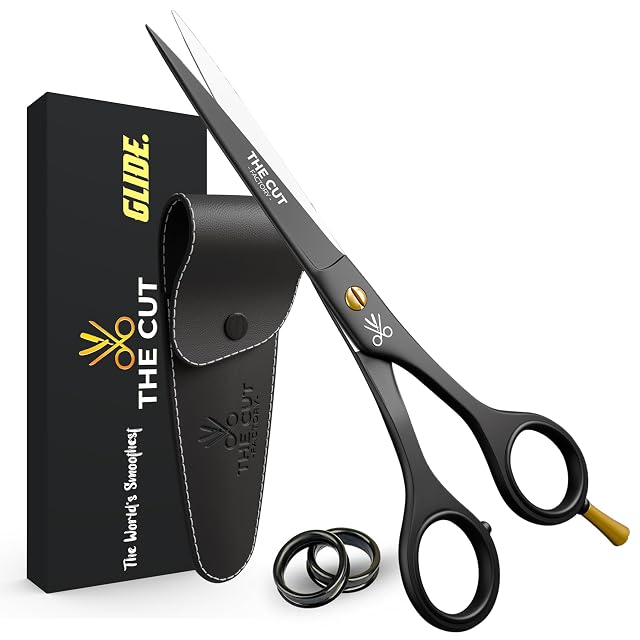
The Cut Factory B013 at $9.99, bullet two, in full: “Why Serrated Beats Razor Edge: Unlike fragile razor edges that dull quickly and require advanced professional techniques, our micro-serrated hair scissors maintain a long-lasting edge, making them foolproof and safe for beginners cutting at home.”
Both pages are right about their own edge, and the difference is real.
A razor edge is ground to a fine, smooth bevel like a knife. It slices a hair cleanly and — crucially — it lets the hair slide along the blade.
That sliding is not a fault. It is the mechanism of slide cutting and point cutting, where a stylist runs the blade down a section to soften a line.
It is also why a razor edge needs a trained hand: the hair will move if you let it, and an uneven line is the result.
A micro-serrated edge has fine teeth on one blade that grip the hair so it cannot slide.
Which makes a blunt cut almost foolproof — the rival page’s word, and a fair one — and makes slide cutting impossible.
So the two edges are not better and worse. They are a trade between control and technique.
The shelf divides three ways.
Razor edge — this, and the Utopia Care at $8.99 (“razor edged blades”)
Micro-serrated — the Cut Factory B013 at $9.99, alone
Unstated — the CIICII kit at $19.98, which says only “hand-polished, the blade line is even and smooth”; the Cut Factory 803 at $9.99 (“flawless sharpness”); the LePinko pair at $6.99 (“straight edge blades”); and the AULikY kit at $13.99, which publishes no bullets at all
The second half of the rival claim — that a razor edge “dulls quickly” — is the part to weigh rather than accept.
A fine edge has less metal behind it, so it does lose keenness sooner than a coarse one.
What decides it in practice is the steel and the tension — and this page addresses both: “precisely tempered”, and a fine adjustment screw.
The tension screw, which is the specification nobody thinks about
It is in the product title — “Fine Adjustment Tension Screw” — and in bullet four: “With an adjustable screw, fine-tune the tension of the haircut scissors to suit your needs.”
What the pivot tension actually does.
Two scissor blades do not meet along their whole length; they bear on each other at one moving point, and the screw sets how hard.
Too loose and the blades separate under load. The hair slips into the gap and folds instead of being cut — which is the single most common fault in a worn pair, and it feels like bluntness and is not.
Too tight and the action is heavy, the hand tires, and the edges wear against each other rather than against hair.
And the tension drifts with use. Every closing works the pivot a little, which is why a professional pair is adjusted as routine rather than as a repair.
So a pair without an adjustable screw is a pair that will eventually fold hair and cannot be brought back.
Two pages on this shelf publish one.
this — a fine adjustment screw, named in the title
CIICII, $19.98 — “Adjustable Screw Design - Adjust the tightness of the hair scissors according to personal feeling”, and it ships the tool: “1 × Scissors Adjuster”
Six publish nothing.
Which is the one place the dearer kit beats this page: an adjuster is a small flat key, and without it the screw on most shears cannot be turned properly by hand.
The right setting, which no page on this shelf gives: hold the scissors closed, lift the top blade to vertical, and let go. It should fall about two-thirds of the way shut and stop. Falling all the way is too loose; stopping at the top is too tight.
Wash a new pair, and what it ships under
“The Equinox hair cutting shears come vacuum-sealed in protective plastic and coated with lubricating oil. Wash them with gentle soap and lukewarm water, then dry with a soft cloth.”
Why a new cutting tool is oiled.
Ground steel rusts in a warehouse, in a container and on a shelf — so it leaves the factory under a protective film.
That film is a preservative, not a lubricant. It is there to keep moisture off during months of storage, and it is sticky.
What it does if you leave it on: hair sticks to it.
A tacky blade drags a section instead of releasing it, which is the exact opposite of what a razor edge is for — and it produces the counter-intuitive thing people meet with any new cutting tool: the new pair performs worse than the old one on the first cut.
So the instruction is not fussiness. It is the difference between the tool working and not.
And this is the same lesson this site publishes on another shelf, more emphatically.
On GroomVerdict’s blade-care shelf, the Oster Blade Wash at $15.88 is the only product of seven to make the point, and it makes it twice: “removing factory-applied preservatives”, and “Removes factory applied preservatives from new blades.”
Clipper blades, scissors and razor blades all arrive the same way.
What the full sequence should be, drawing the halves from two pages on this shelf.
Wash a new pair before the first cut — this page: soap, lukewarm water, dried with a cloth
Then clean after each use — which no page on this shelf publishes any more. Alcohol rather than water, because it evaporates and leaves nothing behind.
And oil the pivot occasionally — which no page on this shelf mentions
That last gap is this page’s own. It says to wash and dry, and never says to oil. A stainless scissor washed and dried is a dry pivot, and a dry pivot stiffens.
The dose is published elsewhere on this site, written for a clipper blade: the Wahl blade oil at $5.99 on the blade-care shelf — “two drops on the left corner, two drops on the right corner, and a single drop in the middle, every few haircuts.” A scissor pivot wants one drop.
Japanese stainless, tempered, and no grade
“the finest Japanese stainless steel… precisely tempered blades”
Two claims, and one of them is a real process.
Tempering is the heat treatment that follows hardening: it draws some hardness back out of the steel in exchange for toughness, so the edge holds without chipping.
It is the step that decides whether a scissor edge rolls, chips or holds — and naming it is more substantial than most of this shelf manages.
“Japanese stainless steel” is an origin rather than a designation.
Which is worth separating, because the shelf has one page that gives an actual grade.
CIICII, $19.98 — “made of 6CR stainless steel, All steel manufacturing”. 6CR is a mid-range martensitic stainless of the 6Cr13 family: hardenable enough to hold a scissor edge, and still rust-resistant.
Cut Factory B013, $9.99 — “Premium High-Carbon Steel”, with a “rust-resistant matte black finish”. Which is the old trade resolved by a coating: high-carbon takes a finer, harder edge than stainless and rusts, so it is painted.
this — Japanese stainless, tempered, no grade
And four pages — “stainless steel” with an adjective
Why the grade matters on scissors more than on most tools.
A scissor edge is the thinnest working edge in a bathroom, and it has to stay thin. Hardness is what holds it, and hardness in stainless comes from carbon.
A soft stainless takes an edge easily and loses it quickly. A hard one holds it and chips.
Which is exactly why the tempering claim here is the useful half of the sentence and the word “Japanese” is the half doing marketing.
No hardness figure appears on any page on this shelf — and hardness is the number that would settle every one of these arguments.
Three and a half ounces, and the shelf’s two opposite arguments
“Weighing in at just 3.5 ounces, these shears are a breeze for anyone to handle.”
3.5 ounces is 99 grams; the catalog says 90 g (3.2 oz) — the same object weighed twice.
The shelf, by weight:
141 g — the Utopia Care at $8.99, the heaviest here
90 g — this
74 g — the Cut Factory B013 at $9.99
30 g — the Cut Factory 803 facial scissor at $9.99, the lightest
Not published — the LePinko pair at $6.99, the AULikY kit at $13.99, the CIICII kit at $19.98
And two pages draw opposite conclusions from the same property.
this — “just 3.5 ounces… a breeze for anyone to handle”
Utopia Care, $8.99 — “The ideal weight of scissors allows perfect balance and stability”, on the heaviest pair on this shelf
Both arguments are real, and they are about different users.
Light matters for endurance. A stylist makes thousands of closings a day, and 50 grams at the end of an outstretched arm is felt by the afternoon.
Weight matters for control. A heavier pair has more inertia: it sits still in the hand, resists being deflected by a thick section, and tells you through your fingers what the blades are doing.
Which is why professional shears are not as light as they could be — and why “a breeze for anyone to handle” is honestly aimed at the home user the same bullet describes.
The third page in that argument is the pet scissors at $18.99, which makes the lightness claim for a third reason: “Lightweight design provides comfort and prevents hand fatigue while trimming.” Which is about the animal rather than the hand — a long session with a nervous dog.
The ergonomics here are the curved finger rest in bullet two.
A finger rest is the small hook behind the lower ring that the little finger sits on — and it is the thing that stops the hand gripping. Without it the whole hand squeezes; with it the hand hangs and only the thumb moves.
Three pages on this shelf mention one, and none of them explains how to use it — which is worth naming, because a finger rest does nothing unless the little finger actually sits on it: thumb in the bottom loop, ring finger in the top loop, little finger on the rest.
What this page does not claim is an offset handle, which the most expensive item here does. The CIICII at $19.98: “Offset Handle Design - Very ergonomic & reduces fatigue.” The thumb ring sits forward of the finger ring so the wrist stays low and flat — the standard professional geometry, and the one real ergonomic distinction on this shelf.
What is not published
No steel grade or hardness, as above.
No oiling instruction, as above — on the one page that tells you to wash.
No adjuster tool. The screw is in the title and the key is not in the box, where the CIICII at $19.98 ships one.
No offset handle, as above.
No edge angle or serration statement beyond “razor-cutting”, which is the class rather than the geometry.
No thinning or texturizing option. Two items on this shelf include thinning shears and one publishes real figures: the CIICII at $19.98 — “28 Teeth Thinning Scissors… (Thinning rate of 25-28%)” — which is the only tooth count anywhere on this site. The AULikY kit at $13.99 claims thinning scissors in its title with no figures at all.
No left-handed option, which no page on this shelf mentions and which matters more on scissors than on anything else on this site: a right-handed pair used in a left hand pushes the blades apart rather than together, which is the folding fault described above.
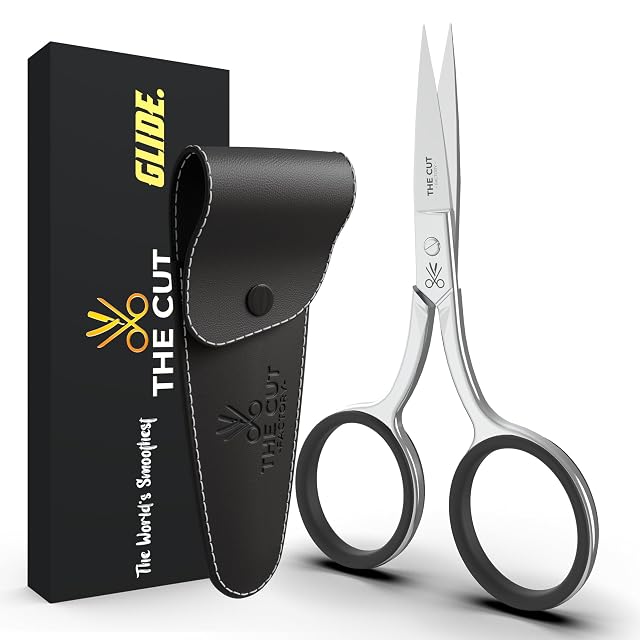
No case or pouch. Three items on this shelf ship one: the Cut Factory B013 at $9.99 with a “protective leather pouch” and a gift box, the Cut Factory 803 at $9.99 with a “sleek PU leather pouch”, and the CIICII kit at $19.98 with a “gift leather bag”. This page ships vacuum-sealed plastic, which is packaging rather than storage — and a bare scissor loose in a drawer is a scissor whose edge meets other steel.
No warranty. One item on this shelf publishes one and it is the richest term on this site: the CIICII at $19.98 — “90-DAYS Unconditional Return + 12-Month Quality Promise”, with support stated to respond “in 12 hours”. Seven publish nothing.
No country of manufacture. No item on this shelf publishes one — and “Japanese stainless steel” here is a material origin rather than a place of manufacture.
Availability
Read on the day this page was built: $9 at the American Amazon shop.
Read from Keepa on the day this page was last revised; stock and price both move without notice.
Prices quoted in this text were read on 2026-10-05. The live price is at the top of the page.