What the maker puts in writing
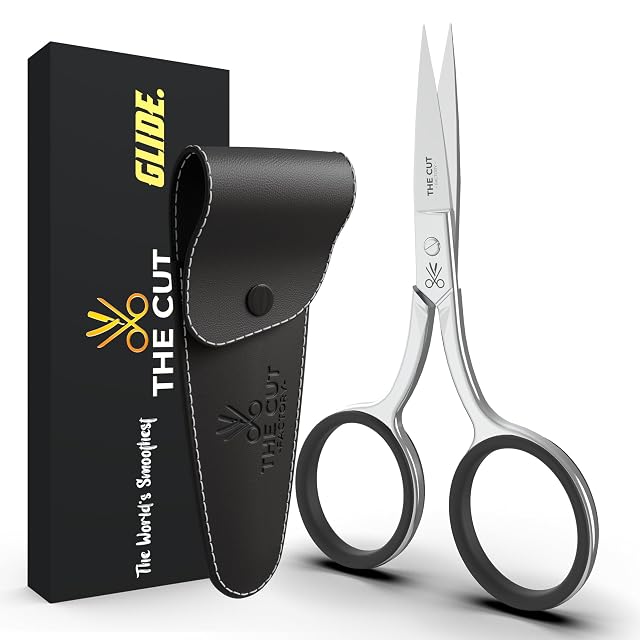
- “Why settle for a cheap pack of 2 or 3? We deliver ONE scissor that outperforms them all — for eyebrows, mustache, and beard”
- “Others throw in extras to hide poor quality”
- “No junk. No fillers. Just one damn good scissor.”
- “No gimmicks. Just Precision”
- “flawless sharpness”, “ergonomic grip”, “mirror-finish” stainless steel
- Supplied in a “sleek PU leather pouch”
- Reference 803 · Catalog: 30 g (1.1 oz), 102 × 51 × 3 mm (4.02 × 2.01 × 0.12 in)
One scissor, argued for — on a shelf with a fifteen-piece kit
“Why settle for a cheap pack of 2 or 3? We deliver one scissor that outperforms them all”, “Others throw in extras to hide poor quality”, “No junk. No fillers. Just one damn good scissor.”
This is the only page on this shelf that argues against sets, and the shelf gives it a target and a counter-example.
The target: the AULikY kit at $13.99. “15 Pcs” in its title, and not one bullet describing any of them — no list, no contents, no specification at all. Which is the strongest possible evidence for this page’s case.
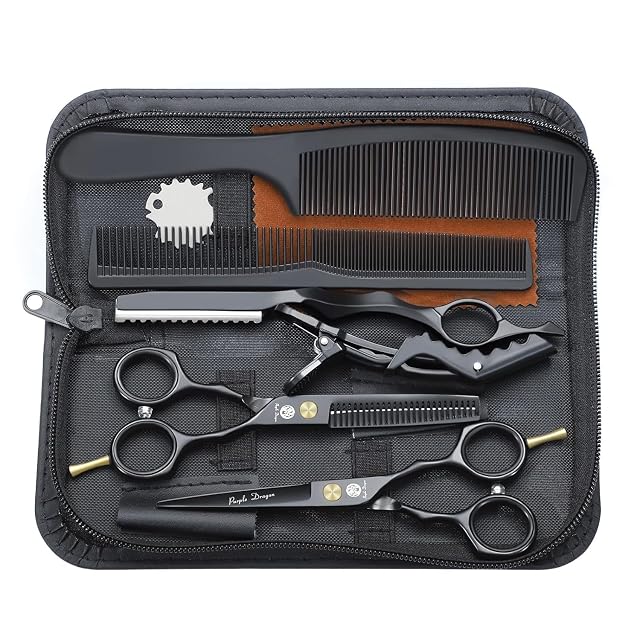
The counter-example: the CIICII kit at $19.98, which itemizes — “1 × Hair Cutting Shears, 1 × Hair Thinning Scissors, 1 × Hair Cutter Comb, 2 × Hair Clips, 1 × Gift Leather Bag, 1 × Cleaning Cloth, 1 × Scissors Adjuster.”
Eight named items, counted, and three of them are tools rather than padding: a thinning shear, a cutter comb, and the adjuster key for its own tension screw.
And a second counter-example: the LePinko pair at $6.99, two pieces, deliberately mismatched — “rounded precision blade tip curves away from skin” on one, “extra sharp pointed tips” on the other. Two tips because a face needs two.
So the honest reading: the argument is right about padding and wrong as a rule.
A set of fifteen unnamed pieces at $13.99 is almost certainly thirteen things you will not use. The page has earned that shot.
But a set whose pieces do different jobs is not padding — and both of the other sets here qualify.
And the irony is that it is a facial scissor making the argument.
The one place a second piece is genuinely useful is a face: a rounded tip for inside a nostril or an ear, a pointed one for a brow hair or a beard line, exactly as its $6.99 neighbor sets out.
This page offers one tip and never says which it is.
Its sibling at the same price is the honest comparison. The Cut Factory B013 at $9.99 is a 6.5-inch hair-cutting shear — a different class of tool. The two together are a set this brand does not sell as one, which is a fair position and worth saying plainly: this page is one half of a pair of purchases, not a complete answer.
What the page never says: pointed or rounded
It gives “flawless sharpness”, an “ergonomic grip”, a “mirror-finish” and three uses — “eyebrows, mustache, and beard”.
It never gives the tip geometry, which on a facial scissor is the one specification that matters.
Why it decides everything on a face.
A rounded tip, especially one curving away from the skin, cannot reach the wall of an opening even if you push it there. That is the standard geometry for nose and ear hair — both trimmed blind, against skin you cannot see — and a sharp point in a nostril is the one grooming injury that is genuinely common.
A pointed tip gets between two hairs and cuts the one you chose. That is brow work, lash work and the hard edge of a beard or a mustache, and a rounded tip simply cannot do it.
The uses this page names all point to a pointed tip, and inference is not publication.
How the rest of the shelf handles it.
LePinko, $6.99 — the only page that publishes both, and sells one of each: “Rounded precision blade tip curves away from skin for safely. Extra sharp pointed tips straight edge blades for precision trimming.” Though it too never says which piece is which.
And six pages, including this one — nothing about the tip at all
Which is defensible on the five full-size hair-cutting shears here, where a haircut is cut with the full blade rather than the tip. It is not defensible on a facial scissor.
The rounded tip is this site’s most consistent published safety feature, which makes the silence more noticeable. On GroomVerdict’s combs-and-brushes shelf, four of seven animal tools claim a rounded tooth tip; on clipper-blades, two of five claim a “round head design” or “widened rounded teeth, no harm for the skin”.
Across four shelves it is the one safety claim this site makes repeatedly — and the facial scissor is where it would count most.
Thirty grams, the lightest here
At 30 g (1.1 oz) this is the lightest item on this shelf, and for this job that is correct rather than cheap.
The shelf, by weight:
141 g — the Utopia Care at $8.99, the heaviest, which sells its weight: “The ideal weight of scissors allows perfect balance and stability”
90 g — the Equinox at $8.90, which sells its lightness: “Weighing in at just 3.5 ounces… a breeze for anyone to handle”
74 g — the Cut Factory B013 at $9.99, this page’s sibling
30 g — this
Not published — the LePinko pair at $6.99, the AULikY kit at $13.99, the CIICII kit at $19.98
Why light is right here and heavy is right on a cutting shear.
A full-size shear is swept through a section, and weight gives it inertia: it sits still, resists being deflected by thick hair, and tells you through your fingers what the edges are doing. That is the Utopia Care argument, and it is sound.
A facial scissor is held like a pen, close to the work, and moved a few millimeters. There is nothing to stabilize and nothing to sweep. Weight here is only mass you are steering, and 30 g (1.1 oz) steers better than 141.
The catalog reads this one at 102 × 51 × 3 mm (4.02 × 2.01 × 0.12 in), which makes it about four inches overall and 3 mm (0.12 in) thick.
That 3 mm (0.12 in) matters for the same reason the LePinko pair publishes its own 3 mm (0.12 in): a flat scissor lies in a wash bag and a thick one does not.
And the length puts it in the right class. Four inches overall against 6.5 for the three cutting shears here — which is the physical reason this is a different tool rather than a smaller version of one: a 6.5-inch shear will not go near a brow, and this will not cut a haircut.
The pouch, which is the cheapest thing that protects an edge
Supplied in a “sleek PU leather pouch”
What actually destroys a household scissor is not use. It is the drawer — loose steel against loose steel, tumbling against tweezers, nail clippers, a razor and another pair of scissors.
A fine edge is a few microns of apex, and one knock against harder steel rolls or chips it in a way no amount of careful cutting will undo.
Which matters more on a small scissor than a large one, because a small one lives in a wash bag and travels — and it is the reason this page’s three-millimeter flatness and its pouch belong in the same sentence.
Who else ships one.
this, $9.99 — a sleek PU leather pouch
Cut Factory B013, $9.99 — a “protective leather pouch” and a gift box
CIICII kit, $19.98 — a “Gift Leather Bag”, plus a cleaning cloth
And four ship nothing: the LePinko pair at $6.99 (a “portable package”), the Equinox at $8.90 (vacuum-sealed plastic, which is packaging rather than storage), the Utopia Care at $8.99, and the AULikY kit at $13.99.
So both Cut Factory pages ship one, which is consistent, and it is the one thing on this page that follows through on “no gimmicks”.
What is missing from it is the cloth. The CIICII kit at $19.98 includes a cleaning cloth, and it is the piece that would complete a care story neither Cut Factory page tells — see below.
The finish, where this page contradicts its own sibling
a “mirror-finish” stainless steel
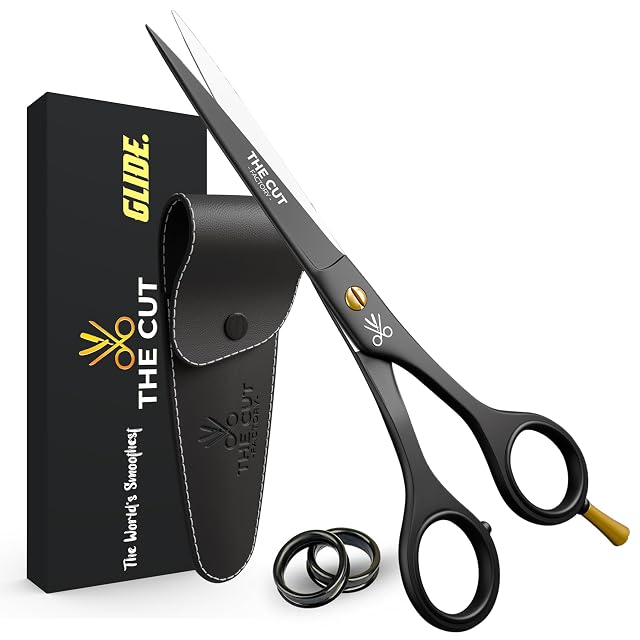
The Cut Factory B013 at $9.99, same brand, same price: “Coated in a sleek, non-glare, rust-resistant matte black finish.”
Same maker, opposite claim — and glare is a real working problem rather than a styling preference.
A mirror-polished blade under a bathroom downlight throws a hard reflection straight up at the person holding it, at the exact angle a scissor is held. Which is why barbers’ shears are so often satin rather than mirror.
On a facial scissor it bites harder, not less.
Brow and beard work is done close to a mirror, with the light above or behind you, looking at a reflection — and a flash off the blade at the moment of the cut is the moment you cannot see the hair.
What a mirror finish does give — two real things.
It is the smoothest surface a steel can have, which means the least to catch hair and the least for water to sit in. A genuinely easier blade to wipe clean.
And polishing is work. A mirror finish is hand-worked, and a maker who polishes is a maker who has handled the blade — which the CIICII at $19.98 claims explicitly: “hand-polished, the blade line is even and smooth.”
What it does not give is protection. A polish is not a coating.
Where the sibling page puts a barrier over high-carbon steel — carbon being harder and rust-prone — this page relies on the stainless itself, which is the normal and reasonable choice for a bathroom tool and means the grade matters.
And the grade is not published.
CIICII, $19.98 — “6CR stainless steel”, a real designation: a mid-range martensitic stainless of the 6Cr13 family, hardenable enough to hold an edge and still rust-resistant
Equinox, $8.90 — “Japanese stainless steel”, “precisely tempered blades”. Tempering is at least a process
this — “stainless steel”, and “flawless sharpness”, which is a claim about the result rather than the metal
No hardness figure appears anywhere on this shelf.
What is not published
The tip geometry, as above — the one thing a facial scissor needs to state.
No length. The catalog reads 102 mm; the page gives no figure at all, where three of the cutting shears here publish 6.5 inches and the Equinox at $8.90 publishes both its overall length and its blade: “6.5 inches in overall length with 2.55-inch blades.”
No blade length, and on a four-inch scissor that is most of what you want to know — because the working part may be an inch or an inch and a half, and that is what decides whether it can take a beard line in one closing.
No edge geometry. “Flawless sharpness” is not a type. Its own sibling publishes one and argues it at length: the Cut Factory B013 at $9.99 is “micro-serrated” and makes the case — “Why Serrated Beats Razor Edge… foolproof and safe for beginners.” Two of the shears here name a razor edge: the Equinox at $8.90 and the Utopia Care at $8.99. This page names neither, which on a precision tool is the gap.
No steel grade or hardness, as above.
No tension screw. Two pages here publish one: the Equinox at $8.90 in its own title — “Fine Adjustment Tension Screw” — and the CIICII at $19.98, which ships the key, “1 × Scissors Adjuster.” The two blades bear on each other at one moving point and the screw sets how hard: too loose and they separate, the hair slides into the gap and folds instead of being cut; too tight and the action is heavy. And the tension drifts with use. On a small scissor the leverage is small, so the consequence is smaller — but a detail scissor gone loose crushes an eyelash instead of cutting it.
No care instruction. One rival gives the first half and neither Cut Factory page gives it. The Equinox at $8.90 on a new pair: they arrive “coated with lubricating oil”, so “wash them with gentle soap and lukewarm water, then dry with a soft cloth” — that film is a preservative rather than a lubricant, and left on it makes hair stick, so a new pair cuts worse than an old one. And no page here gives the second half: wipe the edge dry after each use, with alcohol rather than water, because alcohol evaporates and leaves nothing behind — which is the right instruction for a tool that lives in a wash bag.
No warranty. One item on this shelf publishes one and it is the richest term on this site: the CIICII at $19.98 — “90-DAYS Unconditional Return + 12-Month Quality Promise”, with support stated to respond “in 12 hours”. Seven publish nothing — and a page whose whole argument is that it is built better than a padded set is the page where a term would have carried most weight.
No country of manufacture, which no item on this shelf publishes.
Availability
Read on the day this page was built: $10 at the American Amazon shop.
Read from Keepa on the day this page was last revised; stock and price both move without notice.
Prices quoted in this text were read on 2026-10-05. The live price is at the top of the page.