What the maker puts in writing
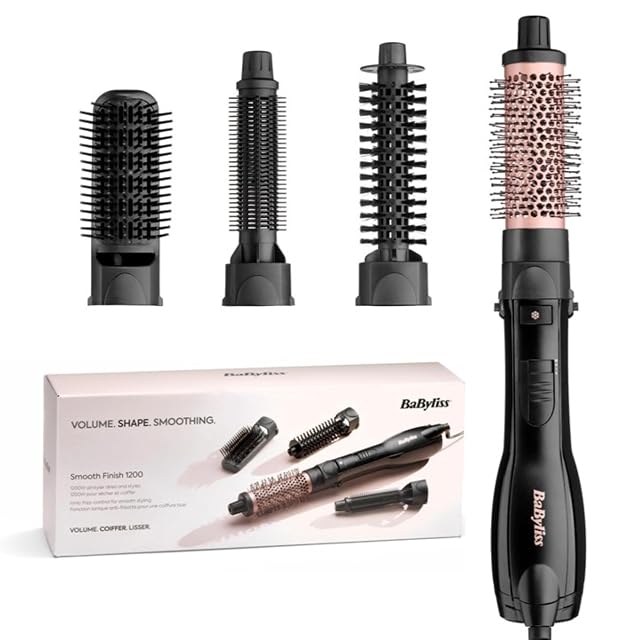
- “VERSATILE TOOL: Multi-vent barrel with outfitted flexible, ball tipped bristles to gently comb your hair for easy hair styles”
- “CURL RELEASE: Features a switch that unlocks and rotates the barrel to release the hair easily and avoid tangled hair”
- “HEAT SETTINGS: 2 Heat/Speed settings for your styling needs”
- “PROFESSIONAL CORD: 8ft. swivel cord and soft-grip handle make each styling experience as comfortable as can be”
- “NOTE: This unit will not dry your hair when fully wet, towel dry your hair before styling.”
- From the description: “1” Hot Air Brush”, “flexible, ball-tipped bristles to help gently comb and pull strands taut”, “Includes a cool tip”
The curl release switch, which nothing else here has
“Features a switch that unlocks and rotates the barrel to release the hair easily and avoid tangled hair”
What goes wrong with these tools.
Wrapping hair around a bristled barrel is easy. Getting it off is the problem.
The bristles grip — that is their entire function, because a brush that lets hair slip cannot pull a strand taut or form a curl. Which means unwinding is done against the grip.
And if you unwind in the wrong direction, or the hair has wrapped past itself, the strand does not come off: it tightens.
That is how people end up with a tool stuck in their hair, and it is the most common complaint about the whole category.
What the switch does.
It unlocks the barrel so the barrel itself turns freely.
So the wrap can unwind without the hair having to slide over stationary bristles — the barrel rotates with the hair instead of resisting it.
A mechanical answer to a mechanical problem, on the cheapest item on this shelf.
How the most expensive item attacks the same problem from the other end.
Tqcir, $139.99 — “The 1.25-inch curling attachment can automatically attract and wrap hair strands.” An auto-wrap: airflow pulls the hair onto the barrel rather than you winding it there.
Which solves the wrapping and does not obviously solve the unwrapping — and that page does not say how the hair comes off.
The four other pages do not address release at all: the Revlon at $30.19, the L’ANGE at $47.99, the HOT TOOLS blow dryer brush at $48.75 and the InfinitiPro by Conair at $52.99.
Two of those are oval smoothing brushes rather than round curling barrels, which makes the problem smaller — you pass the brush through the hair rather than wrapping hair around it. So the omission is fair on them. On a round barrel it is not.
And one companion detail: “Includes a cool tip.”
The far end of the barrel is where your other hand goes to steady the tool, and on a heated barrel that is the spot that burns fingers.
A small, specific, genuinely useful thing — and the only page on this shelf to mention one.
It tells you what it cannot do
“NOTE: This unit will not dry your hair when fully wet, towel dry your hair before styling.”
The Revlon at $30.19 prints the identical sentence, word for word.
The four dearer items claim the opposite.
InfinitiPro by Conair, $52.99 — “you can use this hot air brush on freshly washed, towel-dried wet hair straight from the shower to dry and style at the same time”
Tqcir, $139.99 — “It only takes 5 minutes to dry wet hair thoroughly”
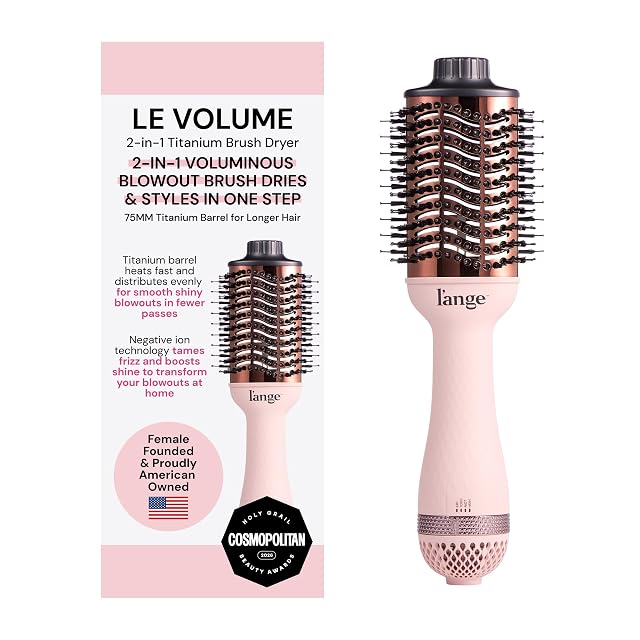
L’ANGE, $47.99 — “This 2-in-1 blow dryer brush dries and styles simultaneously”
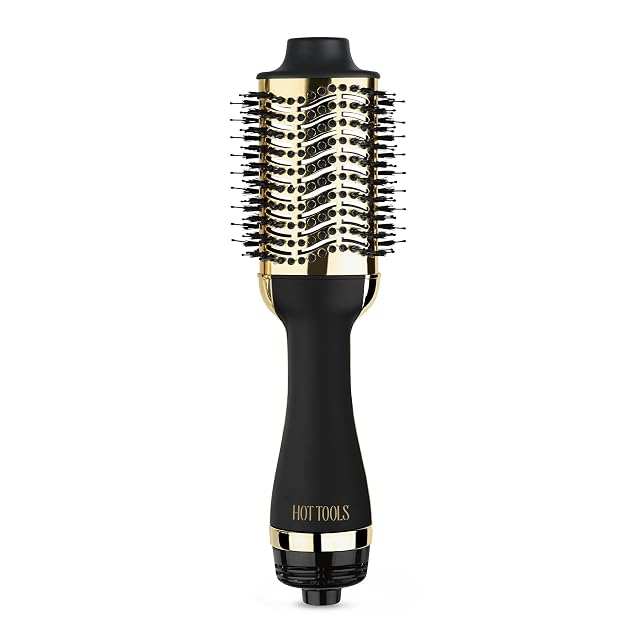
HOT TOOLS blow dryer brush, $48.75 — “experience faster drying for voluminous, bouncy blowouts”
So this shelf holds two different tools under one name.
A hot air brush is a styling tool that blows warm air through a brush: it sets and shapes hair that is already most of the way dry.
A blow dryer brush is a hair dryer in a brush shape: it is meant to take wet hair to dry.
The two cheapest items here are the former, and they say so.
Why the distinction is physical rather than marketing.
Drying hair means moving a lot of water, and moving water requires moving a lot of air.
A brush barrel is full of bristles, which obstruct the airflow by design — so a brush-shaped dryer always trades air volume for the brushing action.
Which means the note is a statement about airflow rather than about power.
And that is borne out by the two pages that publish wattage: the Revlon at $30.19 publishes 1200 W and prints the warning anyway, while the InfinitiPro at $52.99 publishes 1000 W and claims wet-to-dry.
The cheaper tool has more power and the more modest claim.
What follows for a buyer.
If your routine is wash, towel, rough-dry with a dryer, then style — this is the right class of tool and the cheapest one here.
If you want one device to take you from the shower to finished, the note is telling you to look above it.
And the note is worth something beyond its content: a page that tells you what the tool cannot do is a page you can trust about what it can.
One inch, which makes a curl rather than a blowout
The shelf, by barrel.
1 in — this
1 in and 1½ in — the Revlon at $30.19, the only item here with two attachments: “Use the 1” attachment for soft curls and the 1-1/2” attachment for bouncy blowouts”
1.25 in — the Tqcir at $139.99, two auto-wrap curling attachments
75 mm oval — the L’ANGE at $47.99, which is 2.95 inches
Oval, size not published — the HOT TOOLS blow dryer brush at $48.75
Not published — the InfinitiPro by Conair at $52.99
Why the diameter decides the result.
The curl you get is the shape the hair is held in while it cools.
A one-inch barrel wraps the hair into a one-inch cylinder, which relaxes into a defined curl.
A three-inch barrel barely bends the hair at all. It holds it in a wide arc, which relaxes into body and movement rather than a curl — which is what a blowout is.
So the two ends of this shelf are not better and worse versions of the same tool. They make different shapes, and you cannot get a defined curl from a 75 mm (2.95 in) barrel however you use it.
Round against oval is the second part of the geometry.
A round barrel is for wrapping — hair goes around it, which is why this page needs a curl release switch.
An oval is for passing through. The HOT TOOLS blow dryer brush at $48.75 describes “gently curved sides created to smooth hair, while the rounded edges create volume from the roots down” — two faces doing two jobs on one tool.
The “multi-vent” detail here is the other half of the airflow story.
Vents in the barrel let the air out through the hair you have wrapped, rather than only past it — which is what makes a wrapped curl dry from the inside and set faster.
And “pull strands taut” is the honest description of how smoothing works on any of these: tension, not heat. A strand held tight dries straight; a slack one dries in whatever shape it is in.
Ball-tipped bristles, and the convention behind them
“flexible, ball tipped bristles to gently comb your hair”
A ball tip is a rounded bead on the end of each bristle so the bristle cannot scratch the scalp.
Which matters here specifically, because this is a heated tool pressed against the head: a bare bristle end on a hot brush is both a scratch and a hot spot.
One other page names the equivalent, and counts them.
InfinitiPro by Conair, $52.99 — “136 flexible bristles”, “epoxy-tipped nylon bristles”, “specially spaced”
“Epoxy-tipped” and “ball-tipped” are the same idea by two names: a rounded, blunted end.
And 136 is the only bristle count anywhere on this site.
Across GroomVerdict, counts of this kind are almost entirely absent: none of the nine items on the combs-and-brushes shelf publishes a tooth spacing, none of the five on clipper-blades publishes a tooth count, and none of the five on guide-combs publishes a pitch. The only other count on this site is the CIICII scissors kit at $19.98 on the cutting-scissors shelf — “28 Teeth Thinning Scissors… (Thinning rate of 25-28%)”.
The rounded tip is also this site’s most consistent published safety feature. On combs-and-brushes, four of seven animal tools claim a rounded tooth tip. On clipper-blades, two of five claim a “round head design” or “widened rounded teeth, no harm for the skin”. On cutting-scissors, two items claim rounded safety tips.
“Flexible” is the other half of the claim and it is doing real work.
A rigid bristle on a round barrel either does not grip or does not let go. A flexible one bends to take the wrap and springs back to release it — which is the same problem the curl release switch addresses, approached from the bristle rather than the barrel.
Two settings, and no numbers
“2 Heat/Speed settings for your styling needs”
Note that heat and speed are linked on one control: you are not choosing them separately.
Which is normal at this price and it is a limitation worth knowing, because the two want to be independent — a low speed with real heat is how you set a curl, and a high speed with low heat is how you finish one without over-drying it.
What the shelf publishes.
Tqcir, $139.99 — 3 airflow levels and 4 heat settings, independently, plus the only temperature figure on this shelf: a “high-precision temperature sensor” that “limits the max temperature at 250°F to prevent hair cuticle damage”
InfinitiPro by Conair, $52.99 — “multiple heat settings” and a cool shot button
L’ANGE, $47.99 — “adjustable heat settings”
HOT TOOLS blow dryer brush, $48.75 — a “rotating temperature control” and 2 heat/speed settings
Revlon, $30.19 — the 1200 W figure, a cool setting on its smoothing concentrator, and no count of settings at all
this — 2 heat/speed
And no page on this shelf except the Tqcir publishes a temperature.
Which is the gap worth naming, because the cross-reference is on this same site: on GroomVerdict’s heat-protection shelf, eight of the nine protectant sprays claim protection “up to 450 °F”.
So the sprays are rated to a figure, and at least five of the ten tools on this shelf will not tell you what they reach.
The Tqcir’s 250 °F is 121 °C (250 °F) — barely half of what the sprays are sold for — and it is published as a deliberate ceiling rather than a maximum.
A cool setting, which this page does not have and three rivals do, is the other half of setting a curl: hair takes its shape as it COOLS, so a blast of cool air at the end is what fixes the curl you just made. Without one, you wait.
What is not published
No wattage. Two pages on this shelf publish one, and the cheaper of the two publishes more: the Revlon at $30.19 gives 1200 W, the InfinitiPro by Conair at $52.99 gives 1000 W. The Tqcir at $139.99 publishes no watts and gives something more informative instead — a “110,000 RPM high-speed brushless motor” delivering “35m/s strong airflow”. Three pages, including this one, publish nothing about power at all.
No temperature, as above.
No barrel coating. Three pages name one, and all three make the same claim from materials with opposite properties. The Revlon at $30.19 names ceramic (“triple ceramic coating” in its description) for “even heat distribution”. The L’ANGE at $47.99 names titanium, which “protects hair for even heat distribution”. The HOT TOOLS blow dryer brush at $48.75 names 24K Gold technology for “fast, even heat that helps protect hair from heat damage*”, with an asterisk whose footnote text does not appear on the page. Ceramic is a poor conductor, so it heats evenly and radiates; titanium and gold are excellent conductors, so they heat fast and transfer fast. Opposite physics, one sentence.
No ionic claim. Three pages have one, and only one says what it does. The HOT TOOLS blow dryer brush at $48.75: “Ionic Technology helps maintain a neutral charge on the hair’s surface” — which is correct and is about static rather than humidity. Dry hair carries charge, like charges repel, and strands push apart: that is flyaway, and emitting ions neutralizes it. The Revlon at $30.19 and the InfinitiPro at $52.99 both attach ions to “frizz”, which is a different phenomenon — humidity frizz is water going into the hair and swelling it, and ions do nothing about that. The L’ANGE at $47.99 claims the other mechanism instead: “advanced frizz-free technology to seal the hair cuticle.”
No bristle count, as above.
No weight. One page on this shelf publishes one: the InfinitiPro by Conair at $52.99, “weighing just 1.8 pounds”. That is 816 g held at head height with the arm raised, which is not light — and four other pages claim to be lightweight with no figure at all. The only page you can judge is the one that told you.
No country of manufacture.
Availability
Read on the day this page was built: $27 at the American Amazon shop.
Read from Keepa on the day this page was last revised; stock and price both move without notice.
Prices quoted in this text were read on 2026-10-05. The live price is at the top of the page.