What the maker puts in writing
- “Achieve Long-Lasting Blowouts: Master the art of an iconic blowout with this Hot Tools Blow Dryer Brush and experience faster drying for voluminous, bouncy blowouts that last”
- “24K Gold Techology: This blow dryer brush has 24K Gold technology for fast, even heat that helps protect hair from heat damage”*
- “Reduce Hair Frizz & Static: Ionic Technology helps maintain a neutral charge on the hair’s surface, leaving the hair looking conditioned and smooth, while helping reduce frizz and static”
- “Round Brush for All Hair Types: Blowout brush features a rotating temperature control and 2 heat/speed settings providing styling control for all hair types”
- “Stylists-Preferred: Professionals’ #1 Most Trusted & Recommended Hair Tools Brand”*
- From the description: “Its versatile oval brush has gently curved sides created to smooth hair, while the rounded edges create volume from the roots down to beautifully curled ends”, “unique airflow vents for quick styling”
The only correct ionic explanation here
“Ionic Technology helps maintain a neutral charge on the hair’s surface… while helping reduce frizz and static”
Why that is the right phrase.
Dry hair carries an electrostatic charge.
Like charges repel, so individual strands push away from each other — which is why hair stands up after brushing in winter, and why a style that looked finished at the mirror does not look finished at the door.
That is flyaway. Emitting ions neutralizes the charge, so the strands stop repelling and lie down.
A real, well-understood effect, described accurately.
Now the distinction almost every page on this shelf blurs.
Humidity frizz is the opposite phenomenon: water from the air going into the hair and swelling the shaft, which lifts the cuticle and makes the strand wavy and rough.
Ions do nothing about that. What helps is a cuticle lying flat, because a flat cuticle is a slower route for water in either direction.
So an ioniser reliably reduces flyaway and does not stop humidity frizz — and this bullet is the only one on the shelf to name both outcomes separately, “frizz and static”, rather than collapsing them.
What the others say.
InfinitiPro by Conair, $52.99 — “a powerful ion generator and ionic technology help reduce frizz and flyaways”: names the hardware, not the mechanism
Revlon, $30.19 — “Ionic Technology… Less frizz”: attaches ions to the problem they do not solve
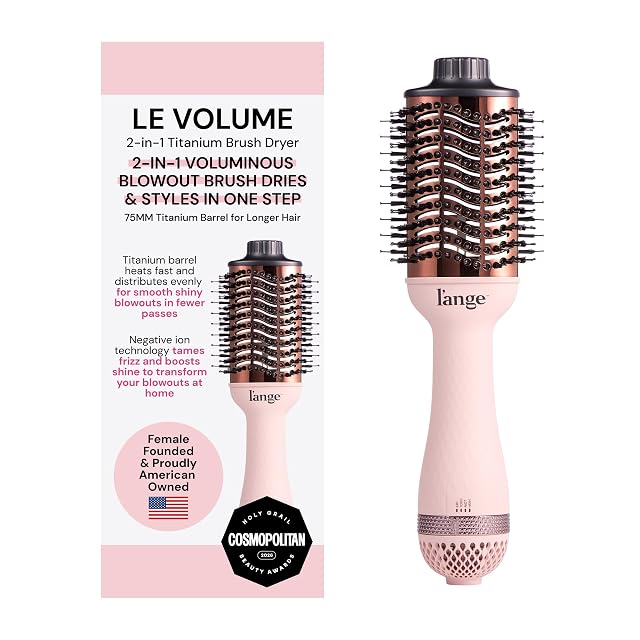
L’ANGE, $47.99 — claims the other mechanism, and it is the right one for humidity: “advanced frizz-free technology to seal the hair cuticle”
Tqcir, $139.99 — lists “flyaway removal” among its functions, with no mechanism
HOT TOOLS, $26.69 — no frizz or static claim at all
So between this page and the L’ANGE at $47.99 you have the two halves of the real answer: ions for static, a sealed cuticle for humidity.
And the honest limit on all of them is that the cuticle is sealed by heat applied with tension.
A strand pulled taut while warm air dries it lies flat — which means the brushing is doing most of the work on every tool here.
The cheapest page on this shelf says that part plainly: the HOT TOOLS at $26.69, “ball-tipped bristles to help gently comb and pull strands taut for ultra-smooth results.”
The oval brush, and why it has two working faces
“Its versatile oval brush has gently curved sides created to smooth hair, while the rounded edges create volume from the roots down to beautifully curled ends.”
This is the only page on this shelf to explain the geometry, and it is worth understanding before buying anything here.
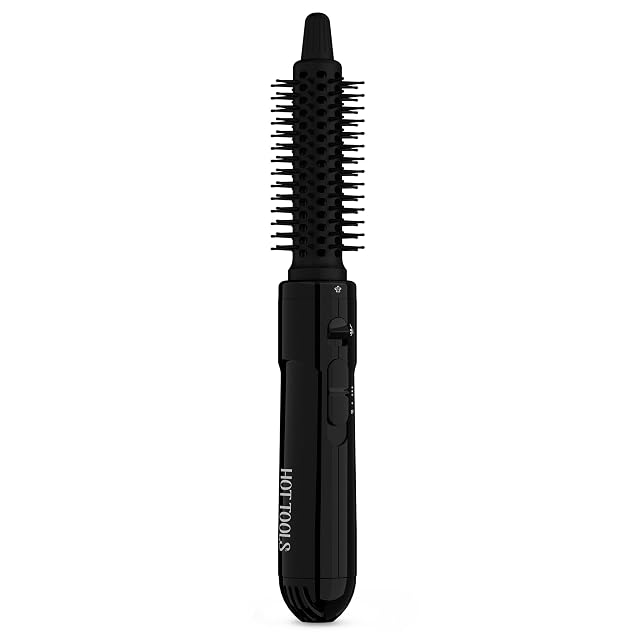
A round barrel is for wrapping. Hair goes around it, you hold it, and it sets into a cylinder — which is why the HOT TOOLS at $26.69 has “a switch that unlocks and rotates the barrel to release the hair easily and avoid tangled hair”. Getting a wrap off a bristled barrel is the category’s real failure.
An oval brush is for passing through, and its two faces are not the same tool.
The flat, gently curved sides are long and shallow. Laid against a section and drawn down it, they hold a lot of hair under tension across a wide, flat surface — which is how you smooth, because tension plus heat makes the cuticle lie flat.
The rounded ends are tight and short. Pressed at the root and lifted, they bend the hair up and away from the scalp — which is how you get volume, and it is the thing a flat brush cannot do at all.
So one pass with the side smooths, and one lift with the end builds root lift.
“One-Step Volumizer” is a fair description of that rather than a slogan.
The “unique airflow vents” detail is the companion: vents let air out through the hair you are holding against the brush rather than only past it, which is what dries a section from the inside as you draw the brush down it.
And the fourth bullet contains a small contradiction worth noting: it is headed “Round Brush for All Hair Types” while the description calls the brush oval. The description is the one doing the work.
No barrel size, which is the specification that matters
No barrel dimension appears anywhere on this listing.
The shelf, by barrel.
1 in — the HOT TOOLS at $26.69
1 in and 1½ in — the Revlon at $30.19, the only item with two, and the only page to label them: “the 1” attachment for soft curls” and “the 1-1/2” attachment for bouncy blowouts”
1.25 in — the Tqcir at $139.99
75 mm oval — the L’ANGE at $47.99, which is 2.95 inches, nearly three times the one-inch barrel
Oval, size not published — this
Not published — the InfinitiPro by Conair at $52.99
Why it matters.
The curl you get is the shape the hair is held in while it cools.
A one-inch barrel relaxes into a defined curl. A three-inch one barely bends the hair, and relaxes into body and movement — which is a blowout.
An oval brush of unstated size could be either.
The description’s own language — “beautifully curled ends”, “volume from the roots down” — suggests a mid-size smoothing tool rather than a curler, and that is an inference rather than a figure.
“This blow dryer brush has 24K Gold technology for fast, even heat that helps protect hair from heat damage”*
The asterisk is a promise that the conditions are stated somewhere, and there is nothing to read: no test, no comparison, no method.
Which matters because “protect hair from heat damage” is a protective claim, and the mechanism offered is a coating material.
Gold is an excellent conductor of heat, so “fast, even heat” is a fair description of what it does — it reaches temperature quickly and gives up its heat quickly to the hair.
How that protects hair is the step the page does not take, and the asterisk is where the explanation should have been.
The comparison on this shelf is instructive, because three pages name a coating and all three make the same claim from materials with opposite properties.
Revlon, $30.19 — ceramic, “triple ceramic coating” in its description: “even heat distribution”. Ceramic is a poor conductor, which is the point: heat spreads into the surface rather than concentrating where the element touches it, so there are no hot spots, and it radiates infrared.
L’ANGE, $47.99 — titanium: “protects hair for even heat distribution”. An excellent conductor.
this — 24K Gold: “fast, even heat”. An excellent conductor.
Opposite physics, one sentence, three times.
The honest distinction is fast against stable: a conductive barrel reaches temperature quickly and transfers heat quickly, while a ceramic one takes longer and holds it more steadily.
At least three of the ten items here name no coating at all: the HOT TOOLS at $26.69, the InfinitiPro by Conair at $52.99 and the Tqcir at $139.99.
The second asterisk is on the brand claim: “Professionals’ #1 Most Trusted & Recommended Hair Tools Brand.”*
Survey claims live entirely in their footnotes — who was asked, how many, when, and on what question — and without it the sentence is unfalsifiable.
It is also the only brand-preference claim on this shelf, and it does not change what the tool does.
A rotating temperature control, which is a better interface
“features a rotating temperature control and 2 heat/speed settings”
The rotating control is the detail worth noticing, and it is unusual at this price.
A switch gives you discrete positions. A rotating control gives you a dial — and on a heated tool that matters, because the right temperature is the lowest one that still sets the style.
A dial lets you find the minimum that works; steps do not — and no other page on this site publishes a continuous speed control.
What the page does not do is reconcile the two claims in the same sentence. A “rotating temperature control” and “2 heat/speed settings” describe different interfaces, and the bullet gives both without saying how they relate.
The settings count itself is the shelf’s low end, tied with its own cheaper sibling.
Tqcir, $139.99 — 3 airflow levels and 4 heat settings, independently, plus the only temperature figure on this shelf: a “high-precision temperature sensor” that “limits the max temperature at 250°F to prevent hair cuticle damage from overheating”
InfinitiPro by Conair, $52.99 — “multiple heat settings” and a cool shot button
L’ANGE, $47.99 — “adjustable heat settings”
this and the HOT TOOLS at $26.69 — 2 heat/speed
Revlon, $30.19 — no count at all, but 1200 W and a cool setting
Note that heat and speed are linked here: you are not choosing them separately, and they want to be independent — a low speed with real heat is how you set a shape, and a high speed with low heat is how you finish without over-drying.
And no page on this shelf except the Tqcir publishes a temperature.
Which is worth setting against GroomVerdict’s own heat-protection shelf, where eight of the nine protectant sprays claim protection “up to 450 °F”. The sprays are rated to a figure; at least five of the ten tools here will not say what they reach. The Tqcir’s 250 °F is 121 °C (250 °F) — barely half of it — and published as a deliberate ceiling.
What is not published
The footnote text for two asterisked claims, as above.
No barrel size, as above.
No wattage. Two pages publish one, and the cheaper of the two publishes more: the Revlon at $30.19 gives 1200 W, the InfinitiPro by Conair at $52.99 gives 1000 W. The Tqcir at $139.99 publishes a “110,000 RPM high-speed brushless motor” and “35m/s strong airflow” instead, which is more informative. Three pages, including this one, publish nothing about power. Which matters here because the first bullet promises “faster drying”: drying hair means moving a lot of water, that means moving a lot of air, and a brush barrel full of bristles obstructs airflow by design. Two items on this shelf print a note saying they cannot dry fully wet hair at all — the HOT TOOLS at $26.69 and the Revlon at $30.19, word for word identically — and this page claims faster drying with no figure to support it.
No temperature, as above.
No cord length. Three pages publish one, and the cheapest has the longest: the HOT TOOLS at $26.69 gives an “8ft. swivel cord” and the InfinitiPro at $52.99 gives 6 feet, while the L’ANGE at $47.99 and the Tqcir at $139.99 claim “professional-length” and “360° tangle-free” with no figure. On a tool used at a mirror, reach is the difference between standing where you can see and standing where the socket is.
No weight. One page on this shelf publishes one: the InfinitiPro at $52.99, “weighing just 1.8 pounds” — 816 g held at head height with the arm raised, which is not light, and is the only figure here you can judge.
No bristle detail. Two pages describe theirs, and one counts them: the InfinitiPro by Conair at $52.99 — “136 flexible bristles”, “epoxy-tipped nylon”, “specially spaced” — and the sibling HOT TOOLS at $26.69, “flexible, ball tipped bristles”. 136 is the only bristle count anywhere on this site: across GroomVerdict, none of the nine items on combs-and-brushes publishes a tooth spacing, none of the five on clipper-blades a tooth count, and none of the five on guide-combs a pitch. A ball or epoxy tip is the same idea by two names — a rounded end that cannot scratch the scalp, which matters more on a heated tool.
No cool setting. Hair takes its shape as it cools, not while it is hot: a strand released while still warm relaxes, and the same strand held until cool keeps the shape. Two pages have one — the Revlon at $30.19 (“cool setting locks in style”) and the InfinitiPro at $52.99 (a “cool shot button”) — and on a tool sold for “blowouts that last”, this is the omission that costs most in results.
No country of manufacture.
Availability
Read on the day this page was built: $49 at the American Amazon shop.
Read from Keepa on the day this page was last revised; stock and price both move without notice.
Prices quoted in this text were read on 2026-10-05. The live price is at the top of the page.