What the maker puts in writing
- “3-in-1 Trimmer Set: equipped with 3 interchangeable heads: a nose hair cutter, an eyebrow trimmer, and a sideburn/beard trimmer.”
- “USB Rechargeable Convenience: a built-in 600mAh rechargeable battery and charges quickly via the included USB Type-C cable. It typically takes about 2 hours for a full charge, which then delivers up to 2 hours of continuous runtime.”
- “HD Digital Battery Indicator: An HD digital display on the handle clearly shows the remaining battery percentage after you turn it on… We recommend recharging your trimmer when the battery level drops below 20%.”
- “High-Efficiency & Pain-Free: The trimmer head features safe rounded tips and dual-edge stainless steel blades. Powered by a high-performance 8,500 RPM motor… The blades are engineered to prevent friction heat, protecting your skin from burns.”
- “Ultra-Quiet Operation: operates at under 60 decibels — quieter than a normal conversation.”
- “Removable & Easy to Clean: Simply twist the head to the right to detach it, and to the left to reattach. Rinse the heads under running water… comes with a cleaning brush and a dust-proof cap.”
“about 2 hours for a full charge, which then delivers up to 2 hours of continuous runtime”
Nobody uses a nose trimmer for two hours.
A nostril takes thirty to sixty seconds. So two hours is roughly 120 uses — which at once a week is more than two years, and at once a month is a decade.
No lithium cell holds a charge for either.
Which means the figure that actually governs this tool is not runtime. It is self-discharge: how much charge is left when you pick it up after six weeks in a drawer.
No page on this shelf publishes that, because nobody does.
Two pages quietly do the right arithmetic and publish months instead.
ZORAMI, $9.99 — “more than 6 months for 5mins’ of use at a time”, on one AA
XOOMRSCP, $16.99 — “two minutes of continuous use for 2-3 months each time”
Those are the useful numbers, because they are expressed in the unit a buyer lives in.
The rest publish continuous minutes: this at 120, the Dollar Shave Club at $29.20 and the MANSCAPED Pro at $39.97 at 60 each, the MANSCAPED at $23.99 at 45.
And three publish nothing: the Conair at $13.29 and the Norelco at $24.96, both AA tools, and the ROYAL at $15.99 — which is entirely manual and needs no figure at all.
The 600 mAh is worth something as a cross-check, though: it is a real capacity, and it is the only one on this shelf.
The battery display, which is the answer to the real problem
“An HD digital display on the handle clearly shows the remaining battery percentage… recharging when the battery level drops below 20%”
This does not solve self-discharge. It makes it visible.
Which on a tool you pick up unpredictably is most of what you want.
You find out it is at 40 per cent while standing at the mirror — rather than finding out it is dead, at the moment you reached for it because you noticed something and you are about to leave the house.
No other page on this shelf offers any charge indication at all.
And it is the one feature here that engages with the category’s actual weakness, which the manual tool on this shelf sidesteps entirely.
ROYAL, $15.99 — “Operated entirely by manual control without batteries or charging cords”
That tool cannot go flat. This one tells you before it does. Those are the two coherent answers on this shelf, and the seven other pages give neither.
The 20 per cent recommendation is a small, sensible addition: lithium cells deliver less current as they drop, and a trimmer motor losing current loses torque — which on a rotary head means it stops cutting and starts pulling.
Friction heat, which only this page mentions
“Powered by a high-performance 8,500 RPM motor… The blades are engineered to prevent friction heat, protecting your skin from burns.”
What produces the heat.
A rotary trimmer shears hair between a blade spinning inside a slotted guard and the fixed edges of the slots.
Metal moving against metal at thousands of revolutions a minute generates heat at the contact, and so does cutting itself.
In open air that heat dissipates. Inside a nostril it does not — the guard is surrounded by warm, moist tissue that insulates it, and the tool is held still against skin for a minute.
So a trimmer that gets warm gets noticeably warm in the one place you would least want it to.
The risk is real, the physics is simple, and eight of nine pages on this shelf do not mention it.
It also connects to the specification above it, which is the coherent part: 8,500 RPM is the second highest figure here, and this is the page that raises the heat question.
The shelf, on motor speed.
10,000 RPM — the XOOMRSCP at $16.99, the same price as this, and the highest here
8,500 RPM — this
7,000 RPM — the MANSCAPED at $23.99, described as “a premium 7,000 RPM motor”
Not published — the ZORAMI at $9.99 (which claims an “upgraded motor… less power-consuming by 5%”, with no baseline), the Conair at $13.29, the ROYAL at $15.99 (manual), the Norelco at $24.96, the Dollar Shave Club at $29.20, the MANSCAPED Pro at $39.97
And faster is not obviously better.
What matters on a rotary head is whether the hair is cut before it is pulled — a function of edge sharpness and slot geometry rather than speed alone.
The one page that names a blade geometry is the Conair at $13.29: a “beveled blade system”. A bevelled edge starts the cut at a point where a square edge pushes before it parts, which is felt as pulling.
So this page publishes a high speed and then publishes the mitigation for the problem a high speed creates, which is more coherent than publishing either alone.
The manual tool on this shelf cannot generate friction heat at all — the ROYAL at $15.99, with “12 dual-edged blades” turned by hand. A limitation that happens to be a safety property, and its page does not claim it.
“3 interchangeable heads: a nose hair cutter, an eyebrow trimmer, and a sideburn/beard trimmer”
Why one head cannot do all three.
A rotary nose head cuts whatever enters its slots, to whatever length the guard leaves, in every direction at once.
Exactly right for a nostril — a curved cavity you cannot see into, where orientation must not matter.
And exactly wrong for a line. It has no straight cutting edge, so it cannot define an edge on a sideburn or a neckline, and it cannot shorten a brow hair to a chosen length.
An eyebrow head is a small clipper: a straight edge, usually with a short comb, that shortens hairs along a line.
A sideburn or beard head is the same idea at a larger width, for an edge you want visible and straight.
So three heads is three tools.
Which makes the claims on two other pages worth reading sceptically.
The ZORAMI at $9.99 says its single rotary head removes hair “from your nose, ears, eyebrows, beard, and face”. The XOOMRSCP at $16.99 says the same thing in the same words.
A rotary head will shorten a stray brow hair. It will not shape a brow, and it cannot edge a beard.
What the shelf actually ships.
3 heads — this
Rotary + detail + eyebrow attachments + pouch — the Norelco at $24.96, the only page to use the plural for eyebrow attachments
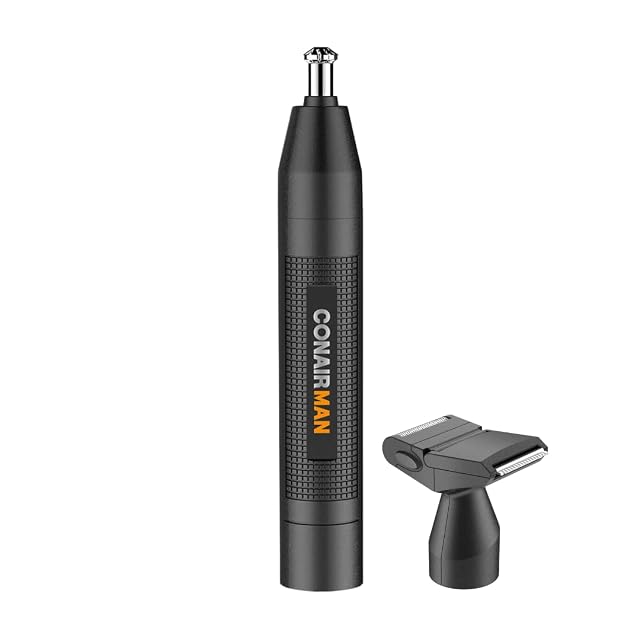
2 heads + pouch — the Conair at $13.29: nose, plus a “2-in-1 Shaver/Detail Trimmer”
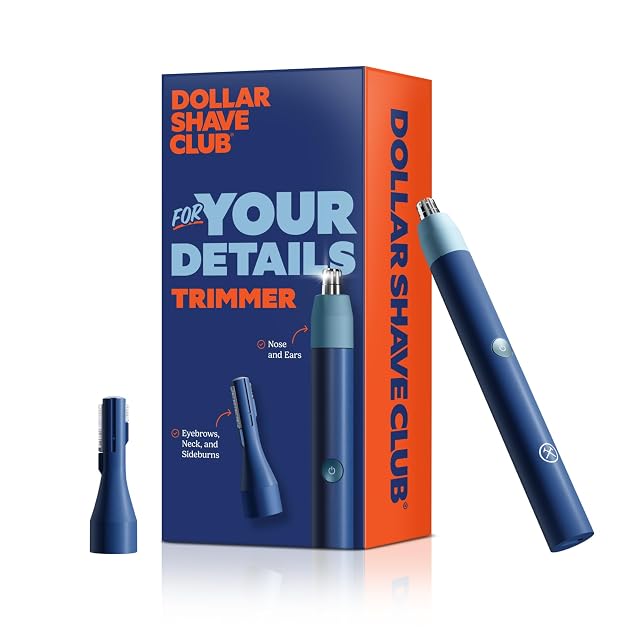
2 heads — the Dollar Shave Club at $29.20 (rotary and brow/detail), and the MANSCAPED Pro at $39.97 (rotary and a “SkinSafe eyebrow trimming attachment”)
1 head — the ZORAMI at $9.99, the ROYAL at $15.99, the XOOMRSCP at $16.99, the MANSCAPED at $23.99
So at $16.99 this is the most heads for the least money on this shelf by a clear margin. The next most generous is the Norelco at $24.96.
And the page does the small thing that makes three heads usable: it tells you how to change them.
“Simply twist the head to the right to detach it, and to the left to reattach.”
Which sounds trivial, and is the kind of instruction otherwise absent everywhere on this shelf — and on a tool with three parts that come off, the direction is exactly what you forget.
Under sixty decibels, and the comparison is wrong
“operates at under 60 decibels — quieter than a normal conversation”
A normal conversation is about 60 decibels.
So “under 60” is roughly conversation level rather than quieter than it.
And two cheaper pages claim better.
Under 50 dB — the ZORAMI at $9.99 and the XOOMRSCP at $16.99, both publishing the identical figure
Under 60 dB — this
No figure — the Conair at $13.29, the ROYAL at $15.99 (manual, so the only noise is the mechanism), the MANSCAPED at $23.99, the Norelco at $24.96, the Dollar Shave Club at $29.20, the MANSCAPED Pro at $39.97
Decibels are logarithmic, so 50 against 60 is about a tenth of the sound energy. The gap between this claim and the cheaper two is larger than it reads.
What no page on this shelf says, and it is the most important thing about noise on this tool.
The trimmer is inside your head.
A motor held in a nostril transmits sound through the bones of the skull directly to the inner ear, bypassing the air path — so a nose trimmer is dramatically louder to the person using it than the same tool measured at arm’s length.
Which means an external decibel figure does not describe what you will hear, and it also explains why this is the one grooming tool people reflexively describe as alarming: not volume, but proximity.
The claim about use that follows is fair, though: “perfect for use even when others are resting nearby.” The person next door hears the 60 dB. You hear something else.
What is not published
No waterproof rating for the body. “Rinse the heads under running water” covers the parts that need it, and a washable head is not a waterproof tool. Three pages on this shelf publish an IP rating: the MANSCAPED Pro at $39.97 defines it fully — “IPX7 rated to protect against immersion in up to one meter of fresh water for up to 30 minutes” — the Dollar Shave Club at $29.20 gives the duration, and the ZORAMI at $9.99 names IPX7 and adds “soak cleaning or having it take a shower”. Why it matters here: what a nose trimmer cuts is short, fine and wet, and the cuttings pack into the slots of the guard rather than falling out. A clogged guard means hair cannot enter the slots, the blade cannot reach it, and the tool pulls instead of cutting — which is the failure this page’s own fourth bullet promises to avoid. The cleaning brush and dust cap are the right companions, and the body still is not rated.
No blade geometry. “Dual-edge stainless steel” gives a configuration and a material class without a grade or an edge angle. One page names a geometry — the Conair at $13.29, a “beveled blade system” — and one names a count: the ROYAL at $15.99, “an exclusive 12 dual-edged blade mechanism”, which is the only blade count on this shelf.
No guard or slot dimension, which no page here publishes and which is the figure that would actually describe how close it cuts and how little skin can reach the blade. The one page that names the guard as a system is the Norelco at $24.96: “The Protective Guard System protects sensitive skin by providing a barrier between skin and blades.”
No self-discharge or shelf-charge figure, as above — the number this whole category needs and nobody publishes.
No usage instruction. One page on this shelf gives one: the XOOMRSCP at $16.99 — “slowly insert the comfortable cone tip into your nose or ear. Allow the nose trimmer to trim hair for at least 60 seconds.”
No warranty. At least six of the twelve items here publish nothing, and this is one of them. The Conair at $13.29 publishes a “Limited 5-year warranty” — the longest fixed term anywhere in GroomVerdict — the Norelco at $24.96 publishes two years, and the ZORAMI at $9.99 a “30-day full-money-back without a lot of arguing required”. Across this site published terms are the exception: two years on one air styler, a lifetime guarantee on one comb, 365 days on one brush, 30 days on one clipper blade and one guide comb, and a “90-DAYS Unconditional Return + 12-Month Quality Promise” on the CIICII scissors kit at $19.98.
No country of manufacture. One item on this shelf publishes one, and it is the only one anywhere on this site: the ROYAL at $15.99 — “Manufactured in South Korea by an established company with 60 years of metal product manufacturing experience”, with a published patent number.
Availability
Read on the day this page was built: $17 at the American Amazon shop.
Read from Keepa on the day this page was last revised; stock and price both move without notice.
Prices quoted in this text were read on 2026-10-05. The live price is at the top of the page.