What the maker puts in writing
- “SAFE NASAL PROTECTION: Designed as a safe alternative to sharp scissors or painful tweezers. The ROYAL manual trimmer features precision rotary blades engineered to trim inside the nose cleanly without pinching, scratching, or causing cuts to sensitive nasal walls.”
- “SMOOTH & PAINLESS TRIMMING: Engineered to eliminate uncomfortable pulling, tugging, or snagging.”
- “WATER-RESISTANT & EASY TO CLEAN: this water-resistant nose trimmer can be used in the shower and rinsed directly under running water.”
- “BATTERY-FREE KOREAN CRAFTSMANSHIP: Operated entirely by manual control without batteries or charging cords. Manufactured in South Korea by an established company with 60 years of metal product manufacturing experience.”
- “THOUGHTFUL GIFT IDEA & PATENTED DESIGN: Features an exclusive 12 dual-edged blade mechanism (PAT# 30-2020-0009*) built for long-lasting reliability and performance.”
“Operated entirely by manual control without batteries or charging cords.”
Think about the duty cycle.
A nose trimmer is used for about a minute, once a week at most, and for many people once a month. It spends essentially its entire life in a drawer.
Which is exactly the condition under which batteries fail you.
A lithium cell left for three months self-discharges. So a rechargeable trimmer picked up after a long gap is a trimmer that needs charging first — at the precise moment you reached for it because you noticed something in a mirror and you are about to leave the house.
The shelf, on power.
Manual — this
AA — the ZORAMI at $9.99, which publishes the most useful battery figure here (“more than 6 months for 5mins’ of use at a time”), the Conair at $13.29, and the Norelco at $24.96
USB rechargeable — the JEETIF at $16.99 (600 mAh, 2 hours of runtime), the XOOMRSCP at $16.99, the MANSCAPED at $23.99 (45 minutes), the Dollar Shave Club at $29.20 (60 minutes), the MANSCAPED Pro at $39.97 (60 minutes)
And the runtime figures expose the problem rather than solving it.
Nobody uses a nose trimmer for 45 continuous minutes.
The JEETIF’s two hours is the longest number on this shelf and the least useful: 120 one-minute uses, if the charge holds for the months it would take to get through them.
Two pages do the right arithmetic and publish months instead: the ZORAMI at $9.99 (“more than 6 months”) and the XOOMRSCP at $16.99 (“two minutes of continuous use for 2-3 months each time”).
This page needs neither figure.
The Dollar Shave Club at $29.20 argues the opposite case explicitly — “without expensive AA or AAA batteries” — and it is the weakest argument on the shelf, because the ZORAMI’s own figure puts the running cost of an AA tool at roughly two batteries a year.
The one rechargeable page with a real answer to the drawer problem is the most expensive: the MANSCAPED Pro at $39.97 ships a travel lock — “press and hold the lock button for 3 seconds” — which stops the tool running itself flat in a bag.
That addresses accidental discharge, not self-discharge. They are different failures, and this page sidesteps both.
Twelve dual-edged blades, which is the only count here
“an exclusive 12 dual-edged blade mechanism (PAT# 30-2020-0009)”*
Twelve dual-edged blades is twenty-four cutting edges.
And it matters precisely because the tool is slow.
How any trimmer on this shelf cuts: a blade turns inside a slotted guard, hair enters through the slots, and it is sheared between the moving blade and the fixed edge of the slot.
The guard is what makes it safe — the blade never touches you, because a slotted shell stands between it and the nasal wall.
What a motor contributes is rotations. What the cut needs is a sharp edge meeting a hair held in a slot.
So a hand-turned mechanism cuts the same way. It simply does fewer cuts per second — and more edges per revolution is how a manual mechanism compensates for not having a motor.
The specification and the design are consistent, and no page here publishes anything comparable.
For contrast, the four pages that publish a motor speed.
10,000 RPM — the XOOMRSCP at $16.99
8,500 RPM — the JEETIF at $16.99
7,000 RPM — the MANSCAPED at $23.99, which calls it “a premium 7,000 RPM motor”
Not published — the other five
And faster is not obviously better. Too fast generates friction heat, which exactly one page addresses: the JEETIF at $16.99 — “the blades are engineered to prevent friction heat, protecting your skin from burns.”
A manual tool cannot generate friction heat at all — a limitation turned into a safety property, and the page does not claim it.
What it costs you in practice: time, and your hand.
Where an electric head clears a nostril in thirty seconds, a manual one takes a minute or two of turning. And you have to keep turning.
What it buys you in exchange is control: you can stop instantly, which is a genuine advantage in a sensitive cavity.
The patent number, and the only country of manufacture on this site
“Manufactured in South Korea by an established company with 60 years of metal product manufacturing experience”
Three specifics, and all three are rare on this shelf.
The patent number is the only one here.
The Conair at $13.29 claims a “patent pending 360-degree beveled blade system” — a pending application rather than a granted right, with no number. And on another shelf of this site, the TYMO heat protectant at $16.99 claims a “patent anti-stuck spray nozzle” with no number either.
A number is the difference between a claim and a reference: it names a specific registered mechanism, and it says the maker went through a process rather than writing a word.
The country of manufacture is the only one anywhere on this site.
Not one of the other eight items on this shelf publishes where it was made — and the same silence runs right through GroomVerdict: no item on the cutting-scissors shelf publishes a country, none on guide-combs, none on hair-dryers, none on heat-protection, none on hot-air-brushes.
Which makes a plain statement of origin genuinely unusual. And South Korea for precision metal work is a credible claim rather than a flattering one.
The sixty years is the softest of the three, and it is doing a specific job.
It says the maker is a metal-products manufacturer rather than a brand that commissioned a trimmer.
On a tool whose whole function is twenty-four cutting edges turning inside a guard, that distinction is the one that would predict quality — and it is also unverifiable from the page.
What the three together buy you is confidence about the only part there is to get right.
An electric trimmer is a motor, a cell, a switch, a seal and a cutting head: five things that can fail. This is a cutting head and a handle.
Water-resistant, and the easiest such claim to believe
“this water-resistant nose trimmer can be used in the shower and rinsed directly under running water”
No IP rating is given — and this is the one tool on the shelf where that matters least, because there is nothing electrical inside to keep out.
Why rinsing is maintenance rather than hygiene on any of these.
What a nose trimmer cuts is short, fine and wet. The cuttings come out mixed with moisture and pack into the slots of the rotary guard rather than falling out.
Which is exactly how one of these stops working: hair cannot enter the slots, the blade cannot reach it, and the tool pulls instead of cutting.
And pulling is the thing every page on this shelf promises not to do — this one twice over, in bullets one and two.
What the shelf publishes.
IPX7, fully defined — the MANSCAPED Pro at $39.97: “immersion in up to one meter of fresh water for up to 30 minutes”
IPX7, duration given — the Dollar Shave Club at $29.20: “temporary immersion for up to 30 minutes”
IPX7, named only — the ZORAMI at $9.99, which adds “soak cleaning or having it take a shower”
Water-resistant, no rating — this, and the MANSCAPED at $23.99 (“works in wet and dry conditions”)
Washable head only — the Conair at $13.29, the JEETIF at $16.99 and the XOOMRSCP at $16.99
Nothing at all — the Norelco at $24.96
A washable head is not a waterproof tool, which is the distinction four of those pages sit on the wrong side of.
And on a mechanism with twelve blades and no seals, “rinsed directly under running water” is a claim with very little to go wrong.
What it is being sold against
“Designed as a safe alternative to sharp scissors or painful tweezers.”
That framing is worth taking seriously, because the alternatives are genuinely worse and this site stocks one of them.
On GroomVerdict’s cutting-scissors shelf, the LePinko two-piece set at $6.99 is sold for exactly this job, and its own bullet explains why the geometry has to be right: “Rounded precision blade tip curves away from skin for safely.”
A sharp point in a nostril is the one grooming injury that is genuinely common — you are working blind, against skin you cannot see, in a cavity that moves when you flinch.
Tweezers are the other half of the comparison, and they are worse in a different way: plucking a nasal hair removes it at the root, and the nasal lining is exactly where that is unwise.
So a rotary guard is the right answer to both, and every item on this shelf is one.
What this page adds to the safety argument is the absence of a motor.
A hand-turned blade stops when your hand stops. An electric one does not — which is the quiet reason the most expensive item on this shelf carries the only disclaimer here: the MANSCAPED Pro at $39.97, “SkinSafe technology does not guarantee cut protection.”
And the one page that names the mechanism properly is the Norelco at $24.96: “The Protective Guard System protects sensitive skin by providing a barrier between skin and blades.”
Which is what makes slot size the specification that would matter most on any of these. No page on this shelf publishes it.
What is not published
No warranty. At least six of the twelve items here publish nothing, and this is one of them — on the page that makes the most of its manufacturing credentials. The Conair at $13.29 publishes a “Limited 5-year warranty”, which is the longest fixed term anywhere in GroomVerdict; the Norelco at $24.96 publishes two years; and the ZORAMI at $9.99 publishes a “30-day full-money-back without a lot of arguing required”. Across this site published terms are the exception: two years on one air styler, a lifetime guarantee on one comb, 365 days on one brush, 30 days on one clipper blade and one guide comb, and a “90-DAYS Unconditional Return + 12-Month Quality Promise” on the CIICII scissors kit at $19.98. On a tool whose selling point is “built for long-lasting reliability”, a term would have been the natural proof.
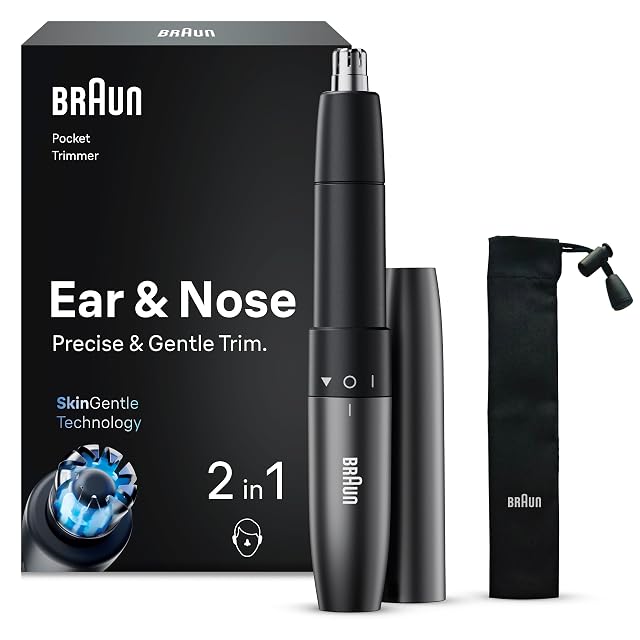
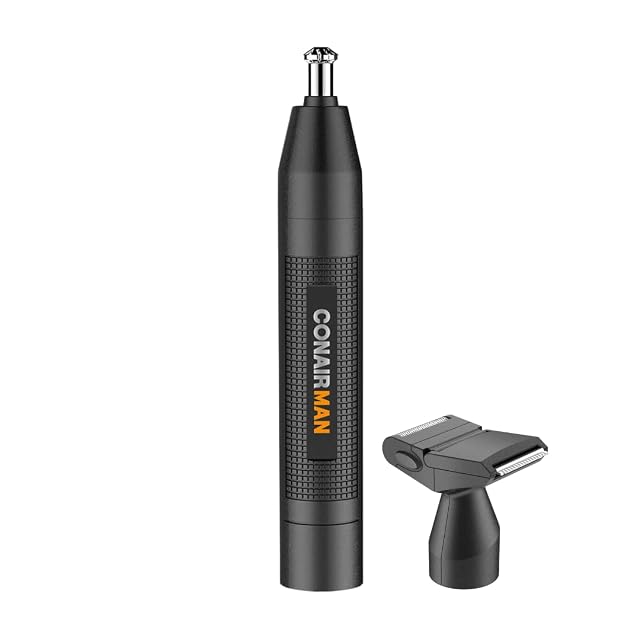
No attachments. This is a single-head tool, and it is a nose tool. Five items on this shelf ship more: the JEETIF at $16.99 ships three heads (nose, eyebrow, sideburn/beard); the Norelco at $24.96 adds a detail trimmer, eyebrow attachments and a pouch; the Conair at $13.29 adds a “2-in-1 Shaver/Detail Trimmer” and a pouch; the Dollar Shave Club at $29.20 adds a brow and detail head; and the MANSCAPED Pro at $39.97 adds a “SkinSafe eyebrow trimming attachment”. The distinction is real rather than a bonus: a rotary head trims whatever enters its slots to a fixed length and cannot shape a line, while a detail or eyebrow head is a small clipper you run along one. And this page is the only one on the shelf that does not claim to do ears, eyebrows or beards — its bullets talk about the nose throughout, which is consistent.
No material. “Metal product manufacturing experience” is about the maker rather than the blades, and no steel grade or type is given — where the ZORAMI at $9.99 says “high-quality stainless steel”, the JEETIF at $16.99 “dual-edge stainless steel blades”, the MANSCAPED at $23.99 a “stainless steel rotary blade” and the Norelco at $24.96 “dual-sided steel blades”. None of those names a grade either.
No IP rating, as above.
No guard or slot dimension, which no page on this shelf publishes and which is the figure that would actually describe how close it cuts.
No usage instruction. One page on this shelf gives one, and it is unexpectedly specific: the XOOMRSCP at $16.99 — “slowly insert the comfortable cone tip into your nose or ear. Allow the nose trimmer to trim hair for at least 60 seconds.” On a manual tool, where the user supplies the speed, a published number of turns or a duration would have been more useful here than anywhere else on the shelf.
No storage. Two items ship a pouch — the Conair at $13.29 and the Norelco at $24.96 — and the ZORAMI at $9.99 and XOOMRSCP at $16.99 ship a dust cap. A rotary guard left open in a drawer collects lint, which clogs the slots the same way hair does.
No cleaning brush, which the JEETIF at $16.99 and XOOMRSCP at $16.99 both include — the companion to rinsing on a tool whose failure mode is a packed guard.
Availability
Read on the day this page was built: $16 at the American Amazon shop.
Read from Keepa on the day this page was last revised; stock and price both move without notice.
Prices quoted in this text were read on 2026-10-05. The live price is at the top of the page.