What the maker puts in writing
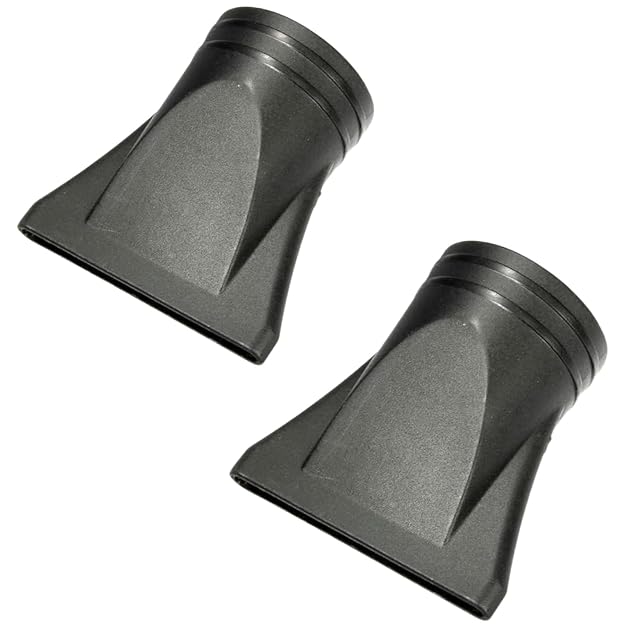
- “WIDE DESIGN: Professional hair dryer nozzle with extra-wide mouth for faster and more efficient hair drying and styling”
- “DUAL PACK: Set includes 2 black nozzle attachments for convenient backup or sharing between multiple styling stations”
- “UNIVERSAL FIT: Compatible with most standard hair dryer models, easy to attach and remove as needed”
- “PROFESSIONAL QUALITY: Salon-grade construction designed for daily use in professional hairdressing environments”
- “CONCENTRATED AIRFLOW: Precision nozzle design helps direct air for precise styling and reduced frizz”
- From the name: “2Pcs”, “Wide Design”, “Black”
- Reference Hdnz-2bk · Catalog: 6 g (0.2 oz)
Wide mouth and concentrated jet, both on one listing
Bullet one: “Professional hair dryer nozzle with extra-wide mouth for faster and more efficient hair drying and styling.”
Bullet five: “CONCENTRATED AIRFLOW: Precision nozzle design helps direct air for precise styling and reduced frizz.”
Why the two cannot both be true of one part.
A nozzle changes the shape of the airflow leaving a dryer, and the whole effect comes from the cross-section.
Narrow the opening and the same volume of air has to move faster through it — so you get a fast, directional jet that can be aimed along a section of hair held under tension. That is a concentrator, and it is what “direct air for precise styling” describes.
Widen the opening and the air slows and spreads — which dries a larger area faster overall, and more gently, and is what “faster and more efficient hair drying” describes.
They are the two ends of one trade: speed of air against area covered.
And the shapes differ visibly. A concentrator is a flattened slot, usually an inch or less across its narrow axis. A wide nozzle is a broad, shallow fan.
So the honest reading is that one of the two bullets was written for a different part — and the product name leans one way: “Hair Dryer Nozzle Wide Design”.
Which matters because the two are used for different jobs.
A concentrator is for smoothing and for a blow-out: hair held taut on a round brush, air aimed down the length of it, cuticle laid flat.
A wide nozzle is for rough-drying, where you want the water gone and do not yet care about shape.
And the third job is on this same shelf, done by neither.
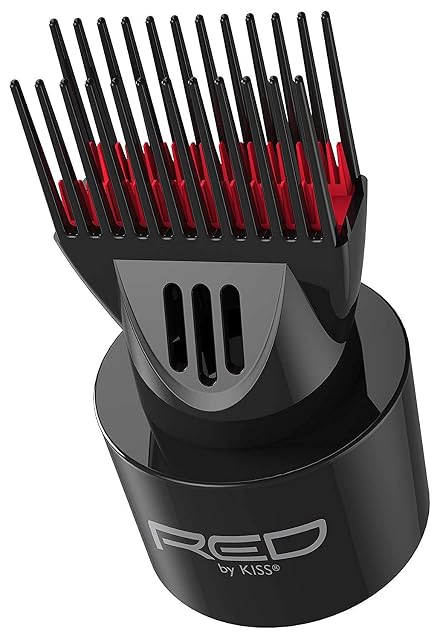
The Red by Kiss pik at $8.49 is a comb that mounts on the dryer — “Efficient Double Layer Detangling: Featuring expertly crafted teeth, this comb ensures hassle-free detangling with its robust double-layer mechanism” — which spreads the air through teeth and detangles while it dries.
Three different jobs, two products, and one page that claims two of them at once.
The practical advice: look at the photograph, not the bullets. The shape of the opening tells you which tool you are buying, and this page’s own two bullets cancel each other out.
Universal fit, with no diameter
“Compatible with most standard hair dryer models, easy to attach and remove as needed.”
How a nozzle actually mounts.
A dryer’s outlet ends in a raised ring, and the nozzle is a collar that pushes over it with an interference fit — sometimes with a bayonet lug, sometimes just friction.
So whether a nozzle fits is a question about one number: the outside diameter of that ring.
Which is not published here.
Nor on the other item on this shelf. The Red by Kiss pik at $8.49: “Precision-engineered, this comb boasts a design compatible with most hair dryers. Whether you own a salon-grade dryer or a household variant, this comb ensures a seamless fit.”
Two attachments, two universality claims, and no diameter on either page.
Why “most standard” is doing a lot of work: there is no standard.
Outlet rings cluster around a few common sizes because dryers copy one another, which is why third-party nozzles exist at all — and a dryer at the edge of that cluster takes nothing but its own.
It is the same gap this park has met before on a different kind of shelf. A sous-vide container lid sold with a pre-cut hole, “tested for ANOVA and CHEFSTEPS machines”, which asks the buyer to “confirm the suitability of your machine according to the size of pre-cut hole” and never publishes the hole’s diameter.
The practical check, since the page will not help: measure the outside diameter of your dryer’s outlet ring with a ruler before buying, and read “universal” as “probably”.
At $3.79 a nozzle, the cost of being wrong is small — which is the fair thing to say for this product, and also the strongest argument for the pair.
“Set includes 2 black nozzle attachments for convenient backup or sharing between multiple styling stations.”
A nozzle is a part that gets dropped, stood on and lost. A spare is worth more than a specification sheet — and this is the only item in this family sold two at a time.
The catalog gives 6 g for the pair, so about 3 g each.
Which is the lightest object anywhere on this site, and it tells you something real: this is a thin molding, not a substantial part.
For comparison, the other item on this shelf is 141 g — the Red by Kiss pik at $8.49, at 83 × 81 × 154 mm, which is consistent with a broad two-row comb head.
A factor of 47 between the two objects on one shelf, which is the clearest illustration of how different they are.
The dimensional figure here is not usable. 25 × 3 × 3 mm cannot describe a nozzle of any kind — a 3 mm nozzle would not pass over the outlet ring of any dryer made.
So the weight is the only credible catalog number on this page, and the mouth width — the thing bullet one sells — is published nowhere.
Which is the specific omission to notice: a nozzle advertised on the width of its mouth, with no width.
No material, and no temperature
The page names no material at all.
Bullet four is the closest it comes: “PROFESSIONAL QUALITY: Salon-grade construction designed for daily use in professional hairdressing environments.”
Which is an adjective about an environment rather than a substance.
The other item on this shelf does better, and gives both halves.
The Red by Kiss pik at $8.49: “Constructed from heavy-duty nylon, this comb is designed for longevity. Its heat-resistant properties and sturdy build eliminate concerns of broken or bent teeth.”
Nylon is the right answer for this service. It is tough, it does not soften until well above anything a domestic dryer produces, and it is the standard material for a comb that lives in hot air.
Why the temperature question is real here rather than pedantic.
A hair dryer is the hottest airflow on this site.
On GroomVerdict’s own air-stylers shelf the highest published figure is 110 °C (230 °F) / 230 °F, on the AVENHO WT-665 — because an air styler deliberately runs cool and lets the airflow do the shaping.
On the curling-tools shelf the figures run to 450 °F, on the Hot Tools waver — but that is a metal barrel in contact with hair, not moving air.
A domestic dryer’s air on its hottest setting sits between those: hot enough to soften a cheap thermoplastic held in the stream for twenty minutes a day.
And a nozzle is the part closest to the element.
What failure to expect: a nozzle that has gone soft stops being a tight fit on the ring, and a loose nozzle blows off mid-stroke.
Which is the predictable end of a three-gram unnamed plastic, and the reason the nylon claim on the other page is worth ninety cents more.
What this attachment is actually for, and where it sits against the rest of the site
A dryer with no nozzle is a hot-air blower. It dries, and it cannot style.
Everything shaped with a dryer depends on directing the air: a blow-out, a smoothed section, a lifted root.
Which is why a nozzle is the one accessory a dryer genuinely needs, and why losing it is the commonest reason a dryer stops being useful.
The alternative approach is the one this site sells a whole shelf of: put the shaping into the tool instead of the air.
On GroomVerdict’s air-stylers shelf, a hot-air styler combines the dryer and the brush in one body — the oudim at $46.50 ships six heads including a diffuser, the StyleVibe at $93.96 ships left and right auto-wrap barrels, and the 7MAGIC at $109.99 names the physics: “auto-wrap curlers powered by advanced Coanda technology.”
And on the curling-tools shelf, four of the seven items are non-electric tools that need a dryer pointed at them — a comb, a spherical brush, a pinned styler.
So this shelf is the cheap end of the same idea: the dryer you already own, aimed properly.
Which makes the comparison with the other item here the useful one. A nozzle makes the air narrow and fast. A pik makes it wide and combed. Neither is better; they are opposite tools, and this page is the one that claims to be both.
What is not published
No mounting diameter, as above — the only figure that decides whether it fits.
No mouth width, as above — on a nozzle whose first bullet is about its width.
No length. A concentrator’s length matters almost as much as its width: a long one aims better and gets in the way more.
No material, as above.
No temperature limit, as above.
No dishwasher or cleaning statement. A nozzle collects lint and product spray round its inner lip, and nothing here says whether it can be washed.
No credible dimensions, as above.
No warranty. Several of the four items on this shelf publishes one — which across this site is the norm rather than the exception: not one item on capes-and-mats, blade-care, clipper-blades or combs-and-brushes publishes a term, and one of six on air-stylers does.
No country of manufacture, which neither item on this shelf publishes.
Availability
Read on the day this page was built: $8 at the American Amazon shop.
Read from Keepa on the day this page was last revised; stock and price both move without notice.
Prices quoted in this text were read on 2026-10-05. The live price is at the top of the page.