What the maker puts in writing
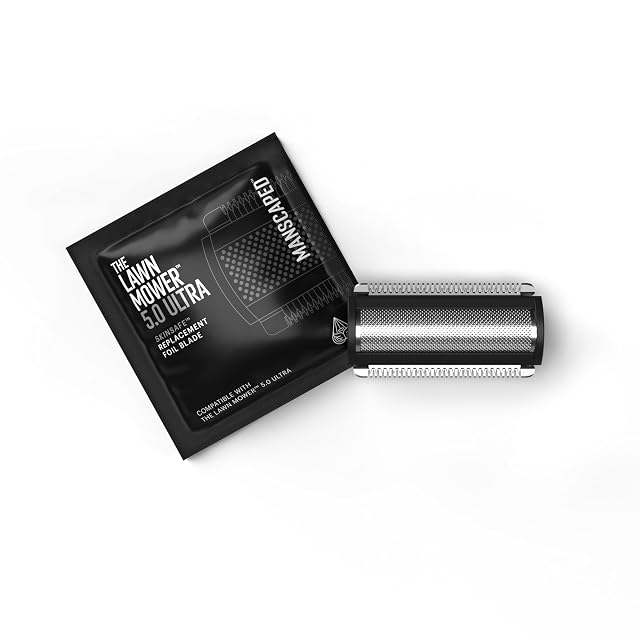
- *“SKINSAFE TECHNOLOGY: The Lawn Mower 5.0 Ultra is equipped with a SkinSafe foil blade to keep your boys in good hands, trim to shave. SkinSafe technology does not guarantee cut protection.”
- “SNAP-IN BLADE MODULE: Because it’s light years beyond other trimmers, The Lawn Mower 5.0 snap-in blade module creates grooming experience like no other.”
- “HOW TO USE: To replace the foil blade on The Lawn Mower 5.0 Ultra, push the bottom of the blade head with your thumb in the direction of the arrow to snap it out. Then, insert the lug of the new blade head into the slot in the top of the trimmer. Then, press it back until it snaps in place.”
- “COMFORTABLY CLOSE: Designed to remove groin hair in a single stroke, the bi-directional foil blades capture any long hairs left behind, while the foil brings the shave down to the skin.”
- “ENGINEERED TO PERFORM: The stainless steel blade was designed to withstand dirt, oil, and buildup that can lead to irritation while also being easy to clean and replace. Each foil comes pre-lubricated to run smoothly, reducing wear and tear while helping you hit max RPMs.”
The only fitting instructions on this shelf
“push the bottom of the blade head with your thumb in the direction of the arrow to snap it out. Then, insert the lug of the new blade head into the slot in the top of the trimmer. Then, press it back until it snaps in place.”
Three movements, a direction, and the two parts that engage: a lug and a slot.
What the rest of the shelf says.
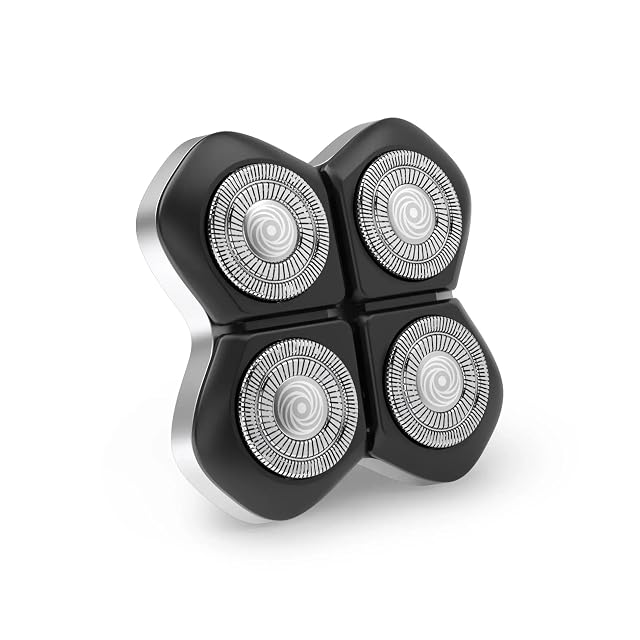
Skull Shaver, $24.97 — “Skull Shaver’s easy-to-remove blade system also simplifies cleaning”
Freebird, $29.95 — “easy to install and maintain, providing a hassle-free grooming solution”
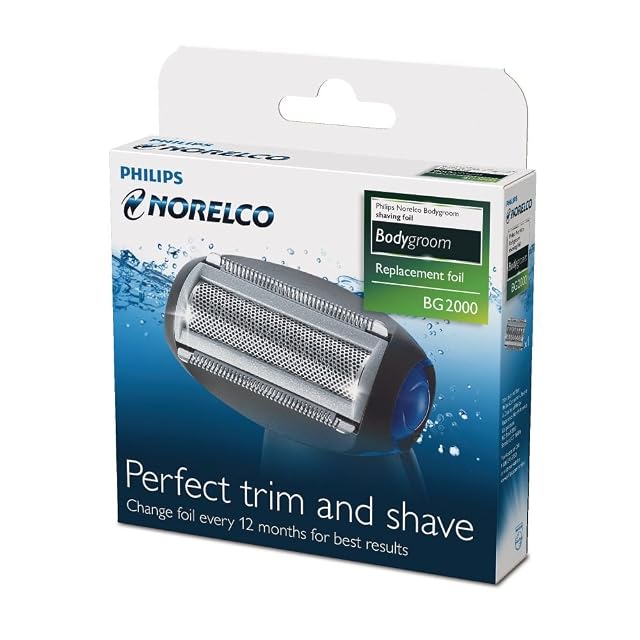
Norelco, $33.33 — nothing at all; its four bullets are entirely model numbers
Three pages assert that it is easy. One explains it.
Why the distinction is practical rather than editorial.
You buy this part to fit it yourself, every few weeks or months, in a bathroom, with wet hands, having last done it long enough ago to have forgotten.
And the specific thing you forget is the direction.
A snap-in module has one release direction and feels solid in every other — so the failure mode is not confusion, it is force. You push the wrong way, it does not move, you push harder, and you break a clip on a part that is otherwise fine.
“In the direction of the arrow” tells you where to look on the tool itself, which is what makes the instruction usable without the page in front of you.
And “insert the lug into the slot in the top” tells you the module hinges in rather than dropping on — the second thing people get wrong, which is trying to press the whole thing flat at once.
What the instruction also tells you about the product.
A snap-in blade module is a different proposition from a bare foil.
On many shavers the replaceable part is the thin perforated sheet alone, which has to be stretched over a frame without creasing it — and a creased foil is a ruined foil.
A module means the foil arrives already mounted in its frame. The delicate assembly has been done for you, and the part you handle is rigid.
Which is worth more than it sounds on a component whose working surface is a few hundredths of a millimeter thick.
The bullet immediately above it carries no information at all: “Because it’s light years beyond other trimmers, The Lawn Mower 5.0 snap-in blade module creates grooming experience like no other.” The instruction bullet carries all of it.
Pre-lubricated, which answers a question the rest of this site raises
“Each foil comes pre-lubricated to run smoothly, reducing wear and tear while helping you hit max RPMs.”
Why this matters more than it reads.
A new cutting part arrives coated in something, always.
Ground steel rusts in a warehouse, in a container and on a shelf, so it leaves the factory under a film.
And the question a buyer cannot answer from most packets is whether that film is a lubricant to keep, or a preservative to wash off.
They look and feel identical, and the consequences are opposite. A lubricant washed off leaves a dry assembly that wears faster and runs hotter. A preservative left on is sticky: it holds clippings against the blade and drags.
This site has the other half of the distinction on two other shelves, stated more clearly than anywhere else in it.
On GroomVerdict’s blade-care shelf, the Oster Blade Wash at $15.88 is the only product of its family to make the point, and it makes it twice: “removing factory-applied preservatives”, and “Removes factory applied preservatives from new blades.”
And on the cutting-scissors shelf, the Equinox shears at $8.90 give the instruction for the other case: they arrive “coated with lubricating oil”, so “wash them with gentle soap and lukewarm water, then dry with a soft cloth.”
Two products, two opposite instructions, both correct for their own part.
So “pre-lubricated… to run smoothly” is this page answering the question outright: the film is the operating lubricant, it is there on purpose, and fitting the part straight out of the packet is the intended use.
No other page on this shelf addresses it.
The “max RPMs” clause is the mechanical reason, and it is sound.
A foil shaver works by an oscillating cutter sweeping under a perforated sheet — metal against metal, thousands of times a minute.
Friction there costs motor speed directly. A dry cutter loads the motor, the oscillation slows, and a slower cutter cuts fewer hairs per pass — which is felt as the shaver being weak rather than dry.
The first half of the bullet is the softer claim: “designed to withstand dirt, oil, and buildup that can lead to irritation.”
Buildup causing irritation is real — a clogged foil drags skin instead of gliding — and “designed to withstand” names no mechanism and no grade.
Which is where the Skull Shaver page at $24.97 is slightly ahead: it names “Japanese stainless steel”, an origin, where this names a material class. Neither publishes a grade, and nor does any page on this shelf.
A foil, and what bi-directional is for
“the bi-directional foil blades capture any long hairs left behind, while the foil brings the shave down to the skin”
What a foil is.
A thin perforated metal sheet stretched over an oscillating cutter. Hair enters through the perforations and is sheared by the cutter sweeping across underneath, and the sheet itself holds your skin off the blade.
That is why a foil can cut closer than anything else: the only thing between the edge and your skin is a few hundredths of a millimeter of steel.
What it cannot do is follow a compound curve.
A foil is flat or gently curved and rigid, so it bridges across a dome rather than conforming to it — which is why no head shaver uses one.
The shelf divides accordingly.
Foil — this, and the Norelco at $33.33 (a Bodygroom and Satinelle part)
Rotary — the Skull Shaver Carver PRO 4 at $24.97 and the Freebird at $29.95 (a “ScalpSafe rotary blade”): circular cutters under slotted caps, on springs, which float and pivot to follow a skull and give up a little closeness in exchange
So the mechanism follows the body part, and “closer shave” claims cannot be compared across the two.
Now “bi-directional”, which is the interesting word.
A single foil cuts on one direction of travel: the cutter sweeps one way, and hair presented from the other side is pushed rather than caught.
Bi-directional means two foils, or a cutter arranged to shear on both strokes — so hair lying against the first direction is taken by the second.
Which is what “capture any long hairs left behind” describes, and it addresses the real limitation of a foil on body hair: groin hair lies in several directions at once and is longer than beard stubble.
Two cutting directions, because one pass in one direction would miss half of it.
And “trim to shave” in the first bullet is the sequence that makes it work, which the page states and does not explain.
A foil cannot cut long hair — the hairs lie flat across the perforations instead of entering them.
So you shorten first with a clipper and finish with the foil. Which is exactly what the Freebird page at $29.95 spells out for the rotary case: “first use the precision clipper… then use the rotary shaving head with light pressure and slow circular motions.”
The disclaimer, carried consistently
*“equipped with a SkinSafe foil blade… **SkinSafe technology does not guarantee cut protection.”
A trademarked safety technology, followed immediately by a line saying it does not guarantee safety.
And the brand carries it across shelves: the identical note appears on the MANSCAPED Weed Whacker 3.0 Pro nose trimmer at $39.97 on GroomVerdict’s nose-ear-trimmers shelf, where it is the only safety disclaimer on a shelf of nine.
Which is worth crediting as consistency rather than as caution.
Why it is also correct on this part.
A foil is a barrier: it holds skin off the cutter, which is genuinely what makes a foil shaver safe to use on thin skin and on the groin.
And a barrier is defeatable. Press hard enough and skin enters the perforations. Catch a fold of loose skin and the cutter reaches it.
So the protection reduces risk and does not remove it, and this is the page that says so.
For comparison, on the nose-ear-trimmers shelf eight of nine pages make an unqualified promise — “No nicks, no pulling, no pain!” on one — and one qualifies it. It is the same brand doing the qualifying in both families.
The phrase “to keep your boys in good hands” is the register the brand uses throughout, and it does identify the intended area plainly, which the fourth bullet confirms: “designed to remove groin hair in a single stroke.”
What is not published
No replacement interval. This is the one figure a consumable needs, and exactly one page on this shelf publishes it: the Freebird at $29.95 — “Replace the ScalpSafe rotary blade every 4 weeks, to maintain buttery smooth blade performance keeping them sharp and rust-free.” At $29.95 a set that interval costs roughly $390 a year, which is worth knowing before adopting it. This page describes a blade “designed to withstand dirt, oil, and buildup” and never says for how long. And the best reason for having a schedule is on a third page: the Skull Shaver at $24.97 — “the replacement head keeps hair clippings out of the transmission”, because a worn head lets debris into the drive mechanism, and at that point the failure is the shaver rather than the part.
No piece count. Whether the pack contains one module or more is not stated, and no page on this shelf publishes a count.
No steel grade or hardness, as above. A shaver blade is the thinnest working edge in a bathroom, and the two things that end it are going blunt and corroding — hardness decides the first, chromium content the second, and they trade against each other. No page here says which way the trade was made.
No wet or dry statement. One page on this shelf addresses it: the Skull Shaver at $24.97 — “Whether you prefer wet or dry shaving, this razor blade for men adapts to your routine.” On a part fitted to a shower-rated trimmer and rinsed after use, corrosion resistance is the property that matters, and the page implies cleanability without claiming it. No IP rating appears anywhere on this shelf, which is fair: a cutting head is a passive part, and the rating belongs to the shaver.
No compatibility beyond one product. The Lawn Mower 5.0 Ultra, and nothing else — where the Norelco at $33.33 lists about forty named models across four brands, including two Remington models, a competitor; the Skull Shaver at $24.97 covers three whole product families; and the Freebird at $29.95 covers one family. A single-model part is the narrowest position on this shelf, and it is also the clearest: there is no ambiguity about whether it fits.
No warranty. No item on this shelf publishes one, which is unsurprising on a consumable. Across GroomVerdict, published terms are the exception: five years on one nose trimmer, two years on another and on one air styler, a lifetime guarantee on one comb, 365 days on one brush, 30 days on one clipper blade and one guide comb, and a “90-DAYS Unconditional Return + 12-Month Quality Promise” on the CIICII scissors kit at $19.98.
No country of manufacture, which no item on this shelf publishes. The only one anywhere on this site is on the nose-ear-trimmers shelf: the ROYAL manual trimmer at $15.99, “Manufactured in South Korea by an established company with 60 years of metal product manufacturing experience.”
Availability
Read on the day this page was built: $25 at the American Amazon shop.
Read from Keepa on the day this page was last revised; stock and price both move without notice.
Prices quoted in this text were read on 2026-10-05. The live price is at the top of the page.