What the maker puts in writing
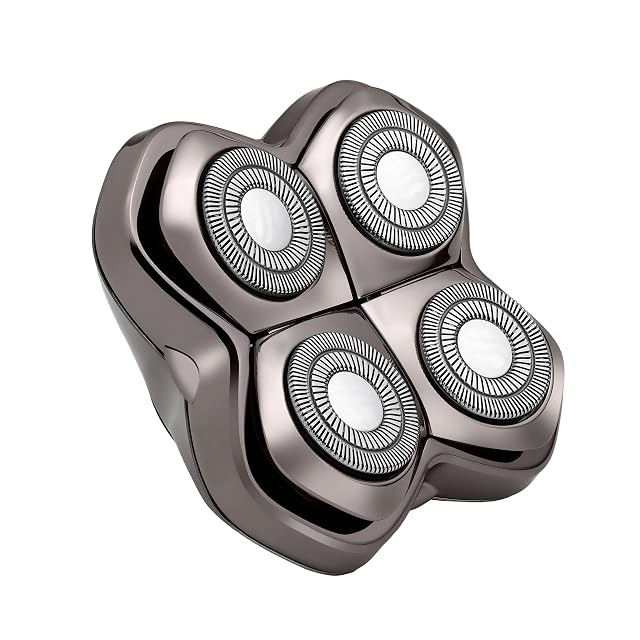
- “Ultimate Shaver Replacement Blade: The Carver PRO 4 is compatible with all Pitbull, Palm, and Butterfly Kiss shavers; with innovative technology, this replacement blade offers a faster, closer shave”
- “Premium Replacement Blade: Japanese stainless steel ensures a sharp, long-lasting blade for the best experience; the spring-loaded blades also minimize skin irritation”
- “Wet & Dry Shaving Blade: Whether you prefer wet or dry shaving, this razor blade for men adapts to your routine; Skull Shaver’s easy-to-remove blade system also simplifies cleaning”
- “Mess-Free Shaving: The replacement head keeps hair clippings out of the transmission for a reliable shaver blade; it’s also designed to capture hair shavings efficiently to reduce mess”
- “Gold Standard in Shaving: With Skull Shaver, you’ll have access to luxury-grade grooming tools that are long-lasting, efficient, and comfortable to use”
The transmission, which is the real reason to replace a head
“The replacement head keeps hair clippings out of the transmission for a reliable shaver blade”
What the transmission is.
On a rotary shaver the motor sits in the handle and drives the cutting discs through a shaft and a set of gears or couplings. That is the transmission.
It is the part you cannot see, cannot clean and cannot replace.
The cutting head sits on top of it, and the head’s outer cap is the only thing between the clippings and the drive.
Why a worn head is a mechanical risk rather than just a worse shave.
A head that is worn, split or distorted no longer seals against the housing.
Clippings and skin oil work past it into the drive, where they bind, abrade and eventually seize the mechanism — and at that point the failure is the shaver, not the twenty-five-dollar part.
So the head is doing two jobs: cutting, and keeping the machine clean. Only the first one degrades visibly.
Which means this is the argument that should govern a replacement schedule — and this page does not publish one.
Exactly one page on this shelf does.
Freebird, $29.95 — “Replace the ScalpSafe rotary blade every 4 weeks, to maintain buttery smooth blade performance keeping them sharp and rust-free.”
That is the figure without the reason. This is the reason without the figure.
Between them you have a complete argument neither page makes alone: replace it on a schedule, because a worn head lets debris into the part you cannot buy.
The MANSCAPED at $24.99 and the Norelco at $33.33 publish neither.
The hair-capture half of the same bullet is the more ordinary claim, and it is worth separating.
“Captures hair shavings efficiently to reduce mess” is about the chamber inside the head — the space clippings fall into so they are not deposited on a sink.
A convenience, and also what makes the first claim possible: clippings held in a chamber are clippings not working their way downward.
Which is why the “easy-to-remove blade system” in the third bullet matters. A chamber that fills has to be emptied, and a head you cannot lift off is a head you cannot empty.
Spring-loaded heads, and why pressing harder makes it worse
“the spring-loaded blades also minimize skin irritation”
What the spring does.
A rotary head is a set of circular cutters under slotted caps. On a spring-loaded design each cutting module sits on its own spring, so when you press the shaver against your head the module retracts instead of transmitting the pressure into your skin.
Why that matters more on a scalp than anywhere else.
A scalp is curved in two directions at once, and it is bone directly under thin skin.
The instinct when a shave is not close enough is to press harder.
And pressing harder on a rotary head does not cut closer: it pushes skin up into the slots — which is what produces the raw patches and the irritation people blame on the blade being blunt.
A spring absorbs that instinct.
It is also the feature that lets a head follow a curve: three or four independently sprung modules sit at different heights, so the set conforms to the dome of a skull rather than bridging across it.
Which is the reason this whole mechanism exists — and it maps onto the division running through this shelf.
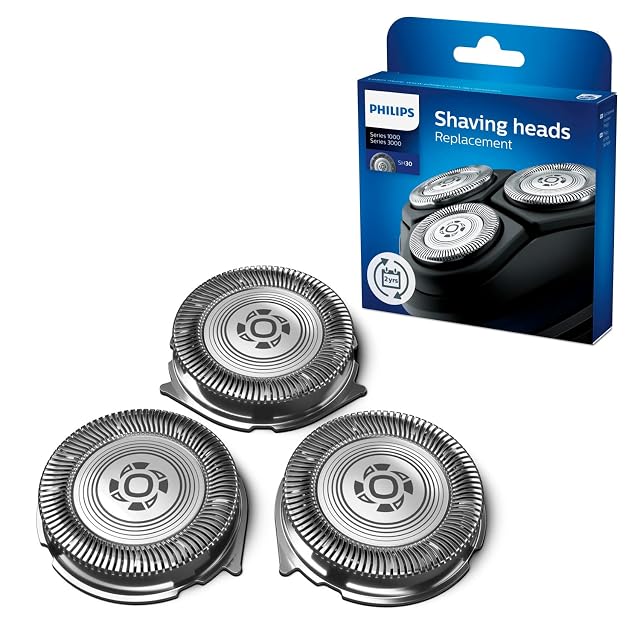
Rotary — this (a Carver PRO 4, for a Pitbull, Palm or Butterfly Kiss) and the Freebird at $29.95 (a “ScalpSafe rotary blade”)
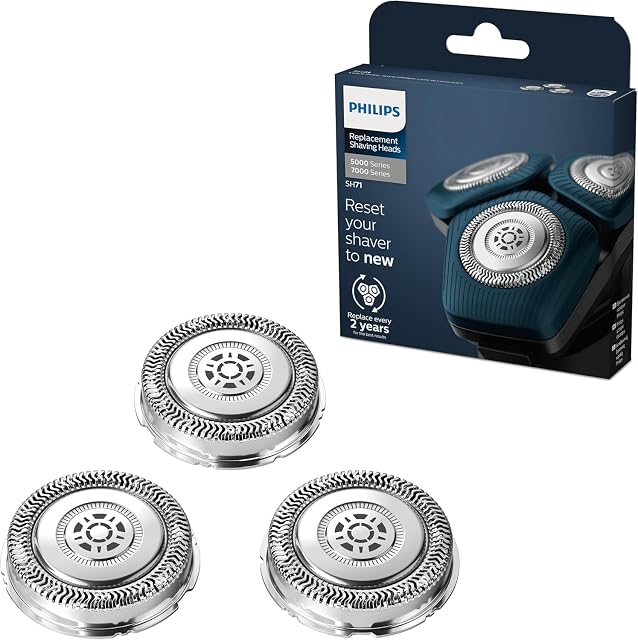
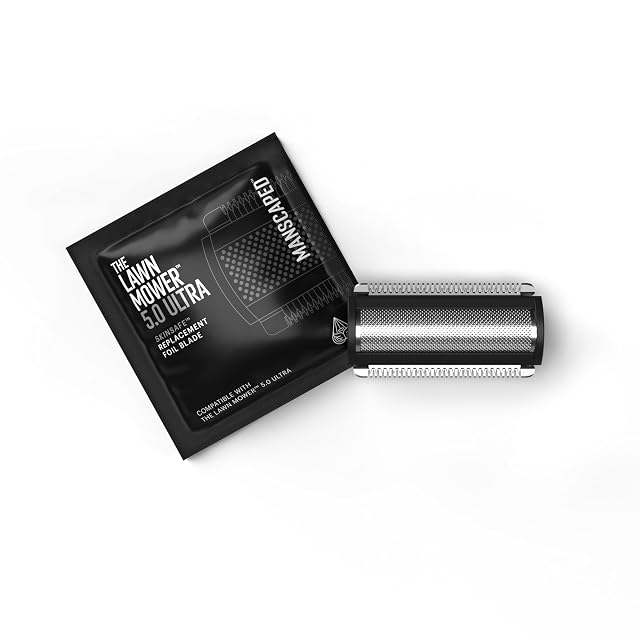
Foil — the MANSCAPED at $24.99 (a “SkinSafe foil blade”, with “bi-directional foil blades” where “the foil brings the shave down to the skin”) and the Norelco at $33.33 (a Bodygroom and Satinelle part)
A foil is a perforated sheet over an oscillating cutter: hair enters the perforations, the cutter sweeps across, and the sheet holds the skin off the blade.
It gives the closest shave available on a flat plane, and it cannot follow a compound curve.
A rotary floats and pivots, so it follows the curve and gives up a little closeness.
Which is why every head shaver is rotary and every groin shaver on this shelf is a foil. The mechanism follows the body part — and “closer shave” claims cannot be compared across the two.
Japanese stainless, which is an origin rather than a grade
“Japanese stainless steel ensures a sharp, long-lasting blade”
No page on this shelf publishes a steel grade or a hardness.
this — Japanese stainless, an origin
MANSCAPED, $24.99 — “stainless steel”, with a purpose attached: “designed to withstand dirt, oil, and buildup that can lead to irritation while also being easy to clean and replace”
Freebird, $29.95 and Norelco, $33.33 — no material at all
What a grade would tell you, and why it matters on a consumable.
A shaver blade is the thinnest working edge in a bathroom, and the two things that end it are going blunt and corroding.
Hardness decides the first. Chromium content decides the second. And they trade against each other, because chromium is added at the expense of hardness.
So a head sold to be rinsed under a tap after every use is a head where the trade has been made deliberately, in one direction or the other — and none of these four pages says which.
The Freebird page at $29.95 is the one that connects the two failures explicitly, in its reason for a four-week interval: “keeping them sharp and rust-free.”
Two ends of the same consumable life, named together.
Wet or dry, and no rating
“Whether you prefer wet or dry shaving, this razor blade for men adapts to your routine”
This is the only page on this shelf to address wet use at all.
And there is no IP rating anywhere here, which is fair: a cutting head is a passive part with no electronics in it. The rating belongs to the shaver, not the blade.
What does belong to the blade is corrosion resistance, and that is the part the wet claim implies without stating.
A head rinsed under a tap after every shave spends its life getting wet and drying. Which is the condition that rusts steel at the thinnest point — the cutting edge — and a rusted edge is a blunt edge.
So “adapts to your routine” is a capability claim where the useful version would have been a care instruction.
Nothing on this shelf gives one. The nearest is the Freebird page at $29.95, whose four-week interval is justified partly by keeping the blade “rust-free” — which is an admission that it will not stay that way indefinitely.
And this site does hold the proper answer, on another shelf.
On GroomVerdict’s blade-care shelf, the Oster Blade Wash at $15.88 exists for exactly this problem — and it is the only product in that family to make a point this shelf should have borrowed: “Removes factory applied preservatives from new blades.”
Which raises the question the MANSCAPED page at $24.99 answers and this one does not: a new head arrives coated in something, and whether that is a lubricant to keep or a preservative to wash off changes what you should do when you open the packet.
MANSCAPED, $24.99 — “Each foil comes pre-lubricated to run smoothly, reducing wear and tear while helping you hit max RPMs.”
That page says lubricant, and says it is there to be used. This page says nothing.
What is not published
No replacement interval, as above — the one figure a consumable needs, on the page with the best reason for having one. Exactly one page on this shelf publishes it: the Freebird at $29.95, “every 4 weeks”. At $29.95 a set, that interval costs roughly $390 a year, which is worth knowing before adopting it. This page’s “long-lasting” and “Gold Standard” tell you nothing you can plan around.
No installation instruction. “Easy-to-remove blade system” is the whole of it. The MANSCAPED at $24.99 publishes a full procedure as its own bullet: “push the bottom of the blade head with your thumb in the direction of the arrow to snap it out. Then, insert the lug of the new blade head into the slot in the top of the trimmer. Then, press it back until it snaps in place.” Which matters because you buy this part precisely to fit it yourself, every few weeks or months — and the thing you have forgotten by then is which way it comes off.
No model numbers. Three families with “all” in front of them, where the Norelco at $33.33 lists about forty named models across four brands — including two Remington models, a competitor. A family name answers “will this fit mine” probabilistically; a model list answers it definitively.
No piece count. “PRO 4” in the name implies four cutting modules and the page never says so, and no page on this shelf publishes an explicit count of what is in the pack. On a rotary head that is a real omission: a set is several modules plus a cap, and whether you are buying one module or the whole assembly changes the value entirely.
No baseline for “faster, closer”. Faster and closer than what — the previous Carver, a worn head, a rival? Nothing on the page says, and the fifth bullet is in the same register: “Gold Standard in Shaving… luxury-grade grooming tools.”
No warranty. No item on this shelf publishes one, which is unsurprising on a consumable and worth recording. Across GroomVerdict, published terms are the exception: five years on one nose trimmer, two years on another and on one air styler, a lifetime guarantee on one comb, 365 days on one brush, 30 days on one clipper blade and one guide comb, and a “90-DAYS Unconditional Return + 12-Month Quality Promise” on the CIICII scissors kit at $19.98.
No country of manufacture. “Japanese stainless steel” is a material origin rather than a place of manufacture, and no item on this shelf publishes one. The only country of manufacture anywhere on this site is on GroomVerdict’s nose-ear-trimmers shelf: the ROYAL manual trimmer at $15.99, “Manufactured in South Korea by an established company with 60 years of metal product manufacturing experience.”
Availability
Read on the day this page was built: $25 at the American Amazon shop.
Read from Keepa on the day this page was last revised; stock and price both move without notice.
Prices quoted in this text were read on 2026-10-05. The live price is at the top of the page.