Skip to content

Dyson Airwrap Origin vs Shark FlexStyle HD446

The engineering, or the second tool?

Two air stylers built on the same aerodynamic principle, far apart in price. Dyson documents the mechanism in unusual detail; Shark makes the same body work as a full hair dryer.

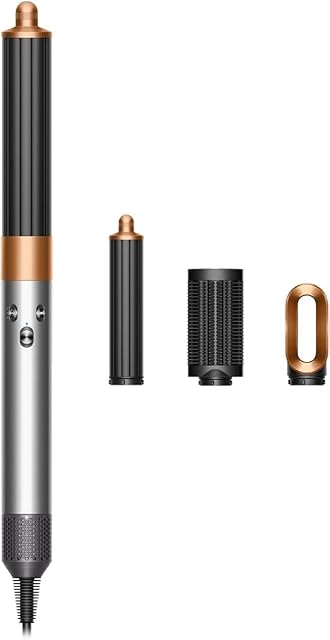
Dyson Airwrap Origin multi-styler and dryer in nickel and copper with three attachments

Dyson Airwrap Origin

8.7/10

Wins 4 of 10

Search Amazon

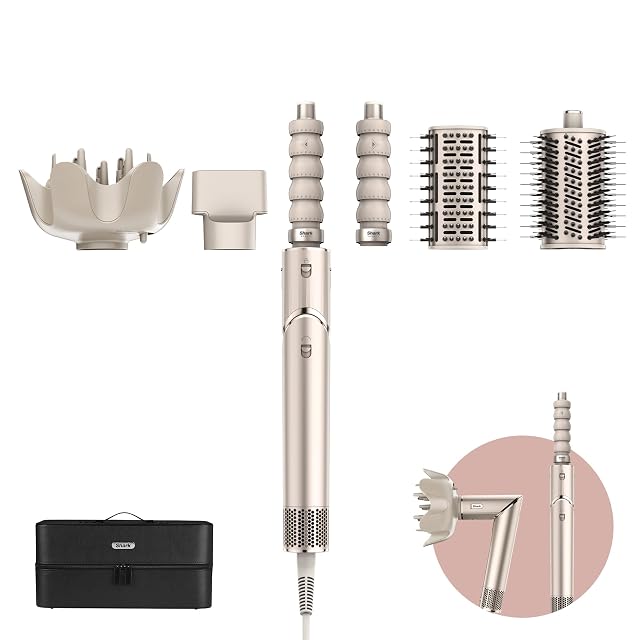
Shark FlexStyle 5-in-1 air styler and hair dryer with auto-wrap barrels and brushes

Shark FlexStyle HD446

7.5/10

Wins 5 of 10

Check price

Detail by detail

Compared on Airwrap Origin FlexStyle HD446
Styling principle Coanda effect Coanda technology
Motor V9 digital, 13-blade impeller, 110,000 rpm Not published
Air pressure 3.2 kPa Not published
Heat sampling More than 40 times per second 1,000 times per second
Attachments Three Six: two auto-wrap barrels, paddle brush, oval brush, concentrator, diffuser
Works as a hair dryer Multi-styler and dryer Converts to a full dryer with concentrator and diffuser
Airflow speeds Three, separate from temperature Not published
Temperature settings Three, no degrees published Not published
Weight Not published 700 g (24.7 oz)
Case included Not published Storage case
Listed on amazon.com No Yes

A tick marks the better answer on that line only. Counting ticks does not decide the page — the two verdicts below do, because these products answer different questions.

Which of the two, for which cut

Airwrap Origin

No amazon.com listing was found for this one. We hold references for other markets but none for the United States, so it may not be buyable here — which is the first thing to weigh against anything below.

Take the Dyson Origin if you want the mechanism documented and the controls separate. It is the only tool on this site that publishes the motor speed and the air pressure behind its own marketing term, and three airflow speeds independent of three temperatures is real control.

Buy the FlexStyle HD446

Take the Shark if it has to replace a dryer as well. Six attachments including a concentrator and a diffuser, a published weight, and a case. What you give up is every figure about how it works.

What people ask about this

What is the Coanda effect?

An aerodynamic phenomenon where a jet of air follows a nearby curved surface, taking the hair with it and wrapping it round the barrel. Both makers name it; only Dyson publishes the air pressure it says is needed to produce it.

Does either publish a temperature in degrees?

No. Both give a number of settings and no figures, and the i.d. gives neither. Three of the nine air stylers on this site do publish degrees, and the hottest figure among them is 230 °F — where the straighteners here run to 446, 450 and 455 °F. The comparison is available; it is just not available on these two.

Each in full detail

  • Dyson Airwrap Origin

    V9 motor, 110,000 rpm, 3.2 kPa · heat measured 40×/s · 3 attachments

    The entry Airwrap: the Coanda effect driven by Dyson's V9 digital motor at 110,000 rpm and 3.2 kPa, with airflow temperature measured more than forty times a second, three intelligent attachments, three speeds and three temperatures.

    Best for: The Coanda format from the company that engineered it, with the motor figures published.

    8.7/10

  • Shark FlexStyle HD446

    Dryer and styler in one · 6 attachments · heat measured 1,000×/s · 700 g (24.7 oz)

    A tool that converts between a hair dryer and an air styler, with two auto-wrap curling barrels, a paddle brush, an oval brush, a concentrator and a diffuser, measuring its own heat a thousand times a second. Case included, 700 grams.

    Best for: One tool instead of a dryer and a styler, in a bathroom with nowhere to put both.

    7.5/10