What the maker puts in writing
- “EFFORTLESS WAVES & TEXTURE — Create gorgeous continuous waves to switch up your everyday style with this beach waver curling iron. Designed for versatile styling across hair lengths…”
- “TRIPLE BARREL DESIGN FOR CONTINUOUS WAVES — Deepen your waves with the 3 barrel curling iron featuring outer barrels at 5/8-inch and an inner barrel at 1/2-inch. This unique barrel system creates defined, uniform waves with natural movement and long-lasting texture…”
- “CUSTOM HEAT FOR ALL HAIR TYPES — Take control of every curl with 30 heat settings up to 400 Degrees Fahrenheit and a Turbo Heat boost. Double Ceramic coating helps distribute heat evenly to reduce hot spots for less damage when used at appropriate heat settings.”
- “LIGHTWEIGHT DESIGN FOR EASY STYLING — Weighing just 1.17 pounds, this waver provides comfortable control for longer styling sessions…”
- “WORRY-FREE STYLING FEATURES — …lock in your look with single voltage and auto off convenience for added safety. The corded electric design delivers worry-free styling and convenient everyday use.”
- From the name: “Curling Iron & Waver”, “Triple Barrel”, “White/Rose Gold”
- Reference CD704L · Catalog: 508 g (17.9 oz), 70 × 102 × 376 mm (2.76 × 4.02 × 14.8 in)
Thirty settings, where the next finest here is ten
“Take control of every curl with 30 heat settings up to 400 Degrees Fahrenheit and a Turbo Heat boost.”
The shelf, on heat control:
30 settings to 400 °F — this
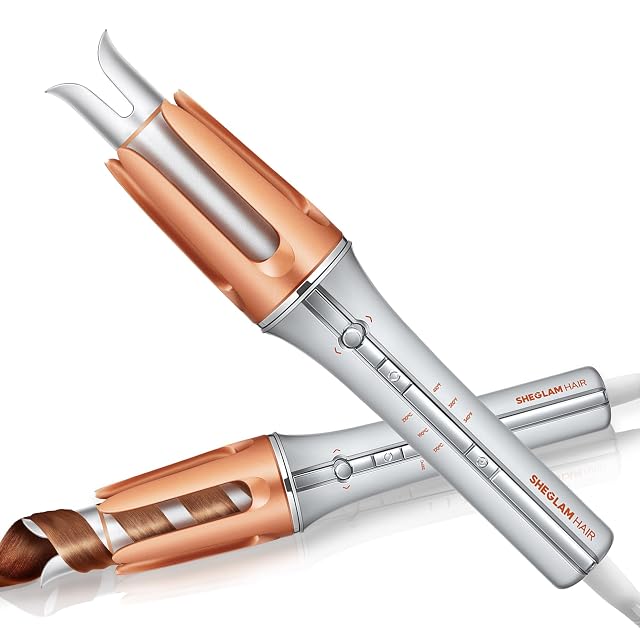
3 settings, 340–410 °F — the SHEGLAM automatic iron at $42.99, the only page here to publish both ends of its range
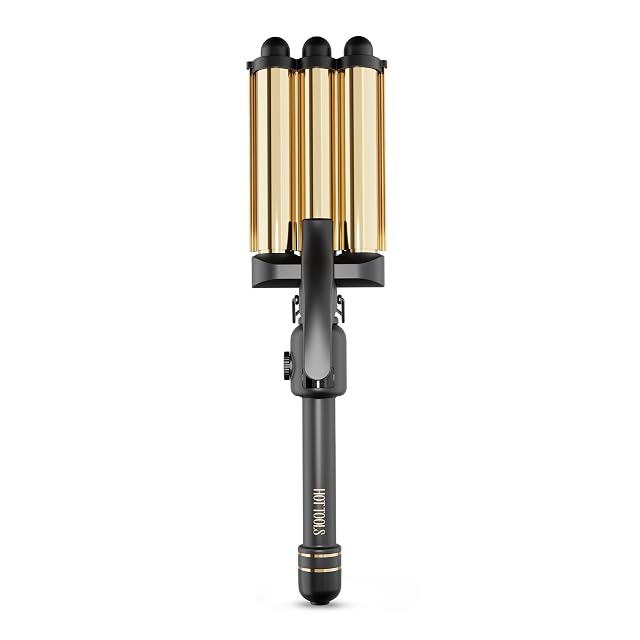
“up to 450 F” with no steps at all — the Hot Tools jumbo waver at $62.99, the most expensive item on this shelf
So one tool offers fine control, one offers three steps, and one offers a ceiling.
Why the number of steps matters more than the maximum.
Hair keratin begins to change somewhere above about 150 °C (302 °F), which is 300 °F — and every electric tool on this shelf works above that.
What decides damage is not the tool’s ceiling but the setting you actually use — and the settings that suit hair vary enormously. Fine or color-treated hair wants the low 300s. Coarse or resistant hair wants the high 300s.
A three-step dial forces you into one of three compromises.
Thirty steps let you find the lowest temperature that will hold a wave in your hair — which is the only heat-protection strategy that actually works.
And the second benefit is repeatability. A numbered setting is a setting you can come back to, where an unmarked high-low slider is a guess every morning.
The Turbo Heat boost is the other half, and it is worth understanding.
A boost is a momentary push above the set temperature, for the one section that will not take a shape — which is a sensible feature and also the one that undoes the careful dial above it.
Use it on a stubborn piece, not as a default.
And the clause at the end of that bullet is the most careful hedging on this whole shelf.
“Double Ceramic coating helps distribute heat evenly to reduce hot spots for less damage when used at appropriate heat settings.”
Which is the page admitting that the coating does not make 400 °F safe.
And no page on this shelf — including this one — says what an appropriate setting is. Which is the gap across the whole family: the hottest setting published here is 450 °F, and not one page mentions a heat protectant. This site has an entire heat-protection family.
Three barrels, two sizes, and why they are unequal
“featuring outer barrels at 5/8-inch and an inner barrel at 1/2-inch. This unique barrel system creates defined, uniform waves with natural movement and long-lasting texture”
What a triple barrel does, and it is not what a curling iron does.
A single barrel wraps. You roll a section round a hot tube and it comes off as a curl.
A triple barrel clamps. Three parallel tubes close on a flat section of hair and press an S-bend into it, and you work down the length clamping one overlapping segment after another.
The result is a continuous wave rather than separate curls — which is why the page calls it a “beach waver” and says “continuous waves” twice.
Why unequal barrels matter.
Three identical tubes press three identical bends — and a repeated identical bend reads as a crimp: regular, mechanical, obviously made by a tool.
An inner barrel an eighth of an inch smaller than the outer two makes the middle bend tighter than the ones either side — so the wave has variation built into it.
Which is what the bullet means by putting “natural movement” next to “uniform waves”. Those two phrases are in tension on purpose, and the asymmetry is how the page resolves it.
What the rest of the shelf publishes.
The Hot Tools at $62.99 is also a triple-barrel waver and publishes no diameter at all. “Jumbo barrels give you crease free waves in no time”, and “this versatile jumbo hair waver” — twice, and nothing in inches.
So the most expensive item on this shelf is the one whose barrel size you cannot know.
The SHEGLAM at $42.99 publishes “1 1/4 inch” and it is a single barrel — a wholly different tool, which wraps rather than clamps, and at 1 1/4 inch makes a loose curl.
So at least two of the eight items here publish a working diameter, and this is the fuller of the two — which leaves the most expensive tool on the shelf as the one whose barrel size cannot be known.
Double ceramic, and what a coating is actually for
“Double Ceramic coating helps distribute heat evenly to reduce hot spots”
What the problem is.
A barrel is heated by an element inside it, and the element does not heat the whole surface equally. Left alone, a metal barrel has bands that run hotter than the rest — and a hot band scorches a stripe across every section that touches it.
A ceramic layer spreads the heat sideways before it reaches the surface, which is what “reduce hot spots” means.
Three tools on this shelf address the same thing in three ways.
this — “Double Ceramic coating… distribute heat evenly… reduce hot spots”
SHEGLAM, $42.99 — “GlossPro Ceramic Coating… reduce frizz and heat damage. It locks in moisture and adds shine”
Hot Tools, $62.99 — “24K Gold… Heats up quickly and holds heat evenly”, plus “Instant heat recovery for consistent results”
Ceramic spreads heat. Gold conducts it, fast and evenly. Both are attacking the same defect from different directions.
And “instant heat recovery” on the Hot Tools names the thing that matters most and that this page does not mention.
A barrel loses heat to every section of hair it touches — and how fast it comes back decides whether section ten looks like section one. On a tool that clamps thirty overlapping segments down the length of a head, that recovery is the whole of consistency.
This page publishes thirty settings and no recovery claim; the most expensive page publishes a recovery claim and no settings.
“Double” is worth one note: it implies two layers rather than one, which would spread heat further. No thickness or process is given, and no page on this shelf gives one.
A pound and a sixth, and the division this shelf has
“Weighing just 1.17 pounds, this waver provides comfortable control for longer styling sessions. The balanced handling allows you to maneuver this 3 barrel curling iron comfortably”
1.17 pounds is 531 grams, and the catalog says 508 g (17.9 oz) — close enough to be the same object weighed twice.
The shelf, by weight:
710 g — the Hot Tools jumbo waver at $62.99, the heaviest here
508 g — this
250 g — the SHEGLAM automatic iron at $42.99
So the three tools here weigh 250 to 710 grams — a factor of nearly three between the lightest and the heaviest, because a heater, a motor and a cord all have mass.
Why weight matters on a waver in particular.
A triple-barrel waver is held in one hand, above the shoulder, clamped shut, for the length of a head of hair — and a clamping tool has to be squeezed as well as supported.
Which is why “balanced handling” is the more useful half of the claim than “lightweight”. A tool whose mass sits out at the barrels pulls forward in the hand; one whose mass is in the handle does not.
“Lightweight” is relative here: this is the second heaviest thing on the shelf, and 200 grams lighter than the one above it.
Single voltage, and auto off
“lock in your look with single voltage and auto off convenience for added safety. The corded electric design delivers worry-free styling.”
What single voltage means.
The tool is built for one mains supply, and it has no circuitry to adapt.
Plug it into a 230 V socket and the heater draws roughly twice the current and dissipates about four times the power. That is not a slow degradation; it is an immediate failure, and on a heating element it is a fire.
The other two electric tools here are the opposite.
SHEGLAM, $42.99 — “[Travel-ready design with dual voltage (100-240V)] that auto-adjusts anywhere you go—no converter needed! …Comes with a US plug; just bring a plug adapter for use outside the USA”
Hot Tools, $62.99 — “universal dual voltage”
And the SHEGLAM is the only page on this shelf to draw the distinction that catches people out: an adapter changes the shape of a plug, a converter changes the voltage.
A plug adapter will happily connect a 120 V appliance to a 230 V socket — which is exactly how a single-voltage tool is destroyed.
It is the same distinction the 7MAGIC publishes on GroomVerdict’s air-stylers shelf — “Do not use it with 220–240V power sources or incompatible voltage converters” — and the same one two AVENHO pages there needed and did not give.
So the honest reading: this is a tool for one country, and the page says so plainly enough that nobody should be caught.
The auto-off is the feature that matters more day to day, and two of the three electric tools here publish it.
this — “auto off convenience for added safety”
SHEGLAM, $42.99 — “Automatic Shut-Off for Hair Styling”, in its own title
Hot Tools, $62.99 — nothing at all
Which is worth noting on the most expensive item: a 450 °F barrel left on is the one real hazard in this family, and the two cheaper electric tools are the ones that switch themselves off.
“Corded electric” is the last phrase and it is the one specification this page leaves hanging: it names a cord and gives no length.
One item on this shelf publishes one, and it is the longest on this site. The Hot Tools at $62.99: “9 ft tangle free swivel cord.” Nine feet is a professional figure — it reaches from a socket to a chair.
What is not published
No wattage. None of the three electric tools on this shelf publishes one — and on a heating tool the wattage is what decides how fast the barrels come back to temperature between sections, which is the recovery question above.
No heat-up time. The Hot Tools at $62.99 claims “heats up quickly” and the SHEGLAM at $42.99 publishes “60 seconds” — but that is its curl time rather than its warm-up. No tool here gives a warm-up figure.
No cord length, as above.
No heat recovery claim, as above — the thing that decides consistency on a tool that clamps a whole head.
No barrel surface temperature tolerance. “30 heat settings up to 400 Degrees Fahrenheit” is a dial range, and no page here publishes how closely the barrel holds the number — which on this shelf is the equivalent of the accuracy-against-stability distinction: a dial that reads 340 °F and delivers 380 is a dial that damages hair at a setting you chose to be safe.
No heat-protection advice, as above — and this is the page that comes closest to needing it, because its own bullet says “when used at appropriate heat settings” and never says which.
No warranty. Not at least one of the eight items on this shelf publishes a term — which is this site’s pattern: none on capes-and-mats, none on blade-care, none on dryer-attachments, none on clipper-blades, none on combs-and-brushes, one of six on air-stylers.
No country of manufacture — and no page on this shelf publishes one, which on a plastic-bodied heated tool is the specification a buyer is most often looking for and least often given.
Availability
Read on the day this page was built: $25 at the American Amazon shop.
Read from Keepa on the day this page was last revised; stock and price both move without notice.
Prices quoted in this text were read on 2026-10-05. The live price is at the top of the page.