What the maker puts in writing
- “[Fast Heating and One-Button Automatic Curling] Achieve beautiful curls in 60 seconds with our automatic curling iron. Simply place your hair, press the button, and let the curling iron automatic hair curler do the work.”
- “[Anti-Burn and Anti-Tangle Design for Safety] The automatic curling iron rotating features an anti-burn top and anti-tangle design to protect your hair from damage. No tangling or burns, making it safe for beginners and easy to use every time”
- “[Travel-ready design with dual voltage (100-240V)] that auto-adjusts anywhere you go—no converter needed! …Comes with a US plug; just bring a plug adapter for use outside the USA”
- “[GlossPro Ceramic Coating for Smooth, Shiny Curls] Our automatic curling iron uses GlossPro ceramic coating to reduce frizz and heat damage. It locks in moisture and adds shine”
- “[3 Temperature Settings for Every Hair Type] With three heat settings (340°F- 410°F), this hair curler is perfect for all hair types. The two-way rotation creates versatile curls, whether soft waves or defined curls”
- “Note: This curling iron is designed for medium to long hair lengths. For very thick or lengthy hair, styling may require additional time and effort.”
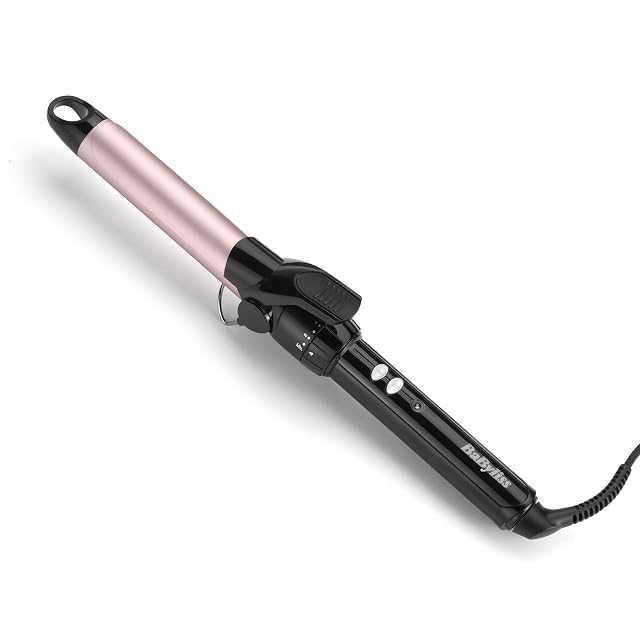
- From the name: “Automatic Curling Iron 1 1/4 inch”, “Anti-Scald, Anti-Tangle Rotating”, “Automatic Shut-Off”
- Reference sb2405315360354252 · Catalog: 250 g (8.8 oz), 315 × 53 × 53 mm (12.4 × 2.09 × 2.09 in)
It does the wrapping, which is the skill a conventional iron demands
“Simply place your hair, press the button, and let the curling iron… do the work.”
What a conventional iron asks of you.
A wand or a clamp iron requires you to wrap a section round a hot tube at an even tension, at a consistent angle, holding it there for a counted time — behind your own head, in a mirror.
That is a learned skill, and it is why most people’s curls come out uneven.
A rotating-chamber iron does the wrapping mechanically. You lay the section into a slot, press, and a motor draws it round the inside of a heated barrel.
Which makes the result far more repeatable — the same tension and the same contact time on every section, which is exactly what hand-wrapping fails at.
The failure it introduces is the one a conventional iron cannot have: a tangle inside a closed chamber.
A wand is open. If something goes wrong you can see it and unwind it.
A chamber is not — and hair wound the wrong way round a rotating spindle, out of sight, against a hot wall, is the thing people genuinely fear about these tools.
Which is why the page claims anti-tangle twice, and three times across the listing.
Bullet two: “features an anti-burn top and anti-tangle design to protect your hair from damage. No tangling or burns, making it safe for beginners.”
And the product title: “Anti-Scald, Anti-Tangle Rotating, Automatic Shut-Off.”
A claim repeated three times is a claim about the thing the maker knows you are worried about.
The two-way rotation is the other half of what the mechanism buys. “The two-way rotation creates versatile curls, whether soft waves or defined curls.”
Which matters for a reason the page does not state: curl both sides of a head the same way and one side turns in and the other turns out.
A tool that rotates either way lets the curl frame the face on both sides — the same point the paired barrels make on this site’s air-stylers shelf, where one page publishes “left/right barrels create natural, face-framing waves without manual wrapping.”
The only full temperature range on this shelf
“With three heat settings (340°F- 410°F), this hair curler is perfect for all hair types.”
The shelf, on heat:
340–410 °F in three steps — this, the only page here to publish both ends
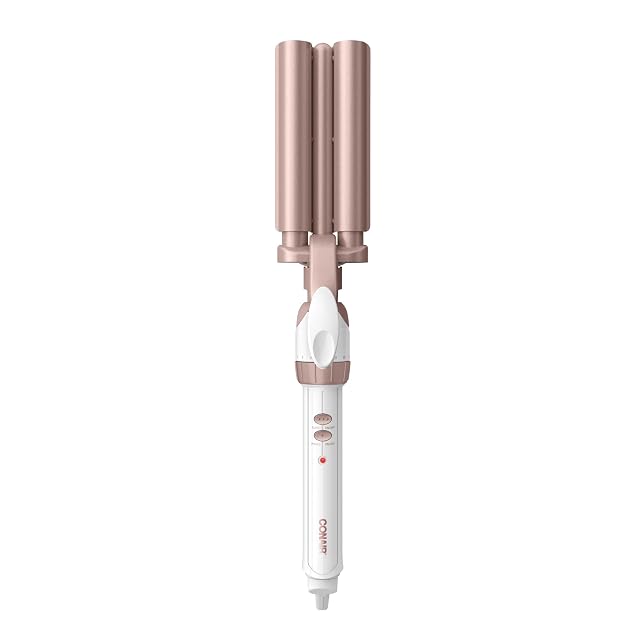
30 settings up to 400 °F, with a Turbo Heat boost — the Conair triple-barrel waver at $25.99
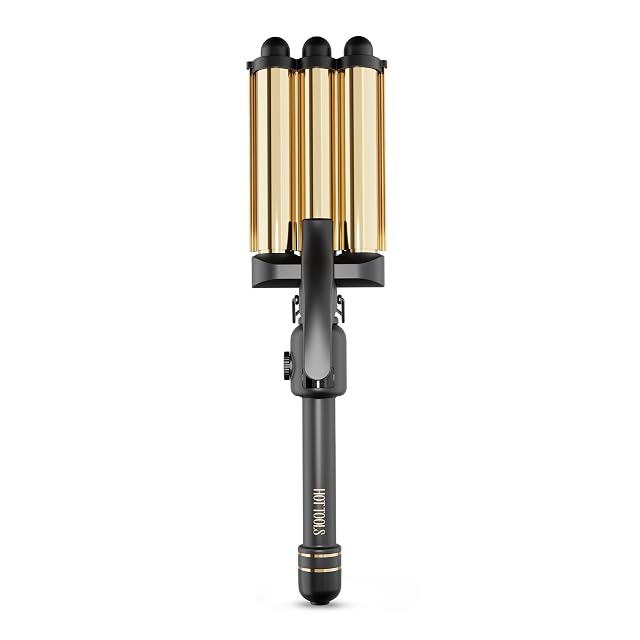
“up to 450 F” with no steps at all — the Hot Tools jumbo waver at $62.99, the most expensive item here
Why publishing the bottom of the range matters as much as the top.
Hair keratin begins to change somewhere above about 150 °C (302 °F), which is 300 °F — and all three electric tools on this shelf work above that.
So the useful question is not how hot a tool gets but how cool it will go. 340 °F is the lowest published floor on this shelf, and it is the setting fine or color-treated hair wants.
The Hot Tools at $62.99 publishes a ceiling and no floor at all — which tells you what it can do to resistant hair and nothing about what it will do to fragile hair.
What three steps cost you against thirty.
The Conair at $25.99 is the tool for someone who wants to find the lowest temperature that will hold a curl in their own hair — because thirty numbered steps let you look for it and come back to it.
Three steps are three compromises. Which is the trade: this tool removes the wrapping skill and gives you less control over the heat.
And the clause the Conair page attaches to its own ceramic coating is worth importing here, because it applies to every tool on this shelf: “for less damage when used at appropriate heat settings.”
No page here, including this one, says what an appropriate setting is — and this site has an entire heat-protection family.
A ceramic coating, and what “locks in moisture” means
“GlossPro ceramic coating to reduce frizz and heat damage. It locks in moisture and adds shine, leaving your curls soft, smooth, and manageable.”
What a coating on a barrel is for.
A barrel is heated by an element inside it, and the element does not heat the surface equally. Left bare, a metal barrel has bands that run hotter than the rest — and a hot band scorches a stripe across every section that touches it.
A ceramic layer spreads heat sideways before it reaches the surface, so the whole barrel delivers something closer to the temperature you set.
Three tools on this shelf address the same defect three ways.
this — “GlossPro ceramic coating… locks in moisture and adds shine”
Conair, $25.99 — “Double Ceramic coating helps distribute heat evenly to reduce hot spots”
Hot Tools, $62.99 — “24K Gold… Heats up quickly and holds heat evenly”, plus “Instant heat recovery for consistent results”
Ceramic spreads heat. Gold conducts it, fast and evenly. Both attack the same problem from different directions.
“Locks in moisture” is the claim to read carefully, because it is the one that describes hair rather than metal.
What heat actually does to a hair is drive water out of the cortex — and a curl is held because that water has gone while the hair was in a new shape. So a tool cannot both set a curl and keep the water in; the two are the same process.
What the phrase plausibly means is gentler: a smooth, even surface at a moderate temperature drives out less water than a hot-spotted one at the same dial setting, because the hair is not being locally overheated.
Which is a real benefit, described in the register of a cosmetic claim.
And “reduce frizz” has the same shape. Frizz is hair standing apart from itself — a cuticle lifted by damage, or by static. A smooth barrel lays the cuticle flat as it passes, which genuinely reduces it, and no coating can repair a cuticle already lifted.
What the page does not publish about recovery is the gap the most expensive tool here fills. A barrel loses heat to every section it touches, and how fast it comes back decides whether curl ten matches curl one. “Fast Heating” in bullet one is a warm-up claim, not a recovery one.
Sixty seconds, a quarter-inch over an inch, and 250 grams
Three figures worth putting together, because they describe the experience.
The 60 seconds is a curl time rather than a warm-up time, which is a distinction the page leaves you to make. Bullet one pairs “Fast Heating” with “curls in 60 seconds”, and no heat-up figure appears anywhere.
No tool on this shelf publishes a warm-up time. The Hot Tools at $62.99 claims “heats up quickly” and the Conair at $25.99 says nothing at all.
A minute a section is the figure to plan around. On a head taking twenty sections that is twenty minutes of curling — and the closing note’s “additional time and effort” for thick hair is a warning about section count, since a chamber sets the maximum section size for you.
The 1 1/4 inch barrel is the second figure, and it sets the curl size.
It is a loose-curl diameter: big enough to produce a soft wave rather than a ringlet, which is consistent with the page’s own “soft waves or defined curls”.
And it is published, which puts this page ahead of the most expensive item here. The Hot Tools at $62.99 says “jumbo barrels” twice and gives no diameter at all. The Conair at $25.99 publishes every one of its three: “outer barrels at 5/8-inch and an inner barrel at 1/2-inch.”
The 250 grams is the third, and it is the lightest electric tool on this shelf.
710 g — the Hot Tools at $62.99
508 g — the Conair at $25.99, published as “just 1.17 pounds”
250 g — this
Which matters because of how this tool is held: a chamber iron is brought to a section and held still while the motor works — rather than swept down a length like a waver — so the weight is carried statically, at arm’s length, for a minute at a time.
Being a third of the weight of the most expensive tool here is a real advantage for that posture.
Dual voltage, and the distinction only this page draws
“dual voltage (100-240V) that auto-adjusts anywhere you go—no converter needed! …Comes with a US plug; just bring a plug adapter for use outside the USA.”
Why that sentence is the useful one on this shelf.
The mains supply differs by country — about 120 V across North America and much of Japan, about 230 V across Europe, the United Kingdom and Australia.
A dual-voltage appliance has circuitry that works on either, which is what “auto-adjusts” means and why no converter is needed.
A single-voltage appliance does not. Plug one into twice its design voltage and the heater draws roughly twice the current and dissipates about four times the power — not a slow degradation but an immediate failure, and on a heating element it is a fire.
And the trap is the plug.
A travel adapter is a passive piece of plastic that makes an American plug fit a European socket. It changes nothing electrically.
So an adapter will happily connect a 120 V-only tool to a 230 V supply — which is exactly how single-voltage tools are destroyed.
The three electric tools on this shelf split on this.
this — dual voltage, with the distinction explained
Hot Tools, $62.99 — “universal dual voltage”, stated and not explained
Conair, $25.99 — “single voltage”, which means it works in one part of the world
That last page states it plainly, which is to its credit, and does not explain the consequence.
It is the same distinction the 7MAGIC publishes on GroomVerdict’s air-stylers shelf — “Do not use it with 220–240V power sources or incompatible voltage converters” — where two AVENHO pages on that same shelf are marked 110 V only, sell themselves for travel, and never mention the trap.
One further point this page gets right by implication: a converter rated for a phone charger cannot carry a hair appliance’s current.
Which is why “no converter needed” is a genuine convenience rather than a flourish — the converters that would do the job are heavy, and the ones people pack are not.
The automatic shut-off, in the product name, is the companion safety feature, and two of the three electric tools here publish one. This, and the Conair’s “auto off”. The Hot Tools at $62.99 publishes none — which is worth noting on the hottest tool in this family, at up to 450 °F.
The only stated limitation on this shelf
“Note: This curling iron is designed for medium to long hair lengths. For very thick or lengthy hair, styling may require additional time and effort.”
Why a chamber has limits a wand does not.
A rotating chamber has a fixed internal volume. A section has to fit into the slot, be drawn round the spindle, and sit against the heated wall without jamming — and a section too thick does not go in, or goes in and binds.
So the tool sets the maximum section size for you, where a wand lets you take whatever section you like.
Which is good for consistency and bad for speed on a dense head: more sections, each taking 60 seconds.
The length half is the other constraint, in the other direction. “Medium to long” has a lower bound as well as an upper one: short hair cannot be fed into a chamber at all, because there is not enough length to draw round the spindle and still be held at the root.
So this is not a tool for a bob, and this is the only page here that tells you.
What the rest of the shelf claims instead.
Hot Tools, $62.99 — “ALL HAIR TYPES: A high heat reach of up to 450 F provides beautiful results for all hair types from thin to coarse and in between”
Conair, $25.99 — “CUSTOM HEAT FOR ALL HAIR TYPES”, and “Designed for versatile styling across hair lengths”
So one page states a boundary and the other two claim everything — and no page here names a hair type it does not suit.
Which is worth remembering generally: an exclusion is more informative than an inclusion, because a tool that suits everything usually suits nothing particularly well.
The same pattern runs through this site. On GroomVerdict’s combs-and-brushes shelf, one tool of nine publishes an exclusion — “Not suitable for cats, puppies or short-haired pets” — and five claim every coat type.
What is not published
No wattage. None of the three electric tools on this shelf publishes one — and on a heated appliance the wattage is what decides how fast the barrel recovers between sections, which on a minute-per-curl tool is the figure that decides whether the twentieth curl matches the first.
No heat-up time, as above. The 60 seconds is a curl time.
No recovery claim. Which the most expensive tool here does publish — the Hot Tools’ “instant heat recovery for consistent results” — and which matters more on a chamber, because the hair is held against the wall for a full minute rather than swept past it.
No cord length. One item on this shelf publishes one and it is the longest on this site: the Hot Tools at $62.99, “9 ft tangle free swivel cord”. Nine feet reaches from a socket to a chair. And a swivel matters on a rotating tool for an obvious reason the page does not mention: a chamber iron is turned in the hand repeatedly.
No chamber capacity. The closing note says a thick section will struggle and gives no section width — which is the figure that would turn a caution into a plan.
No rotation speed or direction control detail. “Two-way rotation” is published and how you select the direction is not.
No surface temperature tolerance. “340°F- 410°F” is a dial range, and no page here says how closely the barrel holds the number — which is the same distinction between a setting and what is delivered that runs through the whole of this site’s heated-tool shelves.
No heat-protection advice, as above — on a shelf whose hottest published setting is 450 °F, and where not one page mentions a protectant.
No warranty. Not at least one of the eight items on this shelf publishes a term — which is this site’s pattern: none on capes-and-mats, none on blade-care, none on dryer-attachments, none on clipper-blades, none on combs-and-brushes, one of six on air-stylers.
No country of manufacture — and no page on this shelf publishes one, which on a plastic-bodied heated tool is the specification a buyer is most often looking for and least often given.
Availability
Read on the day this page was built: $43 at the American Amazon shop.
Read from Keepa on the day this page was last revised; stock and price both move without notice.
Prices quoted in this text were read on 2026-10-05. The live price is at the top of the page.