What the maker puts in writing
- “SIGNATURE GOLD: This versatile jumbo hair waver is the tool of choice for professional stylists. Jumbo barrels give you crease free waves in no time”
- “GLAMOUR 2022 AWARD WINNER: Glamour 2022 Best Beauty Products of 2022 Best Curling Iron: Hot Tools Pro Artist 24K Gold One Three Barrel Waver”
- “LONG LASTING: Go for the gold for gorgeous waves. Heats up quickly and holds heat evenly. That means faster styling and locked in results.”
- “ALL HAIR TYPES: A high heat reach of up to 450 F provides beautiful results for all hair types from thin to coarse and in between.”
- “TRAVEL READY: 9 ft tangle free swivel cord and universal dual voltage, Instant heat recovery for consistent results”
- “STYLISTS PREFERRED: Hot Tools heritage is rooted in the professional community. We’re proud we’ve been a trusted, stylist recommended brand since we began in 1990.”
- From the name: “Pro Artist 24K Gold”, “Digital”, “3 Barrel Hair Waver”, “(Jumbo Size)”
- Reference HTIR8000G · Catalog: 710 g (25 oz), 89 × 401 × 144 mm (3.50 × 15.8 × 5.67 in)
Jumbo barrels, twice, and no diameter
The word appears in bullet one and in the product name, and no figure appears anywhere.
Why the diameter is the specification a waver is bought on.
A triple-barrel waver clamps. Three parallel tubes close on a flat section and press an S-bend into it, and you work down the length one overlapping segment at a time.
The diameter of those tubes is the wave.
A narrow barrel presses a tight, frequent bend — which at the extreme is a crimp.
A wide one presses a long, shallow bend — which is a beach wave.
So “jumbo” tells you the wave is loose, and nothing more precise than that.
What the rest of the shelf publishes.
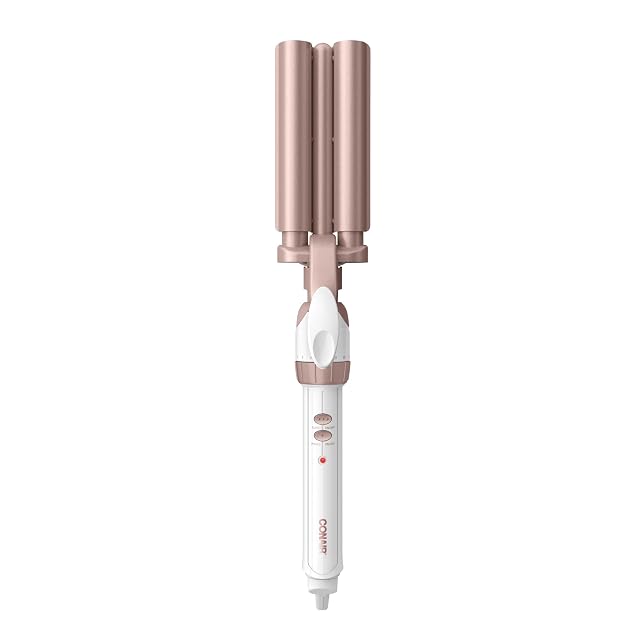
The Conair triple-barrel waver at $25.99 publishes all three of its barrels: “outer barrels at 5/8-inch and an inner barrel at 1/2-inch.”
And it explains why they are unequal — “defined, uniform waves with natural movement” — because three identical tubes press three identical bends, and a repeated identical bend reads as a machine-made crimp.
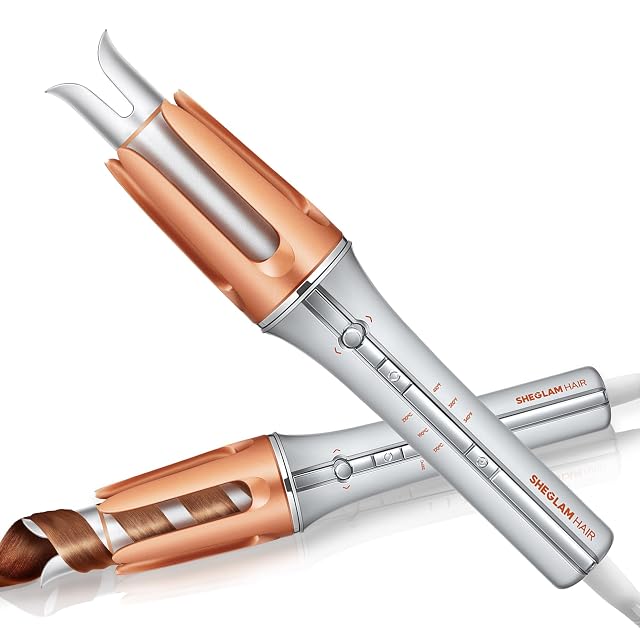
The SHEGLAM automatic iron at $42.99 publishes “1 1/4 inch”, which is a single barrel on a wholly different tool: it wraps rather than clamps.
So the cheapest electric tool on this shelf measures all three of its barrels, and the most expensive measures none.
The second thing “crease free” is pointing at is a real claim, and worth separating.
The failure of a three-barrel waver is the crease: a visible straight line across the hair where one clamp ended and the next began, which happens when the segments do not overlap evenly.
A larger barrel makes that easier to avoid, because the bend is gentler and the overlap more forgiving — so “jumbo barrels give you crease free waves” is a coherent argument, and it is the argument for the size.
What it costs is definition. A jumbo wave on short or fine hair can read as nothing at all.
And this page claims “all hair types from thin to coarse and in between”, where the SHEGLAM at $42.99 is the only page on this shelf to state a limitation of any kind: “designed for medium to long hair lengths. For very thick or lengthy hair, styling may require additional time and effort.”
Instant heat recovery, which matters more than the maximum
“Heats up quickly and holds heat evenly. That means faster styling and locked in results.” · “Instant heat recovery for consistent results.”
What happens on a whole head.
Hair is a heat sink. Clamp a cool section onto three hot barrels and the barrels give up heat into it — the surface temperature drops, and it drops most on the first contact.
If the element is slow to put that heat back, the second clamp happens on a cooler barrel, and the third on a cooler one still — so the waves get progressively weaker down the head.
Which is the real, unglamorous failure of a cheap heated tool, and almost nothing publishes a figure for it.
This is the only page on this shelf to claim recovery at all.
The Conair at $25.99 publishes thirty heat settings and nothing about recovery.
The SHEGLAM at $42.99 publishes “Fast Heating”, which is a warm-up claim rather than a recovery one — the difference being that warm-up happens once and recovery happens thirty times.
And the gold is the mechanism this page is pointing at without naming it.
A metal with high thermal conductivity moves heat from the element to the surface quickly and spreads it sideways — which does two things at once: it evens out the hot bands a bare barrel has, and it brings the surface back to temperature fast after each clamp.
That is why the page pairs “heats up quickly” with “holds heat evenly” in one sentence: they are the same property.
Compare the coatings on the other two.
Conair, $25.99 — “Double Ceramic coating helps distribute heat evenly to reduce hot spots”
SHEGLAM, $42.99 — “GlossPro ceramic coating… locks in moisture and adds shine”
Ceramic spreads heat and insulates slightly. Gold conducts it.
Both even out hot spots, and only the conductor helps with recovery — which is the genuine argument for this surface, and the page makes it without ever using the word conductivity.
“24K” is the one part of the claim to hold lightly. 24-carat gold is pure gold and soft; a barrel surface is a thin plating over a harder substrate. The conductivity benefit is real and the depth is not published.
Four hundred and fifty degrees, and no steps at all
“A high heat reach of up to 450 F provides beautiful results for all hair types from thin to coarse and in between.”
The shelf, on heat:
Up to 450 °F, with no steps published — this, the hottest here
30 settings up to 400 °F, with a Turbo Heat boost — the Conair at $25.99
340–410 °F in three steps — the SHEGLAM at $42.99, the only page here to publish both ends of its range
So the most expensive tool on this shelf publishes a ceiling and the cheapest electric one publishes thirty numbered settings.
Why the floor matters as much as the ceiling.
Hair keratin begins to change somewhere above about 150 °C (302 °F), which is 300 °F — and all three electric tools here work above it.
What decides damage is not the tool’s maximum but the setting you use — and the right setting varies enormously: fine or color-treated hair wants the low 300s; coarse or resistant hair wants the high 300s.
A tool that publishes only a ceiling tells you what it can do to resistant hair and nothing about what it will do to fragile hair — which is awkward beside the claim “all hair types from thin to coarse”.
The product name says “Digital”, which implies a numbered display and therefore settings. The bullets never give a range, a count or a minimum.
And the clause the Conair page attaches to its own coating is the one this page needs: “for less damage when used at appropriate heat settings.”
No page on this shelf says what an appropriate setting is — and this site has an entire heat-protection family.
The companion omission is safety. Two of the three electric tools here publish an automatic shut-off: the Conair’s “auto off” and the SHEGLAM’s “Automatic Shut-Off”, which is in its product name.
This page publishes none — on the hottest tool in the family.
“9 ft tangle free swivel cord and universal dual voltage”
Why nine feet is a professional figure.
A stylist works around a chair, moving from one side of a head to the other, with the socket wherever the wall happens to be.
Six feet tethers you to one position. Nine feet lets you walk round.
And the swivel is the half that matters even more.
A cord fixed rigidly to a tool winds itself up as the tool is rotated — and a waver is rotated constantly, because the barrels have to meet each section at the same angle on both sides of a head.
Thirty clamps down a head with a fixed cord is a cord in a knot. A swivel joint lets the tool turn and the cord stay still.
What the rest of this site publishes about cords: almost nothing.
On this shelf, the Conair at $25.99 names a “corded electric design” and gives no length. The SHEGLAM at $42.99 says nothing about its cord at all.
On GroomVerdict’s air-stylers shelf, one of six items mentions a cord — a “360° swivel cord” — and publishes no length either.
So this is the one page on this site with a figure, and it is a generous one.
“TRAVEL READY” is the heading, and the cord is the part of it that is least about travel.
The travel claim rests on the voltage: “universal dual voltage” — which means the tool works on both the roughly 120 V of North America and the roughly 230 V of Europe, the United Kingdom and Australia.
Which the SHEGLAM at $42.99 explains better than this page does: “dual voltage (100-240V) that auto-adjusts anywhere you go—no converter needed!… just bring a plug adapter.”
That distinction — an adapter changes the shape of the plug, a converter changes the voltage — is the one that catches people out, and only that page draws it.
The Conair at $25.99 is the counterexample here: “single voltage”, which means it works in one part of the world.
And at 710 g (25 oz) with a nine-foot cord, “travel ready” is the one phrase on this page worth discounting.
Seven hundred and ten grams, which is the heaviest thing on this shelf
The shelf, by weight:
710 g — this
508 g — the Conair at $25.99, published as “just 1.17 pounds”
250 g — the SHEGLAM at $42.99
So this is nearly three times the SHEGLAM and nearly nine times the lightest tool here — and the division falls exactly along the electric line, because a heater, a cord and in one case a motor all have mass.
Why weight matters on a waver more than on most heated tools.
A triple-barrel waver is held in one hand, above the shoulder, and it has to be squeezed shut as well as supported — for the length of a head of hair, thirty overlapping clamps at a time.
That is a grip-and-hold action, not a sweep. And 710 g in a clamped hand at shoulder height is the complaint a professional tool earns in a domestic bathroom.
Which the Conair page addresses directly and this one does not: “Weighing just 1.17 pounds, this waver provides comfortable control for longer styling sessions. The balanced handling allows you to maneuver this 3 barrel curling iron comfortably.”
Note that “balanced handling” is the more useful claim than the weight itself. A tool whose mass sits out at the barrels pulls forward in the hand; one whose mass is in the handle does not. Neither page publishes a balance point, and this one publishes no weight at all.
The catalog’s 401 mm (15.8 in) is the length, which is the longest tool on this shelf — consistent with jumbo barrels and a full-length handle.
An award, a date, and what provenance is worth here
“GLAMOUR 2022 AWARD WINNER: Glamour 2022 Best Beauty Products of 2022 Best Curling Iron” · “a trusted, stylist recommended brand since we began in 1990”
Two provenance claims, and they are the only ones of their kind on this shelf besides a country.
The award is a magazine’s product-of-the-year citation, in a named year, for a named category. Which is a real thing and a judged one, and it is a judgment about the whole tool rather than a measurement of any part of it.
Note that the award names a slightly different product — “Hot Tools Pro Artist 24K Gold One Three Barrel Waver” — which is this line rather than necessarily this jumbo size.
The 1990 date is the more substantial of the two, for one reason: it is a claim about a line being revised over decades rather than designed once.
“Hot Tools heritage is rooted in the professional community” and “the tool of choice for professional stylists” are the same argument twice — and the nine-foot swivel cord is the part of the specification that actually supports it, because that is a figure chosen for a salon rather than a bathroom.
What the rest of the shelf publishes for provenance.
And no page on this shelf publishes a country of manufacture at all, which on a plastic-bodied heated tool is the specification a buyer is most often looking for and least often given.
And nothing else on this shelf publishes an award, a date or a country.
Across this site a named country is rare: one of three on combs-and-brushes — the Hercules Sagemann comb, “Made in Germany” — and not one item on clipper-blades, capes-and-mats, blade-care, dryer-attachments or air-stylers.
What is not published
No barrel diameter, as above — on the most expensive item on this shelf, and it is the figure a waver is bought on.
No temperature steps, as above. “Digital” is in the product name and no range, count or minimum appears in the bullets.
No auto shut-off, as above — where both cheaper electric tools publish one, on a tool that reaches 450 °F.
No wattage. None of the three electric tools on this shelf publishes one — and on a tool whose central claim is heat recovery, the wattage is the figure that would support it.
No heat-up time in seconds. “Heats up quickly” is the claim; the SHEGLAM at $42.99 publishes “60 seconds” and that is its curl time rather than its warm-up. No tool here gives a warm-up figure.
No weight, as above — where the Conair at $25.99 publishes its own and builds a bullet on it.
No gold plating thickness, as above.
No surface temperature tolerance. “Up to 450 F” is a reach, and nothing says how closely the barrels hold a chosen number — which on a three-barrel tool means three surfaces to agree with each other as well as with the dial.
No crease guidance. “Crease free waves” is the claim and the technique that produces them — the overlap between clamps — is not described. No page on this shelf publishes a method; the closest is the SHEGLAM’s “place your hair, press the button”.
No heat-protection advice, as above — and this is the page where it matters most, at the highest temperature on the shelf.
No warranty. Not at least one of the eight items on this shelf publishes a term — which on a professional tool at $62.99, from a brand dating itself to 1990, is the omission with the most behind it.
Availability
Read on the day this page was built: $68 at the American Amazon shop.
Read from Keepa on the day this page was last revised; stock and price both move without notice.
Prices quoted in this text were read on 2026-10-05. The live price is at the top of the page.