What the maker puts in writing
- “DRY, SMOOTH, AND VOLUMIZE IN ONE STEP — an all-in-one dryer brush that dries, detangles, and smooths hair simultaneously. No separate dryer or round brush is needed… It works effectively on straight, wavy, curly, and thick hair.”
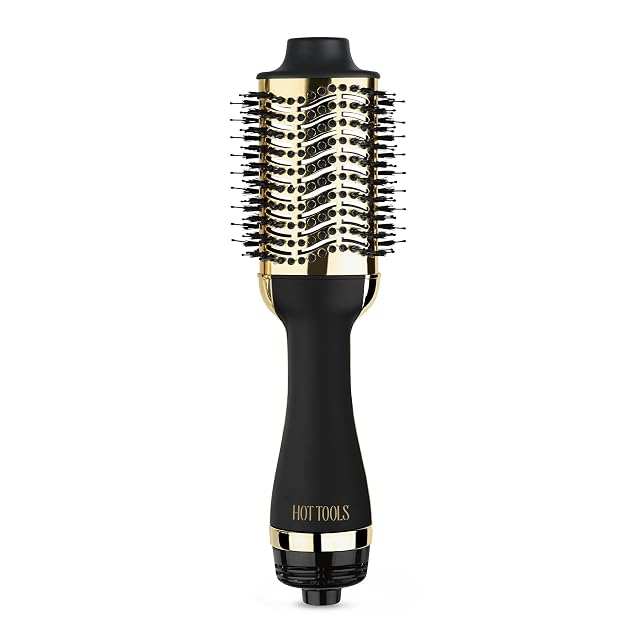
- “PAINLESS DETANGLING WITH 136 FLEXIBLE BRISTLES — Specially spaced, epoxy-tipped nylon bristles glide effortlessly through wet or dry hair to gently remove knots.”
- “FRIZZ-FIGHTING IONIC POWER — A powerful ion generator and ionic technology help reduce frizz and flyaways while boosting healthy-looking shine. Featuring 1000 watts of drying power, multiple heat settings, and a cool shot button.”
- “STYLE AFTER WASHING OR BETWEEN WASH DAYS — You can use this hot air brush on freshly washed, towel-dried wet hair straight from the shower… It is also perfect to use on dry hair to smooth, refresh, and revive second-day styles.”
- “LIGHTWEIGHT STYLING WITH FLEXIBLE REACH — Weighing just 1.8 pounds, this lightweight styling brush is easy to hold and won’t cause fatigue during extended use. The 6-foot cord provides flexible reach.”
It counts its bristles, and nothing else on this site does
“136 FLEXIBLE BRISTLES… Specially spaced, epoxy-tipped nylon bristles”
Why the count matters.
Bristle density is the trade-off at the heart of a brush.
Closely spaced bristles grip a lot of hair at once, which gives you tension — and tension is what actually smooths hair, because a strand pulled taut while warm air dries it lies flat. They also catch on knots, which is where the pulling comes from.
Widely spaced bristles pass through tangles without snagging, and they grip less — so less tension, and less smoothing.
So “136” plus “specially spaced” is a claim about where on that spectrum this brush sits, and it is the kind of figure that would let you compare one brush with another.
If anyone else published one. Nobody does.
How rare it is on this site.
Across GroomVerdict, counts of this kind are almost entirely absent. None of the nine items on the combs-and-brushes shelf publishes a tooth spacing. None of the five on clipper-blades publishes a tooth count. None of the five on guide-combs publishes a pitch.
The only other count anywhere is the CIICII scissors kit at $19.98 on the cutting-scissors shelf — “28 Teeth Thinning Scissors… (Thinning rate of 25-28%)”.
Two counts across fifteen shelves.
“Epoxy-tipped” is the second element, and it is the same idea the cheapest item here names differently.
HOT TOOLS, $26.69 — “flexible, ball tipped bristles”
A ball tip or an epoxy tip is a rounded bead on the bristle end so it cannot scratch the scalp — which matters more on a heated tool, because a bare bristle end on a hot brush is both a scratch and a hot spot.
And the rounded tip is this site’s most consistent published safety feature. On combs-and-brushes, four of seven animal tools claim a rounded tooth tip. On clipper-blades, two of five claim a “round head design” or “widened rounded teeth, no harm for the skin”. On cutting-scissors, two items claim rounded safety tips.
“Flexible” is the third element and it does real work: a rigid bristle either does not grip or does not let go, while a flexible one bends under load and springs back.
The one thing the count cannot tell you, because the page gives no barrel size, is the density. 136 bristles on a small barrel is a dense brush; 136 on a large one is sparse.
1.8 pounds, and the page calls it lightweight
“Weighing just 1.8 pounds, this lightweight styling brush is easy to hold and won’t cause fatigue during extended use.”
1.8 pounds is 816 grams.
Held at head height, arm raised, elbow out, for the length of a blowout.
That is not light. For scale, a full one-liter water bottle is about a kilogram — so this is roughly four-fifths of that, held above shoulder height while you work.
And a blowout brush is held up longer than a curling barrel, because you are drawing it down a full length repeatedly rather than wrapping and waiting.
So “won’t cause fatigue during extended use” is the claim the figure beside it argues against.
Why the figure deserves credit anyway.
It is the only weight on this shelf.
L’ANGE, $47.99 — “LIGHTWEIGHT & EASY TO USE: The electric hair dryer design reduces arm fatigue” — no figure
Tqcir, $139.99 — “Lightweight and compact in design”, and “a sleek, elegant and lightweight body” — no figure
HOT TOOLS, $26.69 — a “soft-grip handle” for comfort — no figure
Revlon, $30.19 and HOT TOOLS blow dryer brush, $48.75 — nothing on weight or comfort at all
this — 1.8 lb, published
So the only tool on this shelf you can judge on weight is the one that told you — and it is penalized for the disclosure. The others may well be heavier.
There is also a reason these tools are heavy that no page explains.
A dryer brush contains a motor, a fan and a heating element in the handle, because the barrel is full of bristles.
A separate dryer puts that mass in your hand with the airflow pointed away. A dryer brush puts the same mass in your hand and requires you to hold the far end against your head.
So the weight is not a design failure. It is what the format costs — and the honest version of this bullet would have said so.
The 6-foot cord in the same bullet is a real figure and the second longest here.
8 ft — the HOT TOOLS at $26.69, a swivel cord
6 ft — this
“Professional-length”, “360° tangle-free” — the L’ANGE at $47.99 and the Tqcir at $139.99, with no figure
Nothing — the Revlon at $30.19 and the HOT TOOLS blow dryer brush at $48.75
Wet hair and second-day hair, and only this page covers both
“You can use this hot air brush on freshly washed, towel-dried wet hair straight from the shower… It is also perfect to use on dry hair to smooth, refresh, and revive second-day styles.”
The wet claim first, and the shelf divides sharply.
The HOT TOOLS at $26.69 and the Revlon at $30.19 both print this, word for word identically: “NOTE: This unit will not dry your hair when fully wet, towel dry your hair before styling.”
So this shelf holds two different tools under one name.
A hot air brush styles hair that is already most of the way dry. A blow dryer brush is a dryer in a brush shape.
This page, the L’ANGE at $47.99, the HOT TOOLS blow dryer brush at $48.75 and the Tqcir at $139.99 are the second kind.
Note that this page’s own wording is more careful than it first appears: “freshly washed, towel-dried wet hair”.
Towel-dried, not dripping — which is very close to what the two warnings ask for. The honest gap between the two camps is narrower than the marketing suggests.
Why airflow is the real variable.
Drying hair means moving a lot of water, and that requires moving a lot of air.
A brush barrel is full of bristles, which obstruct airflow by design — so a brush-shaped dryer always trades air volume for the brushing action.
And here is the awkward comparison: at 1000 W this page publishes less power than the Revlon at $30.19, which publishes 1200 W and prints the warning anyway.
The dearer tool with the bigger claim has the smaller number.
Watts measure the heating element rather than the fan, so the figures do not settle it — and nobody on this shelf publishes an airflow volume, which is what would.
And no page on this site publishes one at all — the dryers give an air speed instead, 110 and 150 km/h, which is a different number and cannot be turned into a volume.
The Tqcir at $139.99 is the only page here with an air figure at all: “35m (115 ft)/s strong airflow” from a “110,000 RPM high-speed brushless motor”.
The second-day claim is the quieter and more useful one, because it is the case most heat styling actually happens in.
Most styling is not done on freshly washed hair. It is done on day two or three — a section that has gone flat, a fringe that has lifted, a curl that has dropped.
And the only other product on this site to address that case is on another shelf: the Moroccanoil heat protectant at $15.00 on GroomVerdict’s heat-protection shelf, whose “unique dry spray application makes it possible to spray on second-day hair for hot-tool touch-ups.”
Which is the matching product for exactly this use.
“1000 watts of drying power, multiple heat settings, and a cool shot button”
Hair takes its shape as it cools, not while it is hot.
A strand heated and released while still warm relaxes. The same strand held until cool keeps the shape.
So a cool air function is what actually fixes a blowout, and it is the difference between a style that lasts the morning and one that drops.
Two pages on this shelf have one.
this — a dedicated cool shot button
Revlon, $30.19 — “The smoothing concentrator in cool setting locks in style”
HOT TOOLS, $26.69 — a “cool tip”, which is a different thing: the far end of the barrel stays cool so you can hold it to steady the tool
And three pages have no cool function at all — the L’ANGE at $47.99, the HOT TOOLS blow dryer brush at $48.75 and the Tqcir at $139.99
A button is the better implementation than a setting, because it is momentary: you hold it for the last second of a pass rather than switching the tool over and back.
“Multiple heat settings” is the weaker half of the same bullet.
Tqcir, $139.99 — 3 airflow levels and 4 heat settings, independently, plus the only temperature figure on this shelf: a “high-precision temperature sensor” that “limits the max temperature at 250°F”
HOT TOOLS, $26.69 and HOT TOOLS blow dryer brush, $48.75 — 2 heat/speed settings, linked on one control
L’ANGE, $47.99 — “adjustable heat settings”
this — “multiple”
Revlon, $30.19 — no count, but 1200 W and a cool setting
And no page here except the Tqcir publishes a temperature.
Which is worth setting against GroomVerdict’s own heat-protection shelf, where eight of the nine protectant sprays claim protection “up to 450 °F”. The sprays are rated to a figure; at least five of the ten tools on this shelf will not say what they reach. The Tqcir’s 250 °F is 121 °C (250 °F) — barely half of it — and published as a deliberate ceiling rather than a maximum.
The ion generator, and what ions actually do
“A powerful ion generator and ionic technology help reduce frizz and flyaways while boosting healthy-looking shine”
Naming the hardware is slightly more than most: an “ion generator” is a component, where two rivals just say “Ionic Technology”.
What ions do, and the distinction this page blurs.
Static flyaway. Dry hair carries an electrostatic charge; like charges repel, so individual strands push away from each other. Emitting ions neutralizes the charge so they lie down. A real, well-understood effect — and “flyaways” is the correct word for it, which this bullet uses.
Humidity frizz. Water from the air goes into the hair and swells the shaft, lifting the cuticle. Ions do nothing about that.
So “frizz and flyaways” puts the right outcome next to the wrong one.
The page on this shelf that gets the mechanism exactly right is the HOT TOOLS blow dryer brush at $48.75: “Ionic Technology helps maintain a neutral charge on the hair’s surface… while helping reduce frizz and static.”
And the page that claims the other mechanism — the one that does address humidity — is the L’ANGE at $47.99: “advanced frizz-free technology to seal the hair cuticle.”
Between those two you have the two halves of the real answer: ions for static, a sealed cuticle for humidity.
And the honest limit on all of them is that the cuticle is sealed by heat applied with tension. A strand pulled taut while warm air dries it lies flat — which means the brushing does most of the work on every tool here, and this is the page with 136 bristles to do it with.
What is not published
No barrel size. This is the specification that decides what shape you get, and this page gives nothing. The shelf: 1 in on the HOT TOOLS at $26.69; 1 in and 1½ in on the Revlon at $30.19, the only item with two and the only page to label them (“the 1” attachment for soft curls” and “the 1-1/2” attachment for bouncy blowouts”); 1.25 in on the Tqcir at $139.99; 75 mm oval — 2.95 inches — on the L’ANGE at $47.99; oval with no size on the HOT TOOLS blow dryer brush at $48.75; and nothing here. The curl you get is the shape the hair is held in while it cools: a one-inch barrel relaxes into a defined curl, a three-inch one barely bends the hair and relaxes into body and movement. Without the figure, you cannot tell which this makes — and the page’s own language (“volumize”, “root lift”, “blowout”) points to the larger end.
No barrel coating. Three pages name one, and all three make the same claim from materials with opposite properties: ceramic on the Revlon at $30.19 (“even heat distribution”), titanium on the L’ANGE at $47.99 (“even heat distribution”), and 24K Gold on the HOT TOOLS blow dryer brush at $48.75 (“fast, even heat”). Ceramic is a poor conductor, which is the point — heat spreads rather than concentrating, so no hot spots — while titanium and gold are excellent conductors that heat fast and transfer fast. Opposite physics, one sentence, three times. Three items here, including this one, name no coating at all.
No temperature, as above.
No curl release. One page has a mechanism, and it is the cheapest item here: the HOT TOOLS at $26.69 — “a switch that unlocks and rotates the barrel to release the hair easily and avoid tangled hair”. That addresses the category’s real failure: bristles grip by design, so unwinding is done against the grip, and a wrap that has gone past itself tightens rather than releasing. On a brush you draw through the hair the problem is much smaller, and without a published barrel shape it is not clear which kind this is.
No cool tip. One page mentions one: the HOT TOOLS at $26.69. The far end of a heated barrel is where your other hand goes to steady the tool.
No airflow volume, as above — the figure that would settle the wet-hair question.
No country of manufacture.
Availability
Read on the day this page was built: $53 at the American Amazon shop.
Read from Keepa on the day this page was last revised; stock and price both move without notice.
Prices quoted in this text were read on 2026-10-05. The live price is at the top of the page.